How does the laying hen breeding system improve the egg production rate?
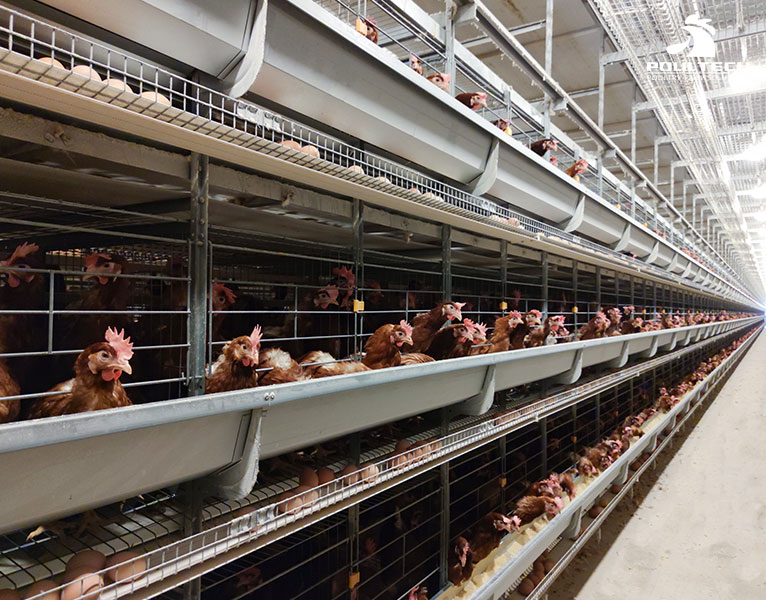
As one of our company’s flagship products, the TechPro series laying hen cage has a long service life, reliable performance, automatic management, and easy operation. It is designed to provide a villa-style living environment for modern laying hen farms. The TechPro series laying hen cage can utilize limited land space resources to breed more laying hens, which is easy to manage, saves labor costs, improves production efficiency, and increases net income.
Factors affecting egg production rate.
Genetic factors, nutritional factors, disease factors, and management factors.
Management: The suitable temperature for laying hens is 15-22℃. If it exceeds 27℃ or is lower than 13℃, the egg production will be affected. If laying hens are kept at a temperature above 22°C for a long time, the egg weight may decrease and the eggshell may become thinner; when the temperature is above 29°C and below 5°C, the egg production rate will be significantly affected; when the house temperature is below –2°C, it is difficult for the chickens to maintain a normal body temperature and a high egg production peak, the nutrients required for maintenance increase, and the nutrients required for production decrease, resulting in a decrease in egg production rate and feed utilization. The model relationship between laying hen production and temperature is: egg production rate = 1.02065–0.006893×highest temperature + 0.00257487×lowest temperature; average egg weight = 62.5644–0.102046×highest temperature + 0.112483×lowest temperature. The suitable range of relative humidity is 55% to 60%. High humidity has the greatest impact on laying hens.
The chicken house should be built in a dry and sunny place, using heat-insulating and moisture-proof materials, and ventilation should be strengthened at ordinary times, and feces should be cleaned in time. After the 17-18-year-old young hens are transferred to the laying hen house, artificial lighting should be gradually increased under natural light, reaching 16-17 hours at the peak of egg production at 26-28 weeks, and this lighting time should be maintained until the end of egg production at 72 weeks of age. The appropriate light intensity is 6-10 lux. The harmful gases in the chicken house are mainly ammonia, hydrogen sulfide, methane, carbon dioxide, etc. The carbon dioxide concentration in the range of 531.44-765.53 mg/kg has no significant effect on egg production rate and egg weight. The way to prevent excessive concentration of harmful gases is to strengthen ventilation and clean up chicken manure in time.
Egg production rate
The average culling age of laying hens is 80 weeks, the peak egg production can generally be maintained for 20 weeks, the egg production rate is above 80% (advanced breeding equipment can reach 90%-96%), after 40-60 weeks of age, the egg production rate is maintained at 70%-80%, and after the egg production rate is lower than 70%, the farmers begin to gradually eliminate old chickens.