What Is the Ideal Stocking Density for Chicks?
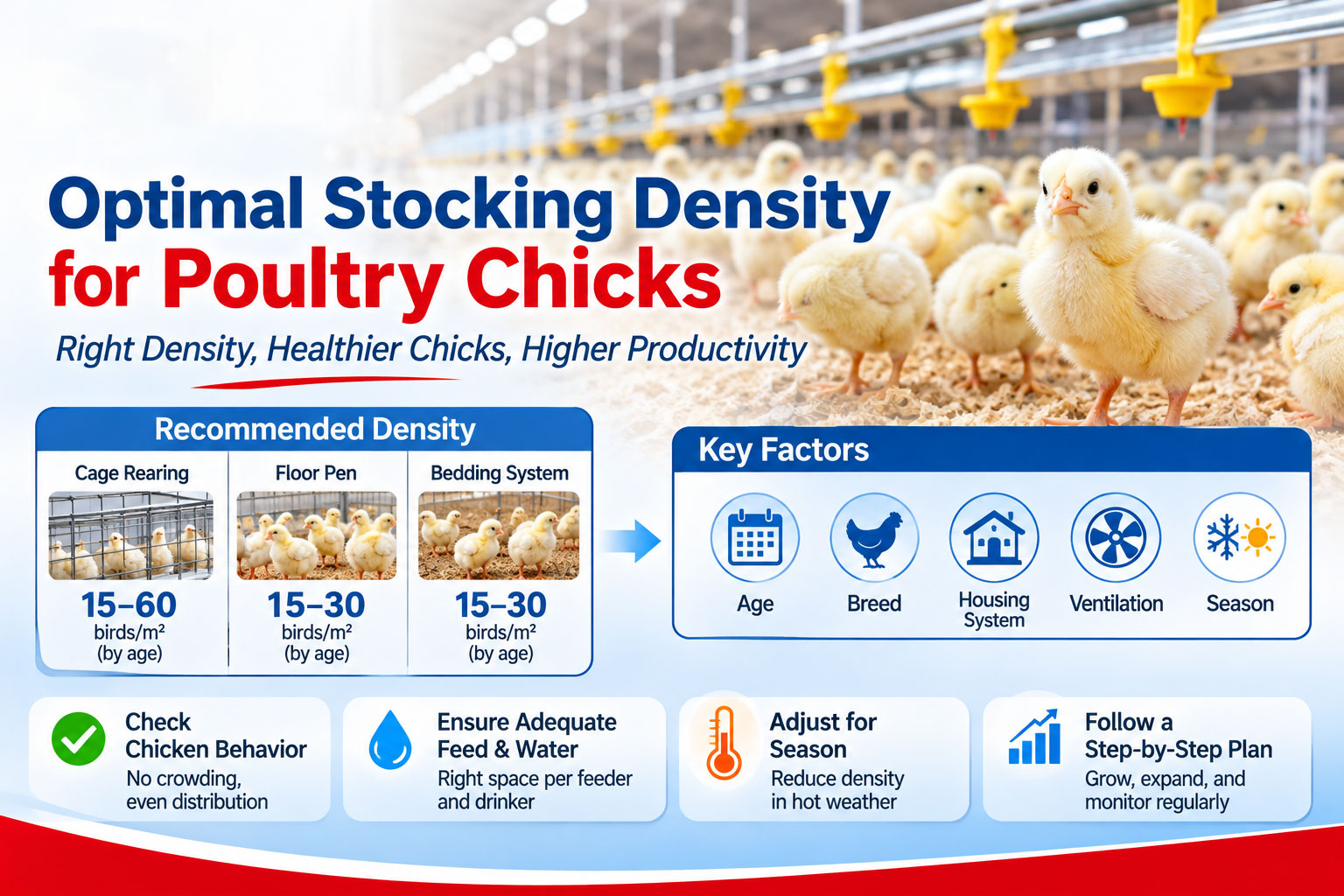
Choosing the correct stocking density is essential for successful chick brooding. If too many chicks are kept in a limited space, competition for feed and water increases, ventilation becomes less effective, and the risk of disease and uneven growth may rise.
However, the ideal poultry stocking density is not determined by age alone. Breed, housing system, ventilation, season, and feeding facilities must also be considered.
In this guide, we explain recommended chick stocking density by age and housing type, how to adjust density according to environmental conditions, and how to identify overcrowding through chick behavior.
1. Recommended Chick Stocking Density by Housing System
Stocking density varies according to the housing system. Cage rearing generally allows higher stocking densities than floor rearing because space utilization and equipment arrangements are different.
The following figures are practical reference ranges. Actual stocking density should follow breed management guidelines, local animal welfare requirements, usable floor or cage area, and ventilation capacity.
1.1 Cage Rearing Stocking Density
| Chick age | Reference density |
|---|---|
| 1–10 days | 40–45 birds/m² |
| 1–2 weeks | 50–60 birds/m²* |
| 3–4 weeks | 35–40 birds/m² |
| 5–6 weeks | 25–30 birds/m² |
| 7 weeks and older | 15–20 birds/m² |
The first two age ranges overlap and should not be applied simultaneously. Confirm the appropriate early-brooding density with the cage manufacturer’s specifications and the chick breed guide.
1.2 Slatted Floor Rearing Stocking Density
| Chick age | Reference density |
|---|---|
| 1–2 weeks | 30–40 birds/m² |
| 3–4 weeks | 25–30 birds/m² |
| 5–6 weeks | 20–25 birds/m² |
1.3 Deep Litter Floor Rearing Stocking Density
| Chick age | Reference density |
|---|---|
| 1–2 weeks | 25–30 birds/m² |
| 3–4 weeks | 20–25 birds/m² |
| 5–6 weeks | 15–20 birds/m² |
Deep litter systems generally require more floor space than cage systems because chicks need sufficient room to move, rest, and access feeders and drinkers.
2. How Breed and Production Type Affect Stocking Density
Different poultry breeds have different growth rates, body sizes, and activity levels. Stocking density should therefore be adjusted according to the type of bird.
● White broilers: Fast-growing birds may require more floor space as body weight increases. Follow the applicable breed guide and target market requirements.
● Layer chicks: Breeds such as Hy-Line and Lohmann should be managed with particular attention to body weight uniformity and access to feed and water.
● Native and yellow-feathered chickens: These birds are often more active, so additional space may be beneficial.
● Male chicks: Consider separate grouping and additional space where aggression and competition become problems.
Do not use one stocking density for every breed or production system.
3. Adjust Stocking Density According to Season and Ventilation
Temperature and ventilation directly affect the number of chicks that can be comfortably raised in a given space.
Summer
High temperatures increase heat stress risks.
● Consider reducing stocking density by approximately 10–15% as an initial management adjustment.
● Ensure adequate fresh air circulation.
● Prevent heat accumulation and excessive humidity.
● Provide sufficient drinking water.
Winter
During cold weather, slightly higher stocking density may sometimes help retain warmth.
However, increasing density by 5–8% should only be considered when ventilation, air quality, and bird comfort remain satisfactory.
Ventilation Considerations
● Poor ventilation: Reduce stocking density and improve air exchange.
● Mechanical ventilation: Higher densities may be possible when the system is properly designed and maintained.
● High humidity: Improve ventilation, inspect drinkers, and manage wet litter promptly.
Monitor ammonia, carbon dioxide, humidity, and temperature with appropriate instruments. Human smell alone is not a reliable way to determine whether poultry house air quality is safe.
4. Provide Enough Feeder and Drinker Space
Correct stocking density is not enough. Every chick must have convenient access to feed and clean drinking water.
Practical starting points from common brooding management guidance include:
● Water access: Avoid long distances to drinking points. A walking distance of approximately 1.5–2 meters can be used as an initial layout reference.
● Early brooding drinkers: Consider approximately 2–3 drinking points per 100 chicks, depending on drinker type and capacity.
● Feeder access: A linear feeding space of approximately 1–1.5 cm per chick may be used as an initial reference for suitable feeder designs.
● Drinker height: Adjust the height as chicks grow, ensuring easy access without allowing them to enter or contaminate the drinking equipment.
Always check the equipment manufacturer’s recommendations, because feeder and drinker capacity varies by design.
5. How to Identify Overcrowding Through Chick Behavior
Stocking density calculations provide a starting point, but chick behavior is one of the most useful indicators of whether the available space is appropriate.
Signs of Appropriate Stocking Density
● Chicks are evenly distributed throughout the brooding area.
● Birds can access feeders and drinkers without excessive competition.
● Chicks rest comfortably without piling on top of each other.
● The litter remains reasonably dry.
● Birds show normal activity and feeding behavior.
Warning Signs of Excessive Stocking Density
● Chicks crowd around feeders and drinkers.
● Birds pile up during resting periods.
● Wet litter accumulates around drinkers.
● Uneven growth becomes more noticeable.
● Feather pecking or vent pecking occurs.
● Ammonia levels and humidity increase.
When these signs appear, inspect stocking density, ventilation, temperature, feeder access, and drinker distribution. Divide the flock or expand the available area when necessary.
6. When Should Chicks Be Grouped or Given More Space?
Flock management should be adjusted as chicks grow.
A practical management schedule includes:
| Age or stage | Management recommendation |
|---|---|
| Arrival day | Separate weak and undersized chicks into a suitable brooding area |
| 4–5 days | Review distribution and expand brooding space if necessary |
| 7–10 days | Check body weight and separate significantly undersized birds |
| 2 weeks | Review stocking density and feeder/drinker access |
| 3–4 weeks | Expand the available area and reassess ventilation |
| 5–6 weeks | Prepare for transfer to the growing facility and reduce density as required |
In multi-tier cage systems, chick placement should consider temperature distribution, ventilation, and access to feed and water. Do not assume that one cage tier is always warmer than another; measure actual conditions before assigning birds.
7. How to Calculate Chick Stocking Density
The stocking density formula is simple:
Number of chicks = Usable area (m²) × Target stocking density (birds/m²)
For example:
A brooding area has 10 m² of usable space, and the selected reference density is 50 chicks/m².
● Theoretical capacity: 10 × 50 = 500 chicks.
● More conservative placement: 10 × 45 = 450 chicks.
The second option leaves additional space for flock movement and management adjustments.
Remember to calculate usable area rather than total building area. Exclude space occupied by equipment or other areas that chicks cannot access.
8. What Happens When Stocking Density Is Too High?
Excessive stocking density can create several management problems:
- Poor air quality: Ammonia, carbon dioxide, and moisture can accumulate when ventilation is insufficient.
- Wet litter: Increased moisture can create conditions favorable to pathogen growth.
- Uneven growth: Competition for feed and water may cause smaller chicks to fall behind.
- Higher stress: Crowding can contribute to feather pecking, injuries, and piling.
- Greater disease-management challenges: Close contact and poor environmental conditions can increase disease transmission risks.
Reducing overcrowding and improving ventilation, hygiene, and equipment access can help maintain healthier flocks.
The ideal chick stocking density depends on more than the number of birds per square meter. Age, breed, housing system, ventilation, season, and equipment capacity must all be considered.
Start with an appropriate density reference, calculate the usable space, and regularly monitor chick behavior and growth.
A well-managed brooding environment provides sufficient room for movement, easy access to feed and water, and effective ventilation. These factors help improve flock uniformity and support better poultry production performance.
Looking for efficient poultry housing and brooding equipment? Contact Poultech to explore modern poultry farming solutions.
Q1: How many chicks can be raised per square meter?
The number depends on age and housing type. For example, the practical reference range for deep litter rearing is approximately 25–30 chicks/m² during the first two weeks, while cage rearing may accommodate higher numbers under suitable conditions.
Q2: Does stocking density affect chick growth?
Yes. Excessive stocking density can increase competition for feed and water, restrict movement, and contribute to uneven body weight and poor flock uniformity.
Q3: Should stocking density be reduced in summer?
Often, yes. High temperatures increase heat stress risks. Reducing density by approximately 10–15% can be considered as an initial adjustment, alongside adequate ventilation and cooling.
Q4: How do you know if chicks are overcrowded?
Common signs include piling, competition around feeders and drinkers, wet litter, uneven growth, and feather pecking. Check environmental conditions and available space when these signs appear.
Q5: How do you calculate poultry stocking density?
Divide the number of birds by the usable rearing area. Alternatively, multiply usable area by the selected target density to estimate the number of chicks that can be accommodated.