Effect of Feed Particle Size Standards on the Growth of Chicks
This overview outlines the feed particle size standards for laying hens at various growth stages—including starter feed (1–3 mm crumbles with <10% fines) and brooding feed (1–2 mm particles constituting 45%–60% of the mix, with <15% fines)—and analyzes the impact of particle size on feed intake, gizzard development, digestion and absorption, and flock uniformity.
Chicks possess an immature digestive system and limited gizzard grinding capacity; consequently, feed particle size directly influences feed intake, gizzard development, and digestive efficiency, making it a critical physical parameter during the brooding phase. Even with a nutritionally balanced formula, unsuitable particle size can hinder the chicks’ initial feed intake and subsequent growth, as well as compromise flock uniformity. The following section details the particle size requirements for each stage of laying hen development—based on standard sieving criteria—and discusses their effects on chick growth.
Why Does Feed Particle Size Have Such a Significant Impact on the Growth of Layer Chicks?
Feed particle size affects not only the chicks’ ability to ingest the feed but also the development of the gizzard and intestinal tract.
Impact on feed intake: If particles are too large, chicks—with their short, small beaks—struggle to peck and swallow them. Conversely, an excess of fine powder makes the feed light and dusty, making it difficult for chicks to consume.
Impact on gizzard development: Appropriately sized particles stimulate the gizzard’s grinding action, promoting functional development. Long-term feeding with ultra-fine powder deprives the gizzard of this necessary exercise.
Impact on digestion and absorption: Proper particle size facilitates the gradual digestion of feed within the gizzard and intestines, thereby improving nutrient utilization efficiency.
Impact on flock uniformity: Weaker chicks that fail to consume enough feed will gradually fall behind; this widens the gap in body weight and increases potential risks for the subsequent rearing stages.
Therefore, strict attention must be paid to feed particle size standards during the layer chick brooding phase.
Particle Size Requirements for Starter Feed (Chicks Aged 1–7 Days)
1. Starter Feed Standards
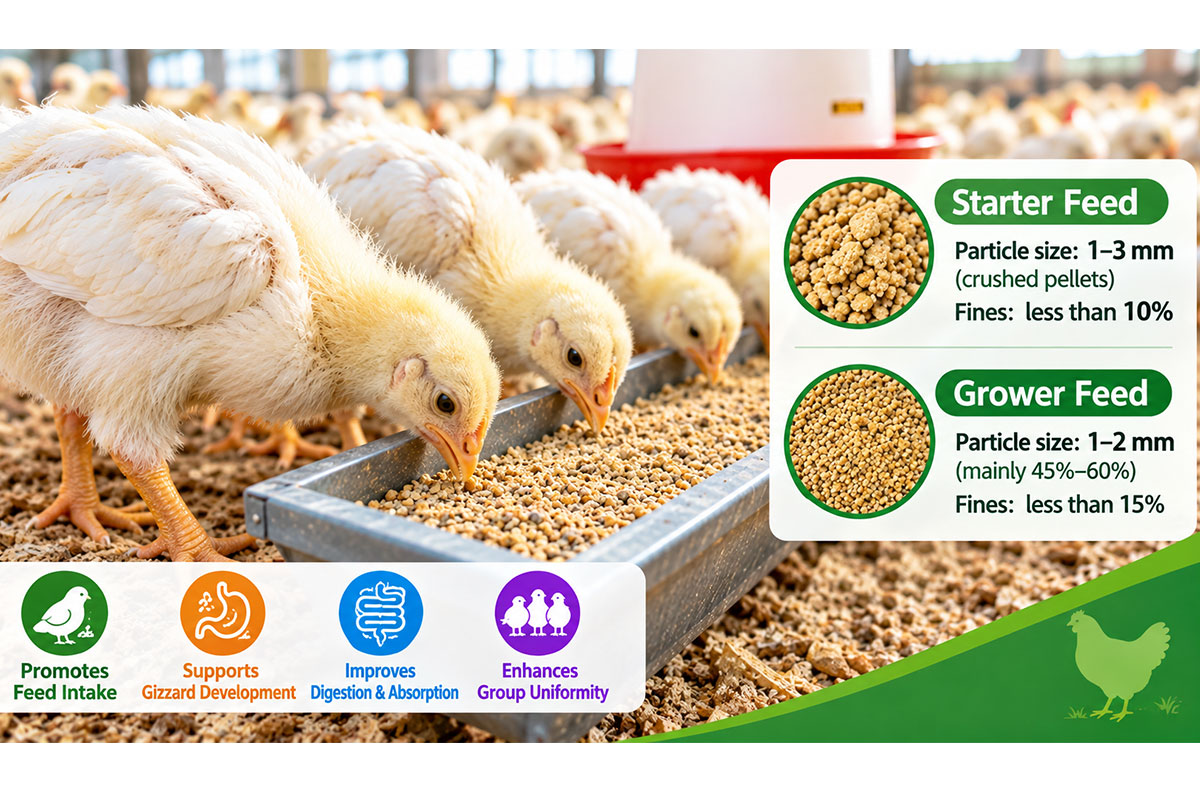
The diameter of crumbled starter feed particles should be controlled between 1 mm and 3 mm, with the proportion of fine powder (particles smaller than 1 mm) kept below 10%.
2. Risks of Excessive Fine Powder (Exceeding the <1 mm Limit)
Excessive fine powder in the starter feed leads to the following issues:
The feed is light and prone to generating dust.
Chicks struggle to consume the feed; fine particles can cause choking or stick to their beaks.
Feed intake fails to increase, delaying the onset of proper feeding.
Long-term feeding with overly fine material deprives the gizzard of the grinding stimulation needed for development, potentially leading to functional atrophy.
Reduced intestinal resilience, making the birds prone to diarrhea later on.
Declines in flock growth performance and uniformity.
3. Risks of Particles Exceeding 3 mm
Particles larger than 3 mm are also detrimental to chick growth:
Newly hatched chicks have small beaks, making it difficult for them to peck at and swallow large particles.
Chicks may become selective eaters, leading to feed wastage.
Weaker chicks may not consume enough feed, widening the gap in body weight across the flock.
Increased risk of crop impaction and indigestion.
4. Key Points for Controlling Starter Feed Particle Size
Using crumbled particles sized 1–3 mm—while strictly controlling the proportion of fine powder—facilitates pecking, ensures a rapid increase in early feed intake, and provides moderate exercise for the gizzard, thereby laying a solid foundation for subsequent digestion.
III. Particle Size Standards for Chick Starter Feed (7–42 Days of Age)
As the digestive tracts of chicks develop during the brooding period, the primary particle size of the feed can be appropriately increased, consisting mainly of 1–2 mm granules.
| Particle Size Range | Proportion Requirements | Notes |
| <1 mm fine powder | Less than 15% | The proportion of fine particles should not be excessive to avoid perpetuating the issue of underdeveloped gizzards from the earlier stage. |
| 1–2 mm granules | 45%–60% | Primary particle size range |
| 2–3 mm granules | 10%–25% | Appropriately increase the proportion of medium and large particles to strengthen gizzard function. |
| >3 mm coarse granules | Should be avoided | Coarse particles larger than 3 mm should be avoided at this stage. |
During the brooding period, appropriately increasing the proportion of medium-to-large particles can continuously strengthen the functional development of the muscular stomach and improve nutrient digestion and utilization. However, the level of fine powder must not be excessive; otherwise, it could impair muscular stomach exercise and intestinal health.
IV. Reference Comparison of Particle Sizes for Rearing and Laying Feeds
As the birds age, their feed intake and grinding capabilities improve, allowing for a gradual increase in the proportion of larger-sized particles in the feed.
| Stage | Particle Size Reference |
| Rearing feed | Predominantly 1–3 mm particles |
| Layer feed | The proportion of 2–3 mm particles is further increased, while a small amount of particles >3 mm is retained. |
Retaining a small proportion of large particles in the laying hen feed helps maintain the normal grinding function of the gizzard. The general principle is to gradually increase particle size in line with the birds’ age, avoiding sudden shifts to excessively fine or coarse textures.
Controlling feed particle size is a crucial detail in the management of laying hen chicks. Starter feed should consist of crushed particles measuring 1–3 mm, with a fine powder content of less than 10%.
For the brooding stage, the feed should primarily consist of 1–2 mm particles, with fine powder kept below 15%. As the birds age, the proportion of larger particles should be gradually increased in the grower and layer feeds. Proper control of feed particle size promotes the development of the chicks’ gizzards and enhances digestive efficiency, thereby laying a solid foundation for future laying performance.