Poultry Manure Drying System: Equipment Appearance and Key Features
Working Principle and System Overview
Working Principle
Putai Technology’s manure drying system employs a simple yet efficient principle: utilizing the waste heat generated by chicken house ventilation to naturally dry fresh manure. In standardized chicken houses where the indoor temperature is maintained at around 20°C year-round, this system uses this existing heat energy to drive the drying process. The moisture content of fresh chicken manure can be reduced from 70–80% to below 20–30% within 24 to 48 hours, without the need for additional fuel for heating.
System Overview
The system uses a multi-layer belt conveyor design, with manure evenly distributed above perforated steel plates. Warm exhaust gas from the chicken house is guided through these material layers, accelerating moisture evaporation. The dried product is suitable for long-term storage, further processing into organic fertilizer, or use as biomass fuel.
Equipment Appearance and Structure
Appearance Design
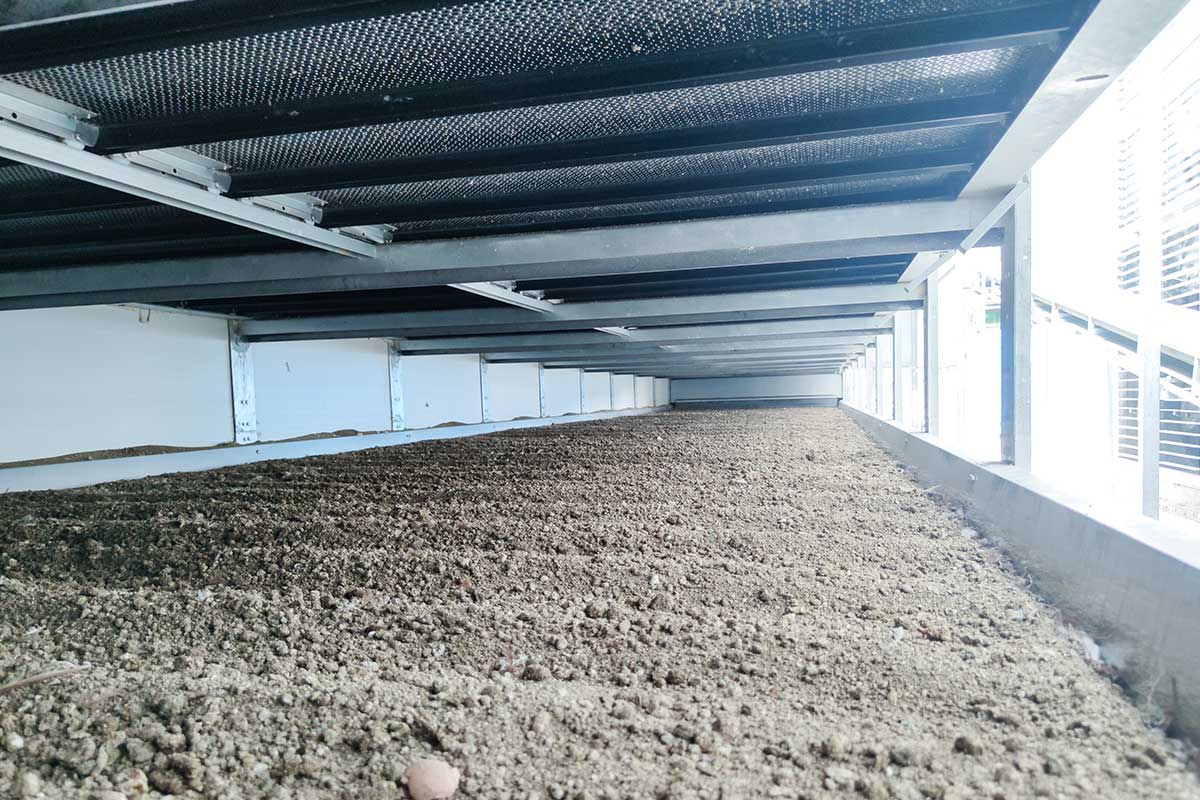
The Putai Technology fecal drying system features a clean, industrial design, characterized by its modular, multi-layer configuration. The equipment consists of a series of stacked drying layers (available in 2, 4, 6, or 8-layer configurations), all encased in a robust steel frame. The overall appearance exhibits a uniform silver-white metallic sheen, achieved through hot-dip galvanizing or cold-dip galvanizing followed by powder coating. From a distance, the system resembles a large vertical belt conveyor—compact in size yet tall, maximizing drying capacity within limited space.
Internal Structure
Inside the drying unit, perforated high-strength carbon steel plates form the drying surface for holding the feces. These perforations serve a dual purpose: supporting heavy fecal loads while allowing warm airflow to pass underneath, creating uniform airflow across the entire fecal layer. The multi-layer design enables continuous operation: fresh feces enter from the top layer and move downwards layer by layer as the drying process progresses.
Key Features and Performance Advantages
High Drying Capacity
Each manure drying unit is designed to process the manure of over 250,000 poultry, suitable for large-scale commercial poultry farms. The system can stably reduce the moisture content of fresh manure from 70–80% to below 20–30% within 24 to 48 hours. This significant reduction in moisture content directly translates to reduced storage volume, lower transportation costs, and improved waste management efficiency.
Modular and Customizable Design
One of the most prominent features of this system is its modular design. Depending on the customer’s wet manure volume and operational needs, the equipment can be configured in 2-layer, 4-layer, 6-layer, or 8-layer configurations. This flexibility ensures that farms of any size—from medium-sized farms to large commercial facilities—can find a configuration that meets their needs without paying for unnecessary processing capacity.
Layered Drying and Automatic Turning
The system employs a layered drying process combined with an automatic turning system. As the manure moves between the drying layers, the automatic device periodically turns the material. This process exposes the damp interior to a drying airflow, accelerating moisture evaporation and preventing surface crusting that could hinder the drying process. The result is thorough and uniform drying of the entire manure pile.
Putai Technology’s manure drying system meticulously integrates robust manufacturing processes, corrosion-resistant materials, and intelligent operating characteristics. Its modular design allows farms to flexibly expand drying capacity to meet their specific needs. Furthermore, the system utilizes waste heat from poultry house ventilation as the primary energy source for drying, eliminating fuel costs and reducing the carbon footprint. For poultry farms seeking durable, efficient, and environmentally friendly manure management solutions, the system’s comprehensive performance in terms of design, construction quality, and capabilities makes it a highly attractive option.