Uses of Air-Drying Equipment for Laying Hen Manure
I. Why Does Egg-Laying Hen Manure Need Drying?
The large-scale development of egg-laying hen farming has brought about a significant problem—the disposal of large quantities of chicken manure. For example, a hen house with 100,000 laying hens can produce 1,500 to 2,000 tons of manure annually. Fresh egg-laying hen manure contains approximately 75% moisture. Direct storage or transportation without drying presents several challenges:
High transportation costs: High moisture content means greater weight and volume, significantly increasing transportation costs;
Severe environmental pollution: Wet manure easily attracts flies and mosquitoes and produces unpleasant odors, especially in summer;
Nitrogen nutrient loss: Moisture plays a crucial role in the production and emission of ammonia in chicken manure, often leading to higher nitrogen loss;
Pathogen proliferation: High moisture levels provide conditions for the rapid reproduction of pathogens and bacteria.
Therefore, manure drying systems have become an indispensable infrastructure for modern egg-laying hen farms.
II. Working Principle of Hen Manure Drying Equipment
En hen manure drying equipment is a high-efficiency drying device specifically developed for the treatment of chicken manure in large-scale poultry farms. Its core working principle is as follows:
1. Heat Energy Recovery and Utilization
The equipment mainly utilizes the hot exhaust gas (or outdoor air) discharged from the exhaust fan at the end of the chicken house, and forces the wet chicken manure to dry through high-pressure ventilation. This method achieves the recovery and reuse of waste heat from the chicken house, significantly reducing operating energy consumption.
2. Uniform Spreading and Through-Flow Drying
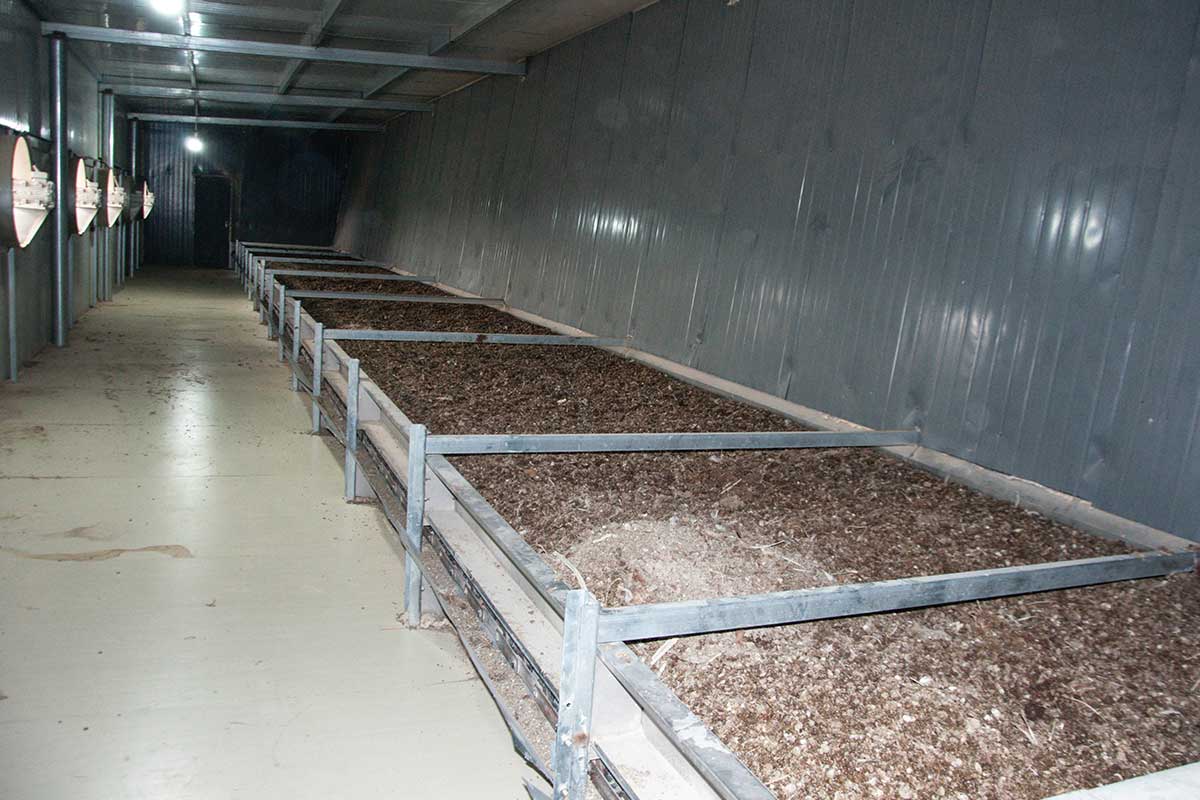
Fresh chicken manure enters the equipment through a conveyor system and is evenly spread on multiple layers of manure boards or conveyor belts, with the manure layer thickness generally controlled at 13 to 15 cm. The exhaust air at the end of the chicken house is pressurized by the high-pressure fan, and the airflow evenly penetrates the chicken manure layer, continuously carrying away the moisture in the manure, thereby achieving a rapid drying effect.
3. Intelligent Control System
Modern drying equipment is equipped with a fully automatic control system, enabling one-button start-up. The weight control unit at the top of the device can evenly control the weight of chicken manure entering the system within a reasonable range based on the humidity of the manure and environmental conditions. The system’s granulation mechanism breaks down chicken manure clumps into a loose state, further improving drying efficiency.
4. Adaptability to Different Seasons
In winter, waste heat from chicken coop ventilation is used for drying; in summer, a combination of waste heat from chicken coop ventilation and warm air from the outside environment is used. During rainy seasons or extreme weather conditions such as low temperatures and high humidity, some equipment can be equipped with a hot air furnace as an auxiliary heat source.
III. Drying Effect of Hen Manure Air-Drying Equipment
1. Significantly Reduced Moisture Content
This is the core processing effect of the air-drying equipment. Fresh hen manure typically has a moisture content of around 75%. After processing by the air-drying equipment:
Poultech’s intelligent hen manure air-drying equipment, after 24 to 48 hours of natural air drying, can reduce the moisture content of fresh hen manure to below 30%;
2. Significant Deodorization and Sterilization Effects
While reducing moisture content, the air-drying equipment also has significant deodorization and sterilization effects. The drying process uses a non-fermentation process, therefore producing no ammonia and no odor, while also avoiding nitrogen fertilizer loss, resulting in higher fertilizer efficiency. The air-dried hen manure is almost odorless, completely solving the problem of foul odors caused by traditional hen manure piles.
IV. Main Uses of Air-Dried Chicken Manure
Air-dried chicken manure is rich in various nutrients and is a highly valuable resource. The organic matter content of air-dried chicken manure can reach 50% to 65%, with a nitrogen content of approximately 3.2%, a phosphorus content of approximately 3.1%, and a potassium content of approximately 2.4%. It also contains calcium, magnesium, and various trace elements.
1. Organic Fertilizer – The Main Application Direction
(1) Direct Application as Organic Fertilizer
After high-temperature sterilization, air-dried chicken manure can be directly used as fertilizer for vegetables, fruits, flowers, nurseries, and other crops. Dry chicken manure is convenient to use; it can be directly spread by hand and is easy to transport.
(2) Processing into Commercial Organic Fertilizer
Air-dried chicken manure can be further processed into commercial organic fertilizer with uniform granules and stable nutrients. These organic fertilizers are rich in nutrients such as nitrogen, phosphorus, and potassium, which can improve soil fertility and reduce the environmental pollution caused by chemical fertilizers, making them a sought-after resource for surrounding orchards and farmland.
(3) Formation of a Circular Industrial Chain
Currently, many regions have formed an ecological circular industrial chain of “laying hen farming—organic fertilizer production—fruit and vegetable planting.” For example, laying hen bases have a scale of 1 million birds, and chicken manure is converted into organic fertilizer raw materials nearby for use in fertilizing crops such as rubber and traditional Chinese medicine.
2. Feed Raw Materials—Utilization of High-Protein Resources
Air-dried laying hen manure contains rich nutrients. Studies have shown that the crude protein content in air-dried laying hen manure can reach 22.34%, and the crude fat content is 2.44%, while also containing a relatively complete amino acid composition. The crude protein content is 2.23 times that of corn.
After processing, air-dried chicken manure can be used as a feed raw material for feeding cattle, sheep, pigs, fish, etc. However, it should be noted that due to the high ash content of laying hen manure, the proportion needs to be controlled when adding it to feed.
3. Other Application Directions
Air-dried chicken manure can also be used for fuel treatment (burning to generate heat for energy use), biogas fermentation, etc. With technological development, the resource utilization pathways of chicken manure are constantly expanding.
V. How to Choose the Right Hen Manure Drying Equipment?
When selecting drying equipment, poultry farms should focus on the following points:
Processing Capacity Matching: Choose equipment of appropriate specifications based on the scale of the farm and daily manure production;
Drying Effect: Focus on whether the output moisture content can reach below 30%;
Energy Consumption: Prioritize energy-efficient equipment that utilizes waste heat from the chicken house;
Automation Level: Fully automatic control systems can reduce labor costs and ensure stable operation;
Climate Adaptability: Understand the drying effect of the equipment in different seasons (especially the rainy season and winter).
Hen manure drying equipment, through the recovery of waste heat from the chicken house and forced ventilation drying process, can reduce the moisture content of fresh chicken manure from 75% to below 30% within 24 to 48 hours, while simultaneously achieving multiple effects such as deodorization, sterilization, and volume reduction. The dried hen manure is rich in organic matter and nutrients such as nitrogen, phosphorus, and potassium, and can be used as high-quality organic fertilizer for agricultural production or processed into feed raw materials, truly realizing the transformation of waste into treasure and a win-win situation for environmental protection and economic benefits. For large-scale egg-laying chicken farms, investing in air-drying equipment is not only a necessary step to fulfill environmental responsibilities, but also a wise choice to open up new avenues for income generation.