Ventilation for Multi-tier Poultry Houses
In modern multi-tier cage-rearing poultry houses, the focus is often placed on total fan capacity, power consumption, and the placement of exhaust fans. Meanwhile, air inlets are frequently treated as mere accessories—often installed in the minimum possible number. However, during the autumn and winter months, many ventilation issues actually stem from the air intake side: as soon as the fans turn on, the birds on the top tier are the first to suffer from the cold. if the airflow is increased, the existing air inlets prove insufficient. Consequently, while the poultry house may not appear to lack airflow, the temperature remains consistently uneven.
Ventilation is about more than just exhausting air. it must address three key questions: where does cold outside air enter, where does it travel once inside, and has it sufficiently mixed with the warm air already in the house before reaching the birds? The configuration of air inlets is precisely what addresses these concerns.
Why Can't the Minimum Number of Air Intake Windows Be Installed?
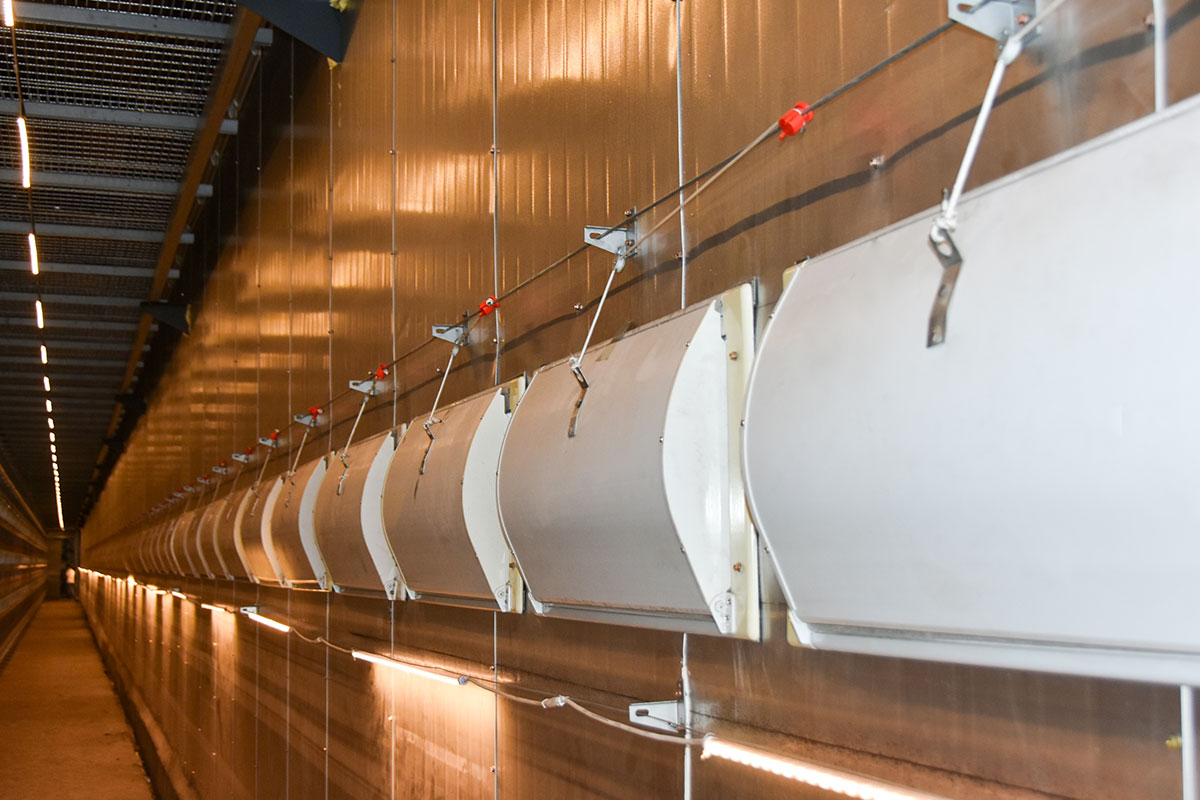
During the coldest part of winter, when airflow requirements are low, a smaller number of side-wall inlets might seem sufficient. However, these inlets cannot be sized solely based on the coldest weather conditions. In spring and autumn—or even during the day in winter when temperatures rise—the poultry house requires increased ventilation. Yet, the outside air may not be warm enough to allow for direct airflow over the birds. In such cases, the better approach is to draw fresh air in through side-wall inlets, allowing it to mix in the upper space of the house before reaching the level of the birds.
If there are too few side-wall inlets, increasing the number of operating exhaust fans will quickly push these inlets to their maximum opening. This leads to excessive air-inlet velocity, overly high negative pressure, or restricted total air intake. Consequently, to achieve the necessary ventilation, the operator is forced to open the tunnel-ventilation inlets prematurely. The birds may not yet require the cooling effect of high-velocity airflow, yet the equipment configuration has already effectively shifted the house into “tunnel mode.”
Under these conditions, birds near the air-inlet end may become chilled, while those further down the house may not receive adequate cooling. Cages can obstruct airflow, resulting in strong drafts in the aisles while the air inside the cages remains stagnant. Such temperature differentials and uneven air speeds complicate subsequent management. While tunnel ventilation is essential during hot weather, it should not be triggered prematurely simply because there are insufficient side-wall inlets to handle moderate ventilation needs.
How Should the Number of Small Windows Be Determined?
Determining the number of side-wall air inlets should not be based solely on “how many units other poultry houses have installed.” During the design phase, you must first establish the target ventilation capacity to be provided by these inlets before transitioning to tunnel ventilation mode. Then, evaluate the actual air intake capacity of each unit under the specific installation conditions.
1. Nominal maximum airflow capacity ≠ actual airflow after installation
The maximum airflow capacity stated in product specifications does not necessarily reflect the actual performance once installed in a poultry house. Factors such as wind hoods, bird-proof netting, wall thickness, and installation methods all affect air intake. When determining the number of units, incorporate a reasonable safety margin and base your calculations on the effective air intake capacity under actual operating conditions.
2. Total number of installed units ≠ number of units opened simultaneously
Some may worry that installing too many air inlets will lead to excessive cold air intake during the winter. However, the total number of installed units and the number of units opened at any given time are two different things. In winter, when lower ventilation rates are required, inlets can be opened in pre-configured groups. This allows the active inlets to maintain an optimal opening width, rather than having all inlets opened just a tiny crack. Managing inlets in groups helps create a more stable and consistent airflow.
3. Ensure proper distribution along the poultry house
Once the required number of units has been determined, they must be distributed appropriately along the length of the poultry house. Avoid clustering them in one section while leaving other areas with insufficient air intake. Uneven distribution of incoming air will exacerbate localized temperature variations and differences in air velocity.
Performance of Small Ventilation Windows
When selecting air inlets, beyond price and dimensions, one should also consider: Where does the air flow when the inlet is only slightly open? Does the airflow direction change as the opening widens? And when it is much colder outside, will the incoming cold air sink immediately upon entering the facility?
Negative pressure affects the velocity of incoming air, but it is a misconception to assume that “higher negative pressure always results in a longer throw (reach) of the airflow.” If the inlets are closed down further to increase negative pressure, the incoming air stream may become too thin to reach the intended target area. Even with the same inlet and opening size, a system that performs well during the day may see the cold air sink prematurely during a cold night.
Therefore, the performance of air inlets should be evaluated by considering negative pressure, opening size, airflow direction, and the temperature differential between the inside and outside—rather than focusing solely on a single figure displayed on a controller. It is highly beneficial if manufacturers provide test data on airflow volume and throw distance across various negative pressure levels and opening sizes. Nevertheless, it is still recommended to verify the actual airflow patterns on-site using smoke tests or streamers.
Leave Space Above the Top Tier of Cages for Cold Air to "Warm Up"
As stacked cage systems grow taller, the placement of air inlets (small windows) must be reconsidered. It is not enough to simply measure an inlet’s height from the floor; one must also consider its position relative to the birds in the top tier. For inlets designed to direct air along the ceiling, the airflow path should remain above the top of the cages, with sufficient space provided to ensure that incoming cold air does not strike the birds in the top tier immediately upon entering the house.
The ideal airflow pattern is for cold air to travel along the ceiling, mixing with the warmer air already inside the house. As the air warms up and its velocity decreases, it then descends toward the birds. If the cage stacks reach nearly to the ceiling, this mixing space is eliminated; cold air may strike the cage frames or structural beams and descend prematurely. In such cases, adjusting negative pressure or inlet openings may not be enough to achieve the desired environment.
The optimal height of an inlet above the top tier of cages depends on factors such as the width of the house, the shape of the roof, the height of the cage stacks, and local winter temperatures—there is no “one-size-fits-all” dimension. A larger space at the top is not necessarily better; the key is ensuring that the airflow can circulate effectively and mix thoroughly. If necessary, circulation fans can be used to bring heat down from the ceiling, while also verifying that fresh air actually reaches the middle and lower tiers rather than simply circulating uselessly near the roof.
Fan Placement: Don’t Overlook the Air Inlet Side During Cold Weather
The debate over whether to install exhaust fans on the roof, side walls, or end walls is common. However, during cold-weather ventilation, the priority should be the air inlets: is the cold air entering as intended, and does it have the opportunity to mix with the warm air inside?
Michael Czarick, an extension professor in the Department of Poultry Science at the University of Georgia, has noted that if the air inside a house is already well-mixed, the specific location of the exhaust fans—whether on the roof, side walls, or end walls—has a relatively minor impact on overall efficiency. The crucial condition here is that the air must be “well-mixed.” If cold air drops immediately upon entry while the warm air near the ceiling is simultaneously exhausted, both ventilation and temperature control will suffer. Simply changing the location of the exhaust fans in such a scenario is unlikely to solve the underlying problem.
Of course, this does not mean that fan placement is unimportant. Even when tunnel ventilation is used during the summer—or in cases where airflow short-circuiting or obstruction by cage structures occurs—the layout of exhaust fans must be carefully considered. Furthermore, when troubleshooting issues during the cold season, one should not overlook the air intake side.
In modern multi-tier cage-rearing poultry houses, cold-season ventilation management often focuses too heavily on exhaust fans while underestimating the importance of air intake inlets. The number of inlets should be determined based on the ventilation requirements that must be met before transitioning to tunnel ventilation, while also accounting for the actual intake capacity of the installed units. These inlets should be distributed appropriately throughout the house and opened in groups; key factors to monitor include negative pressure, opening aperture, airflow direction, and temperature differentials, while ensuring sufficient space above the cages for air mixing. During facility inspections, pay close attention to the airflow at the level of the birds, using smoke tests or ribbons to verify the actual air movement patterns. By properly designing and managing the air intake system, maintaining the airtightness of the poultry house, and integrating a well-designed circulation fan system, cold-season ventilation can be made both more stable and more efficient.