How Should Chicks Be Cared for During Their First Seven Days?
The core objective of managing chicks during their first seven days is simple: ensure they are well-fed and hydrated as quickly as possible while providing a stable, comfortable environment. The process comprises two main stages—pre-arrival preparation (Days -3 to 0) and post-arrival management (Days 1 to 7). By focusing on six key factors—temperature, humidity, water access, initial feeding, lighting, and crop checks—producers can enable the chicks to double their birth weight by the end of the first week.
I. Three Days Before Chick Arrival (Days -3 to 0)
1. Thorough Disinfection (No Blind Spots)
Thoroughly clean and wash down the poultry house and all equipment.
Use sodium dichloroisocyanurate for fumigation disinfection.
Seal the poultry house for 24–48 hours, then ventilate thoroughly to prepare for use.
2. Pre-heating and Pre-humidifying (Ready in Advance)
Turn on heating equipment 24–72 hours in advance to pre-heat the facility.
Stabilize the house temperature at 33–36°C and relative humidity at 60%–70% by 24 hours before chick arrival.
Ensure that the surfaces of all equipment—such as flooring mesh, cages, and feed troughs—are warm; simply having the correct air temperature is insufficient.
3. Equipment Setup and Comprehensive Inspection
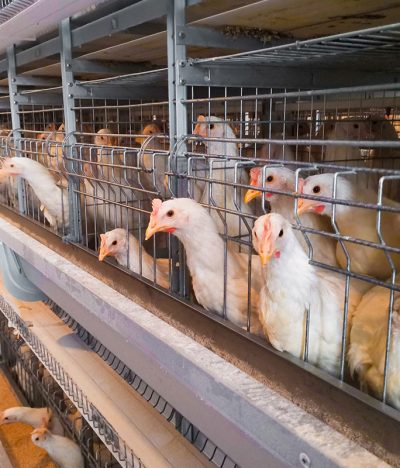
Lower the chick-retention boards between cages and feed troughs in advance to prevent chicks from escaping or falling out.
Stock up on sufficient high-quality crumbled starter feed for the first 5–7 days.
Inspect and flush the water lines beforehand.
4. Initial Drinking Water Preparation (Critical Detail)
Add 3%–5% electrolytes and multivitamins to the drinking water.
Important Note: Do not leave the mixture in the system for more than 6 hours (and absolutely no longer than 12 hours); otherwise, bacteria may proliferate in the water, potentially causing intestinal issues in the chicks.
II. Seven Days After Chick Placement
Point 1: Temperature and Humidity
| Age (days) | Temperature | Relative Humidity |
| 1–3 days | 35~37℃ | 60%~70% |
| 4–7 days | 34~36℃ | 60%~70% |
Core principle: Adjust the temperature based on the chicks’ behavior, not just the thermometer reading.
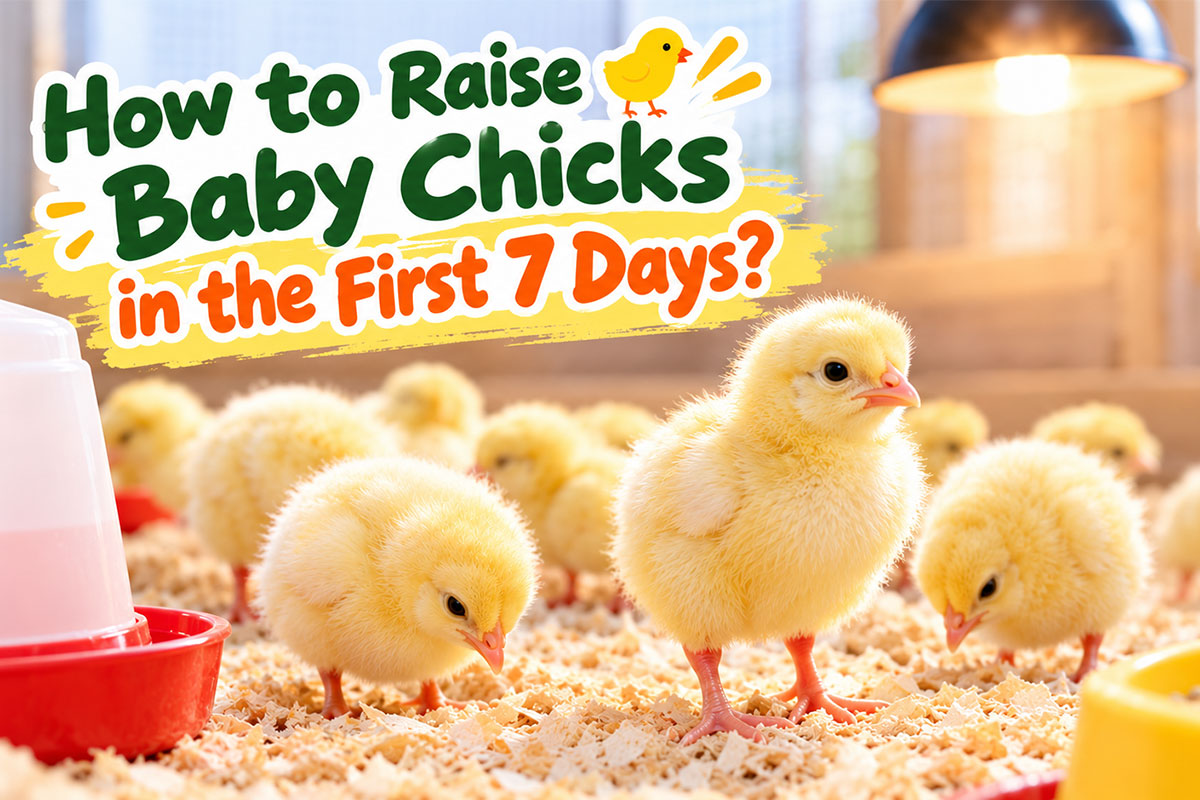
✅ Comfortable temperature: Chicks are evenly distributed, moving freely, and chirping cheerfully;
❌ Temperature too low: Chicks huddle near the heat source and emit sharp, distressed chirps;
❌ Temperature too high: Chicks pant with open mouths, droop their wings, move away from the heat source, and drink excessive amounts of water.
Thermometer readings serve only as a reference; the flock’s behavior is the ultimate indicator.
Point 2: Water and Initial Feeding
Strictly adhere to the principle of “water first, feed second.” However, if the chicks have undergone long-distance transport, water and feed may be provided simultaneously to minimize the risk of dehydration.
Point 3: Lighting Management
Day 1: Provide 24 hours of high-intensity lighting (30–50 lux) to help chicks quickly locate water and feed; this is crucial for ensuring a successful start to feeding.
From Day 2 onwards: Switch to a “four-phase management” cycle of 4 hours of light followed by 2 hours of darkness. This establishes a regular rhythm of feeding and resting for the chicks and helps prevent panic-induced stress (flock scattering) in the event of a sudden power outage.
Point 4: Density Control
It is recommended to stock 25 chicks per brooding cage.
Excessive density leads to uneven feed intake, insufficient water consumption, and poor air quality, directly impacting body weight and flock uniformity at one week of age.
Point 5: Weight Monitoring
On the day of arrival, assign chicks to their cages and weigh them to record their initial body weight.
Subsequently, weigh them at a fixed time each day to monitor daily weight gain and flock uniformity.
Target for Day 7: The body weight at one week of age should be double the initial body weight.
III. Why are these seven days so critical?
The first seven days of a chick’s life are known as the “window of opportunity.”
Management quality during this period directly impacts:
Chick survival rate—the first seven days are the peak period for mortality.
One-week body weight and uniformity—this serves as the “starting line” for growth and development in the subsequent weeks.
Immune organ development—nutrition and environmental stressors during these seven days directly affect the maturation of immune organs such as the bursa of Fabricius and the thymus.
Lifetime production performance—every additional gram of body weight gained during this week creates a positive effect that is continuously amplified regarding later egg production or weight gain.
Flocks that meet body weight targets at one week of age demonstrate stronger disease resistance, superior feed conversion rates, and greater uniformity at the time of market or the onset of laying.
IV. Quick Q&A on Common Issues
Q: What should be done if the crop fill rate is below 75% six hours after chick placement?
A: Immediately investigate three areas: ① Check if temperature and humidity meet standards (35–37°C required for days 1–3); ② Check if lighting is sufficient (30–50 lux required for day 1); ③ Check if feed is evenly distributed and easily accessible to the chicks. Also, verify water pressure and ensure the nipple drinkers are dispensing water freely.
Q: How can I determine if the temperature is appropriate?
A: Adjust the temperature based on chick behavior—even distribution and crisp chirping indicate the right temperature; huddling near the heat source suggests it is too cold; panting with open mouths and moving away from the heat source suggests it is too hot. Do not rely solely on the thermometer.
Q: What precautions should be taken when adding electrolytes and multivitamins to the initial drinking water?
A: A concentration of 3%–5% is sufficient. Do not leave the mixture in the lines for more than 6 hours (and certainly no more than 12 hours), as this promotes bacterial growth and can lead to intestinal issues. It is recommended to prepare the solution fresh as needed and provide it in small, frequent batches.
Q: Must body weight double by the seventh day?
A: Yes. Doubling body weight by one week of age is a recognized industry “gold standard.” It is recommended to weigh chicks daily to monitor weight gain and flock uniformity, making adjustments promptly if issues arise.
Management during the first seven days allows no room for “approximate” measures; success relies on precise execution down to the exact degree, hour, gram, and percentage.
A temperature deviation of just 1°C can cause chicks to huddle; a two-hour delay in the first feeding can cut the crop fill rate in half; and lighting that is 10 lux too dim might result in a group of chicks never finding the feed trough.