How to Design a Poultry Farm with 20,000 Laying Hens?
What is the "124" standardized egg-laying hen farming model?
Before designing, it’s essential to clarify the core design concept of a 20,000-hen farm. The “124” standardized egg-laying hen farming model consists of: one fully enclosed egg-laying hen house; stacked cage-raising of at least 20,000 hens; and an automated production process using four machines (automatic feeder, conveyor belt manure removal machine, evaporative cooling fan, and automatic egg collection machine).
This model features high automation, high production efficiency, low environmental pollution, and suitable investment, making it ideal for small and medium-sized egg-laying hen farmers upgrading their operations. It has become the currently recommended mainstream solution for 20,000-hen egg-laying farms.
Chicken House Architectural Design and Layout
A chicken house is a “collective apartment” for 20,000 laying hens. According to the “124” model standard, a standard 20,000-laying-hen house has strict and specific parameters in its architectural design.
1. Chicken House Size and Dimensions
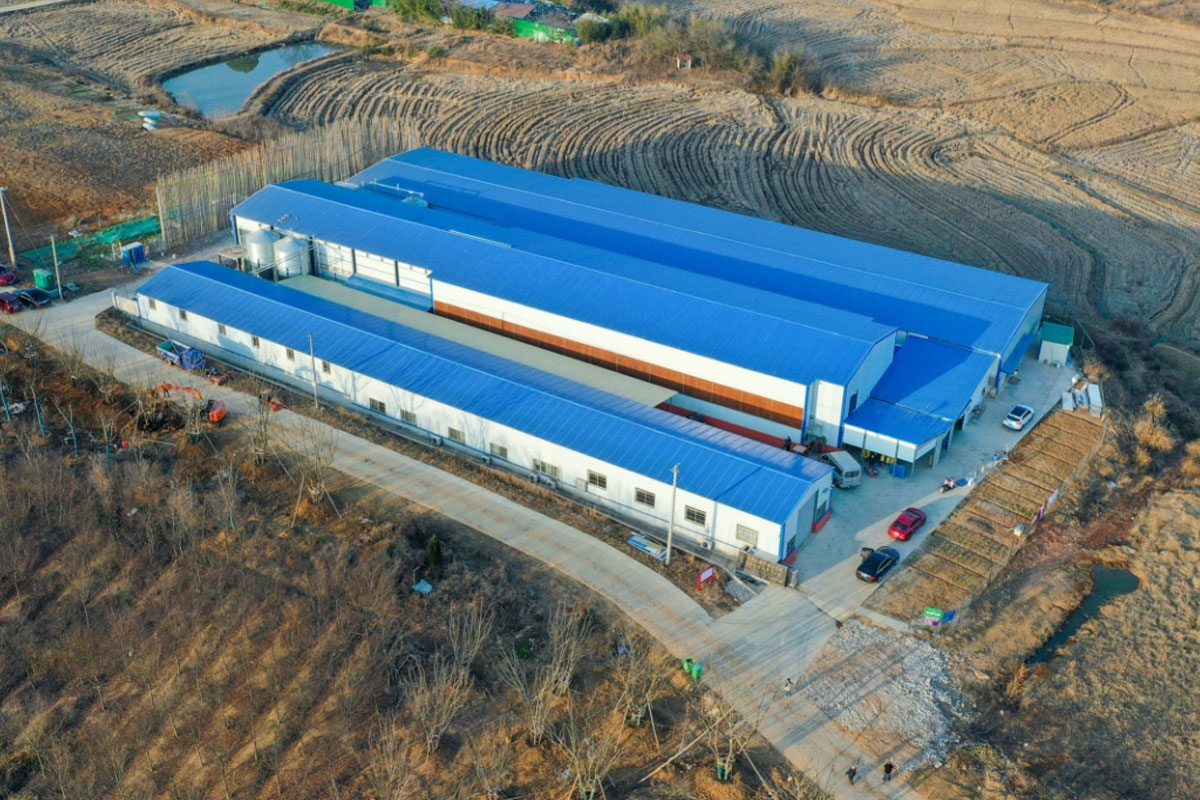
Recommended dimensions for a laying hen house (excluding egg storage rooms, etc.) are: 78 meters long, 7 meters wide, and 4.8 meters high. The chicken house should ideally be a fully enclosed steel structure. The roof and walls should use composite insulation materials with a minimum insulation layer thickness of 7.5 cm, and proper anti-corrosion treatment should be applied. In practice, larger span designs of 100 meters long, 16 meters wide, and 13 meters high are also used to house more laying hens; farmers can flexibly adjust these designs based on land conditions and budget.
2. Internal Cage Layout
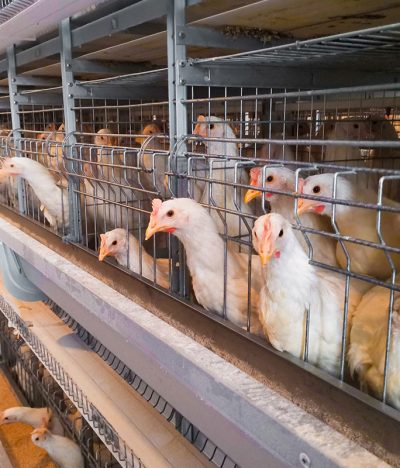
The core of the internal layout is efficient space utilization. A layout of 3 rows, 4 layers, and 4 aisles can house approximately 20,000 laying hens. H-type laying hen cages (i.e., stacked cages) are recommended, as this is commonly used in vertical layer hen farming. Specific design parameters for reference:
Each layer height should be no less than 68cm.
Each chicken occupies approximately 450cm² of cage floor area.
The aisle width should be approximately 1.2–1.5m.
The cage should be 4m from the clean aisle end wall and 3m from the dirty aisle end wall.
The evaporative cooling pad should be at least 2.5m from the chicken cage, with a height of 2.2–2.5m, and equipped with an adjustable-angle windbreak.
Automated Equipment Support
The design philosophy of a 20,000-layer hen farm hinges on a “four-machine system.” High-density rearing necessitates these fully automated, interconnected machines; otherwise, management pressure would exceed manual capacity. If tiered cage rearing is employed, the system should include an automatic feeder, a conveyor belt manure remover, a wet curtain fan, and an automatic egg collector—a “four-machine system.” Depending on the scale of the operation, additional equipment such as intelligent environmental control, shed deodorization, and manure utilization systems should be added.
1. Automatic Feeding System
A fully automated mechanized feeding system should be used, including a feed tower, screw conveyor, feeder, feeder, feed trough cleaner, and cage cleaning equipment. The central feed line and feed tower should be equipped with a weighing system to meet the needs of daily automatic feeding and precise delivery. A traveling feeder system is recommended, where the trolley moves along the feed trough, allowing simultaneous discharge from each layer’s outlet to ensure each hen receives sufficient feed.
2. Automatic Drinking System
An automatic drinking system using nipple drinking lines is adopted, including drinking pipes, drinking nipples, dosing devices, pressure regulators, pressure reducing valves, backflush water line system, and intelligent control system. The drinking pipes should be made of corrosion-resistant plastic, and each water line should be equipped with a pressure regulator to ensure sufficient water supply at both the front and rear ends. Water cups should also be installed below the nipple drinkers to prevent leakage.
3. Automatic Manure Removal System (No Manure on the Ground)
This is crucial for meeting environmental standards. A conveyor belt manure removal system is adopted. Each cage bottom should be equipped with a conveyor belt for layered cleaning. Manure is transported to the rear of the chicken house by a longitudinal conveyor belt, and after being scraped by scrapers, it falls onto a bottom transverse conveyor belt, and then directly transported outside the house via transverse and diagonal conveyor belts. Core requirements: no manure on the ground, daily collection and removal. The manure removal conveyor belt should preferably be made of new polypropylene material, with anti-static, anti-aging, and anti-deviation functions.
4. Automated Egg Collection System
An automated egg collection system is adopted, including egg collection belts, egg collection machines, a central egg conveyor line, egg storage, and an egg grading and packaging machine. During the egg collection process, eggs from each layer should be automatically conveyed to the chicken coop head rack, and then centrally conveyed to the egg storage for subsequent packaging via the central egg collection line. The egg grading and packaging machine typically processes 30,000 to 180,000 eggs per hour, and can be configured according to actual production needs.
Intelligent Environmental Control System
For high-density chicken farming of 20,000 hens, a stable internal environment in the chicken house is crucial for successful breeding.
1. Temperature Control
The optimal temperature for laying hens is 13℃~25℃, with a daily temperature difference not exceeding 10℃; the minimum temperature in winter should not be lower than 4℃, and the maximum temperature in summer should not exceed 30℃. The chicken house needs to be equipped with intelligent fans, evaporative cooling pads, etc., which monitor and automatically adjust in real time through temperature and humidity sensors.
2. Humidity Control
The suitable relative humidity is 60%~65%. Excessive humidity easily breeds bacteria and parasites, while insufficient humidity leads to increased dust and a higher risk of respiratory diseases in laying hens.
3. Ventilation Design
A cross-ventilation pattern can be adopted: evaporative cooling pads are installed at the clean ends of the horizontal and vertical passages, and negative pressure fans are installed at the dirty ends of the vertical passages. Average wind speed should be controlled between 0.1 m/s and 1.0 m/s. In winter, minimum ventilation is recommended, with a duration of 5-8 minutes being optimal, and the wind speed should not exceed 0.2 m/s. In summer, temperature-controlled ventilation is preferred, with a flow rate not lower than 0.5 m/s.
4. Air Quality
All air quality indicators inside the shed should be strictly controlled: carbon dioxide ≤ 1500 mg/m³, ammonia ≤ 10 mg/m³, hydrogen sulfide ≤ 5 mg/m³, odor ≤ 70 times dilution, inhalable particulate matter ≤ 4 mg/m³, and total suspended particulate matter ≤ 8 mg/m³.
5. Lighting Management
Energy-saving lamps with even distribution are recommended for lighting inside the shed. After entering the peak egg production period, the daily lighting time should be maintained at 16 hours, with a light intensity of approximately 1 W/m² to 1.2 W/m², to simulate the optimal natural light cycle and stabilize the ovulation and egg production rhythm of the hens. Installing a microcomputer-controlled automatic lighting system allows for precise control.
Manure Treatment and Resource Utilization
The amount of manure produced daily by 20,000 laying hens is considerable (approximately 1.2-1.5 tons/day), and improper treatment can cause serious environmental pollution.
1. Manure Removal Technology Selection
An automatic conveyor belt manure removal system is adopted to achieve immediate treatment without touching the ground. This is not only an environmental requirement but also crucial for eliminating wastewater pollution and odor within the farm.
2. Resource Utilization Pathways
Pathway 1: Processing into Organic Fertilizer. Chicken manure undergoes rapid air drying, biological fermentation, and high-temperature sterilization to transform into odorless, high-quality organic fertilizer, which can be sold to surrounding orchards and farmland, forming an ecological circular industrial chain of “laying hen farming – organic fertilizer production – fruit and vegetable planting.”
Pathway 2: Direct Return to Fields Through Integrated Farming and Cropping. The farm signs contracts with surrounding farmers for the direct use of chicken manure as fertilizer, reducing chemical fertilizer usage by more than 30% compared to previous years.