Solving the Odor Problem in High-Density Broiler Farming
In large-scale broiler farming, high density is often equated with high risk. Many farm owners have accepted an unspoken rule: high yields mean enduring the pungent smell of ammonia, damp bedding, and constant coughing and respiratory distress. Uneven growth and rising mortality rates due to inadequate environmental control seem to be the price to pay for high profits.
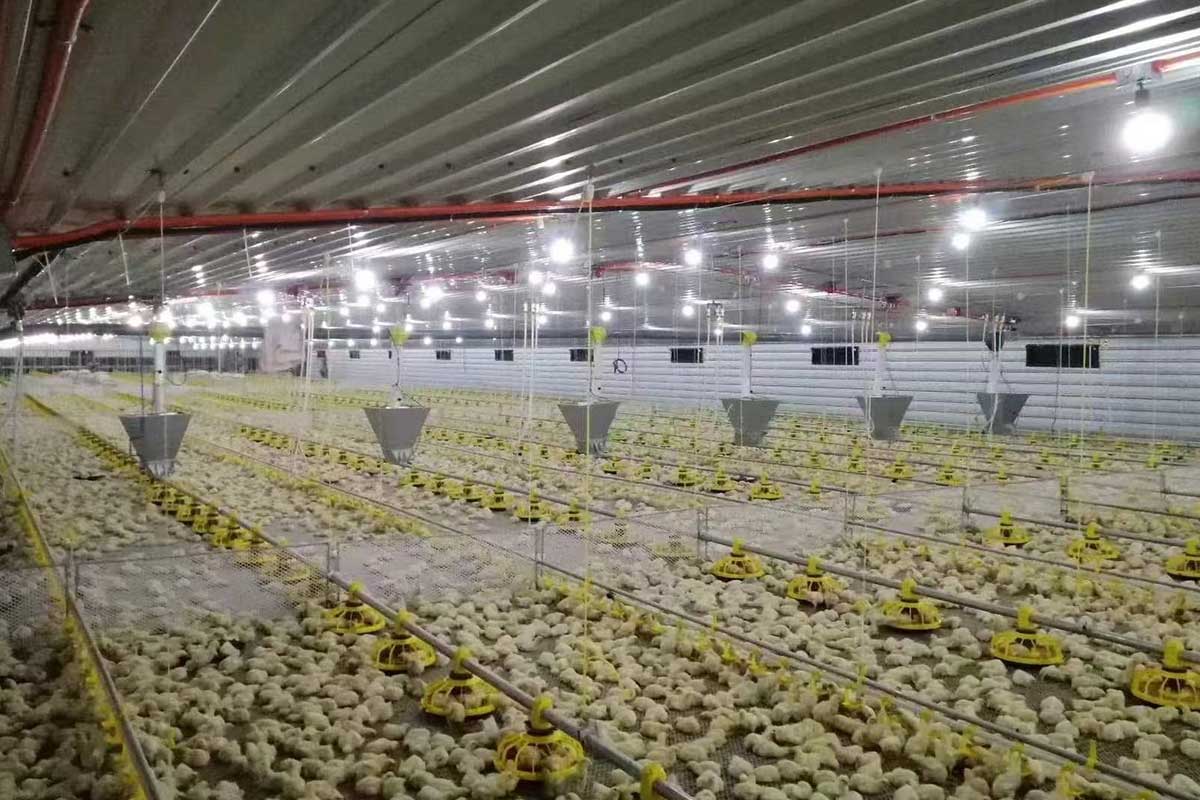
How do they achieve high-density farming with “no odor and no stuffiness” in a space nearly 20 meters wide and 160 meters long? The answer doesn’t rely on expensive chemical deodorizers, but rather on returning to the essence of farming—a scientific hardware architecture and a precise dynamic balance of negative pressure ventilation.
I. Controlling Air Quality at the Source: The Overlooked Key Hardware Parameters
Many chicken coops suffer from strong odors due to inherent deficiencies. Low eaves and narrow spans create a “thermal dome” effect, causing hot air and harmful gases (such as hydrogen sulfide and ammonia) to stagnate in the chickens’ activity area and fail to dissipate.
This farm established a solid foundation for air circulation from the outset:
Eaves Height: 10 feet (approximately 3.05 meters)
Roof Height: 14 feet (approximately 4.27 meters)
Cloth Span: Nearly 20 meters
Cloth Length: Approximately 160 meters (550 feet)
This high-roof, wide-body design not only provides a large buffer space for airflow but, more importantly, overcomes the inherent “stuffy” feeling of low-ceilinged chicken coops. The wide body design, combined with precise wind speed control, allows airflow to evenly sweep across the chickens’ backs, avoiding dead zones.
II. The "Dynamic Philosophy" of Negative Pressure Ventilation: A Complete Air Exchange Every 50 Seconds
The farm’s core secret to odorlessness lies in the precise application of its negative pressure ventilation system. Under negative pressure, outside air is forcibly drawn in through the air inlets, filling every corner of the chicken house and “squeezing out” stale exhaust fumes.
1. The Golden Standard of Pressure and Airflow
During hot weather, the farm maintains a daily negative pressure value between 1.0 and 1.2. This standard balances fan efficiency and airflow uniformity within the house.
High Oxygen Consumption Satisfaction: Older broilers have a high metabolic rate. The ample airflow provided by this system ensures a sufficient oxygen supply, greatly mitigating the risks of ascites and pulmonary hypertension in broilers.
Forced Cooling: During periods of high temperature, fans operate continuously, utilizing the air-cooling effect to lower the perceived temperature for the chickens.
2. Flexible Switching of Multiple Air Intake Modes
A single air intake mode cannot cope with changing weather conditions. The farm employs three ventilation strategies, precisely adjusted based on the chickens’ age and outside temperature:
Cross-ventilation (transitional ventilation): Suitable for spring and autumn or the early brooding period, preventing cold air from blowing directly on the chickens.
Top ventilation (vertical ventilation): Utilizes the principle of rising hot air to effectively break down the thermocline and mix the temperature difference between upper and lower layers.
Tunnel ventilation (longitudinal ventilation): Activated during hot weather, air flows in from one end, sweeping across the flock at high speed and carrying away heat.
Amazing efficiency: At maximum ventilation, the air inside the coop can be completely exchanged in just 50 seconds. This means that harmful gases such as ammonia and carbon dioxide are completely replaced before they can accumulate, eliminating odors at their source.
III. The "Subtraction Art" of Litter Management: The Miracle of 7cm Wheat Straw
Litter is the first line of defense for the intestinal health of chickens. Many farmers mistakenly believe that the thicker the litter, the better, resulting in a dry surface and a hardened, moldy bottom, becoming a breeding ground for bacteria.
This farm has taken a different approach, using wheat straw as litter, with a strict thickness of 7cm. This figure may seem thin by some traditional standards, but it reflects the farm’s meticulous management:
Thorough Batch Cleaning: The farm insists on thoroughly cleaning all litter after each batch of broilers is sold, achieving zero residue. The 7cm thickness ensures that the labor and material costs for manure removal and litter replacement are minimized.
Ecological Adaptation: Wheat straw has moderate water absorption and a loose structure. Combined with precise ventilation, it allows surface moisture to evaporate quickly, keeping the litter dry.
Foot Health: Thin, dry litter significantly reduces the incidence of breast cysts and footpad burns in chickens, allowing the flock to move freely and eat more evenly.
IV. Precision Feeding in Four Stages
The transition in feed form directly determines the development of the digestive system. This farm implements a four-stage feeding system with extreme strictness, not simply judging success by weight, but strictly adhering to the age milestones:
| Age Stages | Feed Categories | Particle shape |
| 1-14 days old | Primary Crushed Feed | Medium crushing |
| 14-17 days old | Chicken Feed | Large crushed material |
| 17-23 days old | Growing Chicken Feed | Small particles |
| 24 days old to market weight | Adult Chicken Feed | Medium particles |
The essence of this approach lies in its gradual implementation. Using large-particle feed too early can easily lead to picky eating and indigestion in chicks; delaying the transition will limit feed intake and cause stunted growth. This refined “feed progression” is the key guarantee for the farm’s high flock uniformity and the absence of weak chicks.
Competition in large-scale broiler farming has shifted from simple price wars to a contest of environmental control capabilities. This farm’s success verifies a truth: high density does not equal high pollution.
By establishing a foundation with ample physical space, relying on dynamic negative pressure ventilation to purify the environment, using thin litter for batch cleaning to block pathogens, and finally using four-stage precision feeding to tap into genetic potential—these four interconnected steps together construct a complete biosecurity and welfare farming system.
When your chicken coop is free of odor and the flock uniformity is significantly improved, the economic benefits of high density can truly translate into tangible profits, rather than heavy medication bills.