Fan Selection for Enclosed Chicken Houses
In the modern chicken farming industry, fully automated enclosed chicken houses have become the mainstream model due to their precise environmental control capabilities. However, the selection of the core equipment of the ventilation system—the fan—directly affects the air quality, temperature control, and farming efficiency of the chicken house.
I. Core Requirements of Chicken House Ventilation Systems
Fully automated enclosed chicken houses achieve environmental control through mechanical ventilation. Their core requirements include:
1. Temperature Control: In summer, the perceived temperature needs to be reduced through wind cooling; in winter, direct cold air should be avoided to prevent stress to the chickens.
2. Air Quality: Timely removal of harmful gases such as ammonia and carbon dioxide, maintaining an oxygen concentration ≥19.2%.
3. Airflow Uniformity: Avoiding dead zones and ensuring an air velocity of 1.67-3 m/s at the chickens’ back height.
4. Energy Efficiency: Switching ventilation modes according to the season to reduce energy costs.
For example, a chicken house 100 meters long, 12 meters wide, and with an eaves height of 3.8 meters has a volume of 5640 m³. If a longitudinal ventilation mode is used, a complete air exchange per minute is required in summer, meaning a total air volume of 338,400 m³/h is needed. If a single fan with an exhaust volume of 36,000 m³/h is selected, theoretically 9.4 units would be needed. However, in practice, 1-2 spare units should be added, and a safety factor of 10%-20% should be considered. Therefore, a final configuration of 11-12 units would be more reasonable.
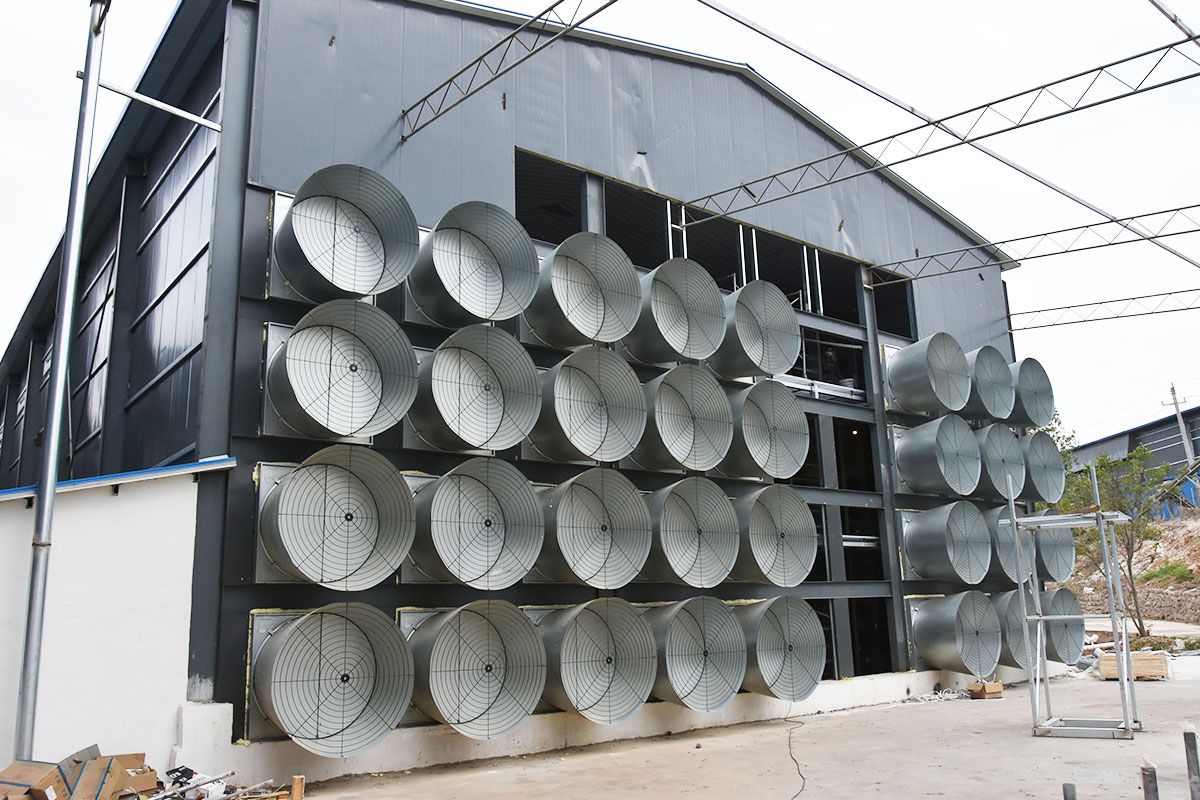
II. Four Core Parameters for Fan Selection
1. Air Volume and Negative Pressure Matching
Air Volume Calculation: Determine the total requirement based on the chicken house volume and air exchange rate. For example, laying hens require 4.76 m³/h of air exchange per kilogram of body weight. A flock of 35,000 chickens weighing 2 kg each would require an air volume of 35,000 × 2 × 4.76 = 333,200 m³/h in summer.
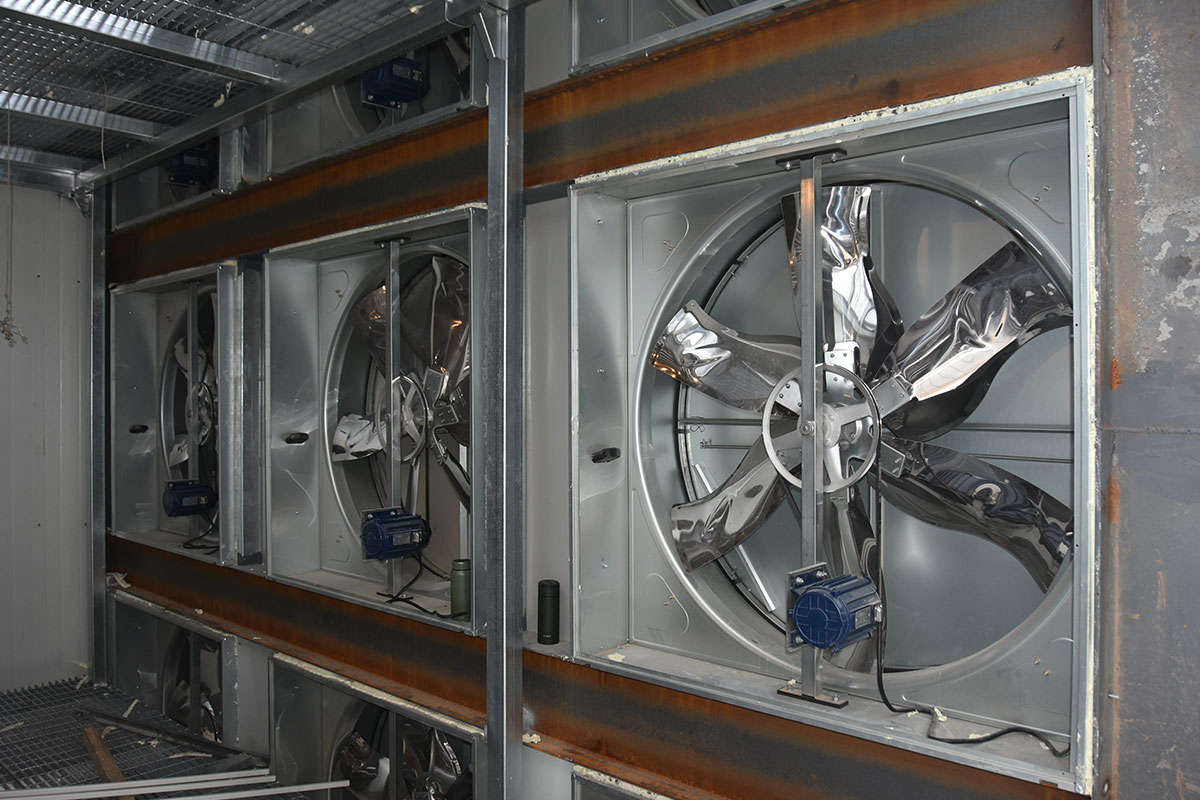
Negative Pressure Matching: Enclosed chicken houses typically use negative pressure ventilation, requiring selection based on the fan’s performance curve. For example, the BF55 fan can achieve an exhaust volume of 58,000 m³/h under 20Pa negative pressure, while ordinary fans may experience a reduction of over 30% under the same conditions.
2. Energy Efficiency and Motor Type
Power Selection: For enclosed spaces under 10㎡, a 45W fan is preferred, with measured noise levels ≤40 decibels. For open chicken houses over 15㎡, a 60W model is recommended, as its large air volume allows for rapid removal of ammonia.
Motor Material: Copper wire motors have a lifespan more than 30% longer than aluminum wire motors, reducing maintenance costs over long-term use. For example, after renovation at a broiler farm in Weifang, the wind power of copper wire motor fans decreased by only 5% after two years of operation, while aluminum wire motor fans experienced a 35% decrease.
3. Fan Types and Applicable Scenarios
Axial Flow Fans: Suitable for longitudinal ventilation. For example, the CFJT4.0 model has a single-unit exhaust volume exceeding 50,000 m³/h, low noise, and energy saving. 3-4 units per chicken house are sufficient to meet summer needs.
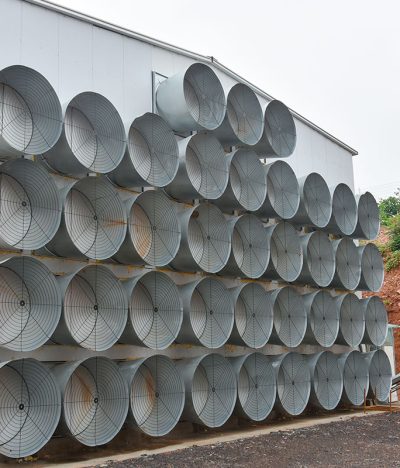
Negative Pressure Fans: Utilize air convection for forced ventilation, achieving a cooling effect of 90%-97%. For example, a 140-meter breeder chicken house uses 8 voltage-stabilized BF55 fans, with a total exhaust volume of 464,000 m³/h and a wind speed of 3.5 m/s, meeting the requirements of high-temperature and high-humidity environments.
Variable Frequency Fans: Automatically adjust power according to day-night temperature differences. For example, a duck farm uses a 60W mode for rapid cooling during the day and switches to 45W for silent operation at night, reducing overall energy consumption by 20%.
4. Structure and Durability
Material Selection: The FRP shell is acid and alkali resistant and corrosion resistant, with a service life of 10-20 years; the aluminum alloy motor is tightly sealed and consumes very little power, requiring only 1.125 kWh per hour.
Transmission System: The use of a PK multi-V belt reduces slippage and noise, and the computer-balanced fan blades (balance level G6.3) reduce vibration amplitude by 60%.
III. Seasonal Ventilation Mode Configuration
1. Minimum Ventilation in Winter
Timed Circulation Mode: Air exchange for 5 minutes every 10 minutes to avoid temperature fluctuations caused by continuous ventilation. For example, a 100-meter chicken house equipped with 5 36-inch fans, with an exhaust volume of 705 m³/min, can meet basic ventilation needs.
Air Inlet Design: The air inlet gap length should reach 80% of the total length of the chicken house, and adjustable deflectors should be used to guide airflow and prevent cold air from blowing directly on the chickens.
2. Mixed Ventilation in Spring and Autumn
Side Wall + Longitudinal Fan Combination: When the side wall exhaust fans cannot meet the demand, 50% of the longitudinal fans are turned on. For example, a chicken house with 4 36-inch fans installed on the side walls and 4 48-inch fans configured longitudinally automatically switches modes according to temperature.
3. Longitudinal Ventilation in Summer
Fully Enclosed Negative Pressure System: Close the side walls, leaving only the air inlets at the fan ends open. For example, a 90-meter chicken house uses 21 fans with a capacity of 37,000 m³/h, combined with evaporative cooling pads. The wind speed at the chickens’ backs reaches 2.5 m/s, reducing the perceived temperature by 5-8°C.
Safety margin: The total airflow needs to be increased by 10%-20%, and the fan blades should be cleaned regularly to remove dust; otherwise, the exhaust volume may decrease by 50%-75%.
IV. Selection Guidelines to Avoid Pitfalls
1. Avoid “underpowered” fan specifications: If calculated air volume (a) and cooling capacity (b) are required, but the selected fan can only meet either cooling capacity (a) or air volume (b), the fan performance curve needs to be re-evaluated to ensure a total pressure value ≥ 5-7 mmHg.
2. Prevent condensation risks: If the fan outlet temperature is too low, a variable frequency model can be selected or the supply air temperature adjusted. For example, a chicken farm prevented condensation and mold growth by controlling the temperature of the evaporative cooling pads at 18-22℃.
3. Verify actual operating conditions: The air volume specified by manufacturers is often based on zero static pressure. The actual exhaust volume must be selected based on the resistance of the chicken house (such as shades and filters). For example, after installing shades in a chicken house, the ventilation volume needs to be increased by 15% to compensate for pressure loss.
V. Industry Case Studies
Case 1: 140-meter Breeder Chicken House
Requirements: Wind speed 3.5 m/s, total exhaust volume 460,000 m³/h.
Solution: 8 pressure-stabilizing fans (58,000 m³/h/unit) were selected, reducing the total cost by 12% compared to energy-saving models, and improving wind speed uniformity by 25%.
Case 2: Broiler Farm Renovation
Requirements: Rapid ammonia removal from a 30-meter chicken house.
Solution: Two 60W negative pressure fans were installed on each side, combined with water curtain cooling, improving temperature uniformity by 3-5℃ and reducing the feed conversion ratio by 0.05.
The selection of fans for fully automatic enclosed chicken houses requires a comprehensive consideration of four parameters: air volume, negative pressure, energy efficiency, and structure, and should be scientifically configured in conjunction with seasonal ventilation patterns. Case studies have verified that proper fan selection can reduce energy consumption by 7%-12% and improve breeding efficiency by more than 15%. It is recommended that farms regularly test the uniformity of wind speed, clean the dust accumulated on the fans, and refer to the BESS laboratory test report to select a fan model with stable performance to create a healthy growth environment for the chickens.