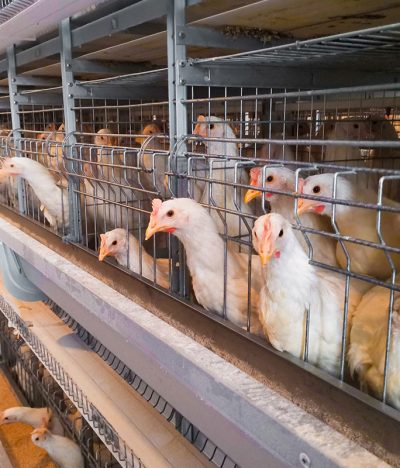
What is the Appropriate Humidity Level for a Laying Hen House?
Many laying hen farmers face a puzzling dilemma: despite maintaining proper temperatures and using high-quality feed, their flocks still suffer from strong ammonia odors, persistent respiratory issues, deteriorating eggshell quality, and increased mortality or culling rates.
Laying hens are essentially “dry-environment” animals; they are far more sensitive to humidity fluctuations than most people realize. Excessive humidity causes ammonia levels to spike and promotes coccidiosis outbreaks, while overly low humidity fills the air with dust and triggers frequent pecking behavior. Problems in poultry houses rarely stem from a failure to hit the exact target of 60% humidity; rather, they arise when conditions consistently deviate from the optimal range and drift into the danger zone.
I. Humidity in the Laying Hen House
✅ Acceptable Range
A relative humidity (RH) of 50%–70% is considered acceptable.
⭐ The “Golden Range”
55%–65% is the “golden range” where laying hens feel most comfortable and achieve optimal production performance.
🚨 Two Absolute Red Lines (Limits)
| Red Lines | Value | Risk Level |
| 🔴 High-humidity danger line | Sustained >75%–80% | High-risk zone; immediate intervention required |
| 🔴 Low-humidity danger line | Sustained <40% | High-risk zone; immediate intervention required |
II. Hazards of Excessive Humidity (>75%, especially above 80%)
1. Ammonia Spike and Respiratory Damage
In high-humidity environments, the decomposition of manure accelerates, causing ammonia concentrations to skyrocket. Ammonia directly irritates the respiratory mucosa and impairs ciliary defense mechanisms, making outbreaks of rhinitis, bronchitis, and airsacculitis more likely. For many flocks, the root cause of respiratory issues lies not in viruses, but in humidity levels.
2. Damp Litter and Proliferation of Coccidia and Mold
Damp litter and manure pits create a “paradise” for coccidial oocysts; their survival rates surge, making coccidiosis recurrent and difficult to control.
Mold proliferates rapidly in humid conditions, leading to mycotoxin issues that damage the liver and kidneys while suppressing the immune system.
3. Cold-Damp Stress and Reduced Feed Efficiency
In high-humidity environments, chickens’ feathers struggle to stay dry, resulting in a significantly lower perceived temperature (the “cold-damp effect”). To maintain body temperature, the flock consumes more feed; this raises the feed-to-egg ratio and quietly erodes profits.
4. Increased Incidence of Footpad Dermatitis and Breast Blisters
Damp flooring damages the skin on the chickens’ feet and breasts, leading to a higher incidence of quality issues such as footpad dermatitis and breast blisters, which in turn lowers the market value of culled birds.
🌧️ Special Note: Prolonged Rainy Spells / Plum Rain Season
Most issues in poultry houses during this period stem from two root causes: inadequate ventilation and moisture rising from the floor or corners, keeping humidity consistently around 80%. Simply spreading lime is ineffective in this situation; ventilation is essential to actively remove the moisture.
III. Hazards of Excessively Low Humidity (<40%)
This issue most frequently arises in enclosed poultry houses during winter and spring. Problems stem not only from excessive moisture but also from conditions that are dangerously dry.
1. Airborne dust and chronic respiratory irritation
When the air is too dry, dust, feather dander, and feed particles remain suspended, causing “dust-induced respiratory irritation.” Prolonged inhalation by the flock can lead to chronic symptoms—such as coughing, sneezing, and tracheal congestion—even in the absence of viral or bacterial infections.
2. Tendency toward dehydration and loose droppings (risk of misdiagnosis)
In dry environments, water intake increases significantly, resulting in looser droppings. Many farmers mistake this for an intestinal disease and administer medication indiscriminately, often exacerbating the problem.
3. Triggering of pecking vices
Dry conditions can cause skin itching and brittle feathers in chickens, leading to a marked increase in feather pecking, vent pecking, and other pecking vices; once these harmful habits are established, they are difficult to correct.
4. Static electricity interfering with equipment readings
Increased static electricity in dry environments can cause reading drift in equipment such as electronic scales and sensors, thereby compromising management decisions.
IV. Quick Reference Table
| Season/Condition | Common humidity patterns | Key Measures |
| Hot and humid summer | Predominantly high humidity (combined high temperature and high humidity) | Increase exhaust volume, appropriately lower water line pressure, and strictly prevent water accumulation in manure pits. |
| Winter/Spring (enclosed period) | Low humidity (<40%) or “cold outside/warm inside” conditions (leading to inner-wall condensation and “false” high humidity) | Do not set the minimum ventilation rate too low; promptly clear condensation to prevent localized dampness. |
| Prolonged overcast/rainy weather (plum rain season) | Persistently >75% | Prioritize unobstructed exhaust pathways, activate high-intensity exhaust when necessary, and utilize every opportunity for ventilation. |
| Spring/Autumn transitional periods | Significant diurnal fluctuations; prone to rapid shifts between dry and humid conditions | Adjust ventilation strategies in advance based on weather forecasts to avoid drastic fluctuations. |
V. Q&A on Common Misconceptions
Q: Can I spread lime when humidity is high?
A: Spreading lime only absorbs surface moisture temporarily; it treats the symptom but not the root cause. Unless the sources of moisture (manure, drinking water, ground dampness) are addressed, humidity will quickly rise again. Proper ventilation is the fundamental solution.
Q: Can I reduce ventilation in winter to conserve heat?
A: Absolutely not! The primary goal of minimum ventilation in winter is not cooling, but rather exhausting moisture and harmful gases. Reducing ventilation leads to skyrocketing humidity and excessive ammonia levels, which in turn trigger respiratory diseases. It is better to spend a little more on heating than to skimp on ventilation.
Q: Where is the best place to hang a hygrometer for accurate readings?
A: Hang them in at least two locations—near the air inlet and in the central aisle of the coop—at the same height as the chickens’ backs (approximately 30–40 cm above the ground). Do not hang them at human eye level (above 1.5 meters), as readings taken there are not representative of the conditions the flock is actually experiencing.
Q: The ideal humidity is 60%, but I can only maintain it at 50% or 70%. Is that okay?
A: A range of 50%–70% is acceptable. The key is to avoid levels consistently above 75% or below 40% for extended periods. Stable “sub-optimal” conditions are better for the flock than “perfect” conditions that fluctuate wildly.
The core of humidity management in a laying hen house is not rigidly adhering to a specific number, but finding a dynamic balance between heat retention and ventilation, and between humidification and dehumidification.
For high humidity: Prioritize checking for adequate ventilation, timely manure removal, and leaks in the watering lines.
For low humidity: Check for excessive ventilation, insufficient water supply, or overly dry flooring.
Remember this: Aim for the 55%–65% range, but as long as your coop maintains humidity between 50% and 70%—without consistently exceeding 75% or dropping below 40%—the flock’s performance generally won’t disappoint you.