Floor Rearing vs. Cage Rearing for Broilers
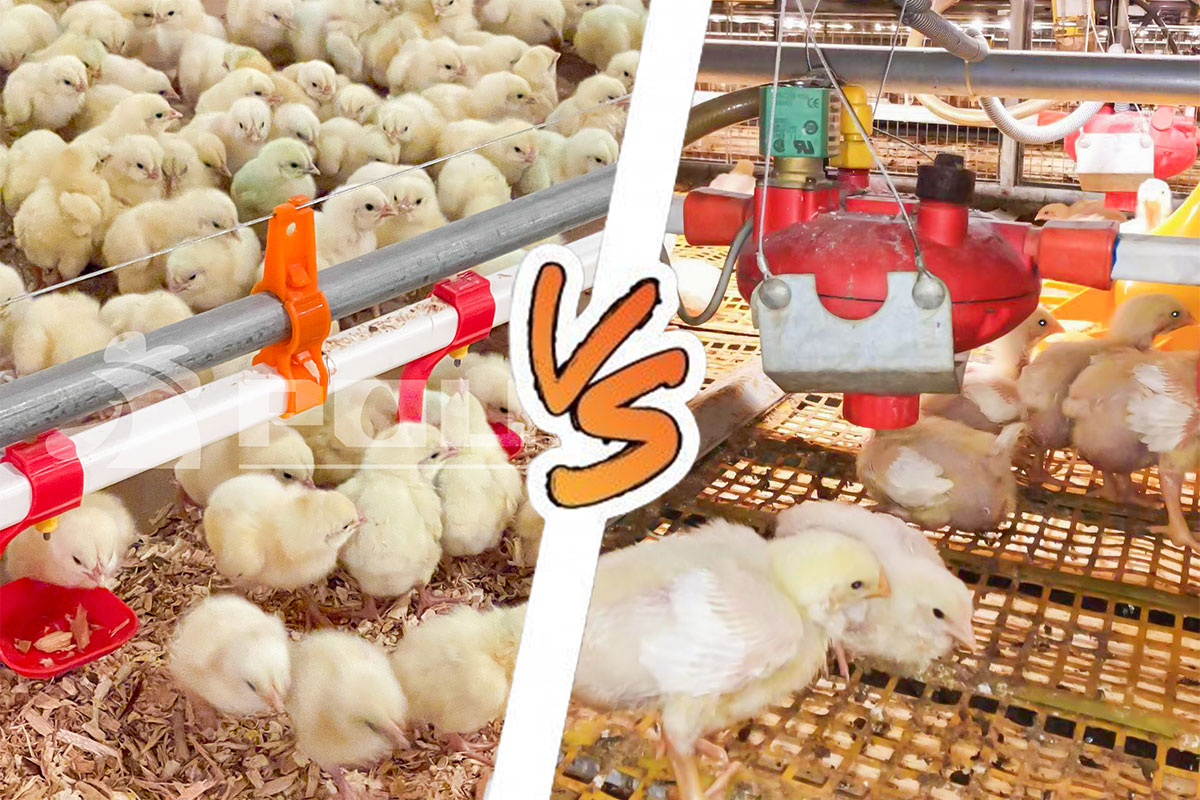
The broiler farming sector is clearly diverging: floor-based rearing suits welfare-oriented and small-to-medium-scale farms, while tiered cage systems are the mainstay of high-density, intensive large-scale operations. Neither model is inherently superior; success hinges on matching the specific farming setup with tailored equipment—covering feeding, watering, manure removal, and environmental control—to maximize production efficiency and streamline daily management.
The core advantage of cage rearing is a twofold increase in land-use efficiency, whereas floor rearing prioritizes litter management and overall environmental stability.
Ⅰ. Floor-based rearing: Relying on automation to stabilize bedding and environmental conditions, thereby reducing the risk of disease.
Floor-reared broilers enjoy ample space, resulting in lower incidences of leg disorders and breast blisters, as well as a premium on meat quality. However, there are distinct challenges: managing litter, controlling high dust levels, preventing excessive ammonia, and ensuring uniform feed distribution.
Optimizing floor-rearing management centers on two key priorities: keeping litter dry and ensuring uniform ventilation throughout the house. Automated feeding and watering systems reduce the need for frequent human entry—thereby minimizing the introduction of pathogens—while environmental control systems dynamically balance temperature, humidity, and harmful gas levels. As long as the litter remains dry and air quality meets standards, survival rates and growth uniformity can be consistently improved.
1 Fully Automated Pan Feeding System
Features a centralized external feed silo combined with individual house silos; augers transport feed from the central silo to each house silo.
Feed is then distributed via augers from the house silo to the feed line hoppers and finally to individual feed pans.
Feed line configuration matches standard house widths: 3 lines for 120×12m houses, 4 lines for 120×15m houses, and 5 lines for 120×18m houses.
The one-piece molded PP feed pan offers six feed-level settings, suitable for the entire growth cycle from chick to market weight; an inward-curved rim prevents feed spillage.
Galvanized piping undergoes rigorous salt-spray testing, ensuring stable transport and minimal pellet breakage, which improves the feed conversion ratio by 3%–5%.
Centralized external feed loading eliminates the need for vehicles to enter the house, significantly enhancing biosecurity.
2 360° High-Sensitivity Nipple Drinking System
Nipples allow water flow from any angle (360°), significantly reducing the effort required for birds to drink.
Includes height-adjustable square water lines, pressure regulators, and flushing components for one-touch pipeline cleaning.
Snap-on drip cups catch overflow, preventing litter dampness and caking at the source, thereby reducing the risk of coccidiosis and intestinal disease outbreaks.
Water line height is flexibly adjusted according to the birds’ age, accommodating the lower height needs of chicks and the higher reach required by mature birds.
3 Integrated Ventilation and Heating Management System
Tunnel ventilation doors and gas-fired heating equipment are essential for floor-rearing systems:
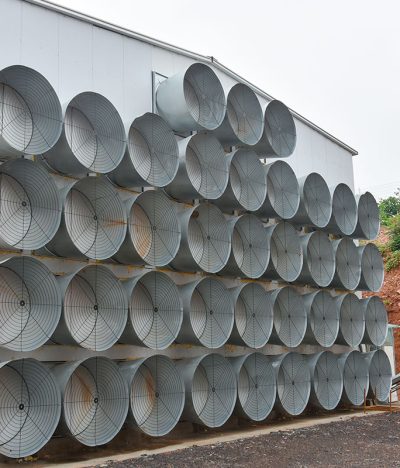
Tunnel doors: Provide thermal insulation in winter and facilitate longitudinal ventilation in summer; paired with high-performance fans, they rapidly exhaust ammonia and moisture generated by litter fermentation.
Gas heaters: Quickly raise the temperature within the house; paired with circulation fans, they ensure uniform temperatures, preventing localized hot or cold spots that cause the flock to huddle together.
4 Intelligent Environmental Control Hub
Sensors for temperature, humidity, ammonia (NH₃), CO₂, and static pressure are distributed throughout the house.
Automatically generates temperature curves based on the broiler’s age and synchronizes the operation of fans, cooling pads, heating units, and air inlets for coordinated regulation.
Real-time monitoring of indoor humidity levels (correlated with litter moisture) triggers increased ventilation automatically if humidity becomes excessive.
Supports remote monitoring via mobile devices and fault alarms, reducing the need for 24-hour manual supervision and solving the challenge of maintaining a uniform environment in floor-rearing systems.
II. Stacked Cage Rearing: Vertical intensification, automated manure removal, and high-density management for increased profitability.
Stacked cage rearing is the preferred choice for large-scale farms (10,000+ birds) facing land constraints. Stocking density per unit area is more than double that of floor rearing; complete separation of manure from broilers significantly reduces the incidence of coccidiosis and pullorum disease.
The core logic behind optimized cage management is efficient space utilization combined with immediate manure separation. Fully automated feeding, watering, and manure removal systems require minimal labor for a 10,000-bird house. Tiered environmental control eliminates the uneven conditions often found in vertical systems, improving feed conversion rates by 5–10% compared to floor rearing and lowering overall production costs.
1 Independent Automated Feeding System per Tier
Each cage tier is equipped with its own feed trough and delivery line; a traveling feeder ensures uniform feed distribution across all tiers.
V-shaped trough design minimizes feed waste.
The system includes an integrated weighing module to automatically track daily feed consumption and accurately calculate the feed-to-meat ratio.
The galvanized, corrosion-resistant cage structure maintains its shape during long-term, high-density rearing and supports configurations of 3 to 8 tiers.
2 Independent Watering Lines per Tier
Each tier features an independent pressure-regulated water line and flushing system, preventing cross-contamination of water quality between tiers.
Adjustable nipple drinker heights ensure comfortable access for broilers.
3 Fully Automated Conveyor-Belt Manure Removal System
Manure collection belts are installed at the bottom of each tier, with scheduled automatic removal and lateral transport of manure out of the house.
Manure does not accumulate inside the facility, reducing ammonia concentrations at the source.
Eliminates the need for manual manure removal, significantly cutting labor costs and reducing the risk of pathogen introduction by personnel.
Centralized manure collection allows for direct processing into organic fertilizer, facilitating a circular farming economy.
4 Specialized Vertical Smart Environmental Control System
Multi-tier vertical cage structures are prone to temperature differentials and ventilation dead zones; a specialized controller enables zoned management:
Temperature is monitored by zone, with independent control of air inlets, baffles, and the number of active exhaust fans.
Synchronized operation of fans, heating systems, and cooling pads significantly reduces the risk of heat stress in high-density flocks. At the same time, data on the total consumption of water, electricity, and materials is recorded to facilitate cost accounting.
III. Selecting Equipment Based on Needs
Optimizing production efficiency and management standards can be achieved by configuring appropriate feeding, watering, manure removal, and environmental control systems tailored to specific farming models:
Cage-based systems prioritize space utilization and automated manure handling.
Floor-based systems rely more heavily on litter management and comprehensive ventilation systems.
Regardless of the farming method, intelligent environmental control serves as the core component for both systems. Jiangxi Xinzengxin offers comprehensive broiler farming solutions—covering the entire equipment chain, including steel-structure houses, cage racks, and systems for feeding, watering, and ventilation, as well as intelligent environmental controllers. These solutions can be customized based on house dimensions and farming scale, balancing automation, biosecurity, and long-term profitability.
Q: Which is more profitable for broilers: floor rearing or cage rearing?
A: There is no absolute answer. Floor rearing suits a “high-welfare” or premium-quality approach, commanding higher price premiums for meat quality. Cage rearing suits high-density, large-scale operations, offering superior land utilization and a 5–10% improvement in feed conversion rates, resulting in lower overall costs. The choice depends on your land, capital, sales channels, and management capabilities.
Q: What is the biggest advantage of stacked cage rearing?
A: Stocking density per unit area is more than double that of floor rearing. Manure is completely separated from the birds, significantly reducing the incidence of coccidiosis and pullorum disease. Combined with automated manure removal and environmental control systems, a single house of 10,000 birds requires minimal labor.
Q: What are the key management challenges in floor rearing?
A: Issues include damp litter, excessive ammonia levels, high dust concentrations, and uneven feeding. The core strategy involves configuring automated feeding/watering systems and an intelligent environmental control hub to ensure dry litter and uniform ventilation throughout the house.
Q: Is it feasible to convert an old broiler house from floor rearing to cage rearing?
A: It requires an assessment of the structure’s load-bearing capacity, ceiling height, ventilation, and manure removal pathways. Stacked cage rearing places higher demands on building structure and environmental control; a professional assessment followed by a phased renovation is recommended. Jiangxi Xinzengxin offers customized renovation solutions.
Q: How do intelligent environmental control systems differ between floor rearing and cage rearing?
A: In floor rearing, control focuses on monitoring temperature, humidity, ammonia, CO₂, and static pressure across the entire house, coordinating fans, cooling pads, and heating systems. Cage rearing requires zoned control to address temperature differences between tiers and eliminate ventilation dead zones, while also tracking water and electricity usage.
Floor rearing and cage rearing represent fundamentally different production logics: floor rearing relies on litter management and environmental stability, whereas cage rearing relies on spatial efficiency and automated manure handling. Neither is inherently superior; the best choice depends on whether the method aligns with your specific farming operation.
Regardless of the chosen model, intelligent environmental control serves as the essential foundation. Properly equipping and integrating the four major systems—feeding, watering, manure removal, and environmental control—is key to ensuring a healthy flock, uniform growth, low costs, and stable profitability.