Comprehensive Comparison Between Broiler Cage Rearing Equipment and Floor Rearing Systems
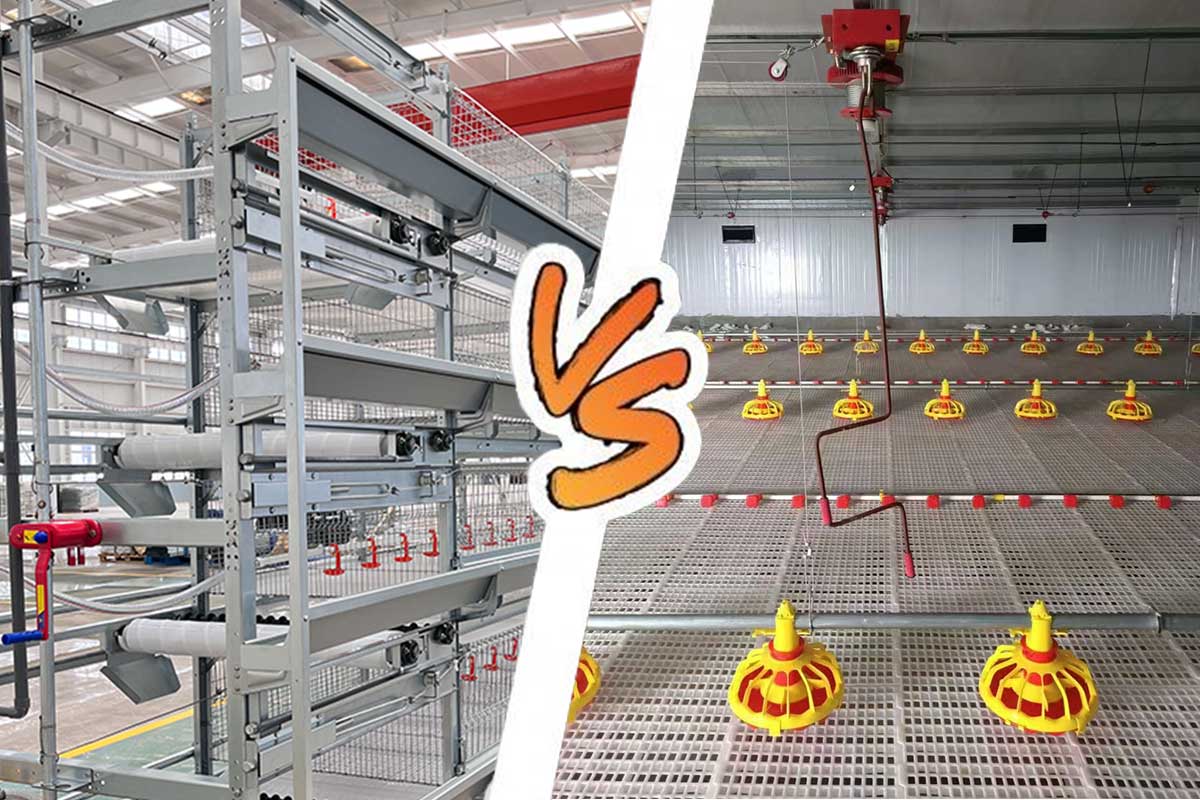
In the wave of large-scale and intensive development in the broiler farming industry, the choice of farming model directly affects production efficiency and the long-term competitiveness of enterprises. Currently, broiler farming is mainly divided into two schools of thought: cage farming, which focuses on intensive space, and floor farming, which features free movement. Cage farming, due to its advantages such as high efficiency and low labor costs, has already occupied about 80% of the market share in white-feathered broiler farming. However, floor farming still maintains a place in terms of animal welfare and certain export markets.
Overview of Main Broiler Farming Models
1. Definition and Classification of Floor-Raising Systems
Floor-raising refers to a method of raising broilers on a flat surface, allowing them to move freely. Based on structural differences, it is mainly divided into two categories: ground floor-raising and wire mesh floor-raising.
Ground floor-raising is the traditional and most common method of broiler farming. A 5-10 cm thick layer of bedding material, commonly made of absorbent materials such as rice husks, sawdust, and grain husks, is laid on the floor of the chicken house, allowing the broilers to move freely. If the bedding is too thin, it can easily become damp and compacted, leading to breast cysts; if it is too thick, it may induce diarrhea or intestinal diseases. Bedding management is the core technical aspect of ground floor-raising. The advantages of ground floor-raising are that it requires less sophisticated chicken house construction and equipment, resulting in lower investment, lower costs, and easier management; the fermentation of bedding and manure generates heat, which can raise the temperature inside the house, especially in winter; and the chickens moving on soft bedding have a lower incidence of leg diseases and breast cysts. The disadvantages are that it requires less land, has a large demand for bedding, and direct contact between the chickens and manure is not conducive to disease prevention.
Net-frame rearing is a method of raising broilers by constructing metal mesh frames at a certain height above the ground and laying plastic or metal mesh mats. Net-frame beds are easy to build, economical, and practical. Chickens do not directly contact feces, significantly reducing the risk of coccidiosis. The stocking density is slightly higher than ground-level rearing. However, because the chickens live on a hard mesh surface, they are prone to breast cysts and foot diseases, and the equipment cost is also higher than ground-level rearing.
2. Definition and Classification of Cage Rearing Systems
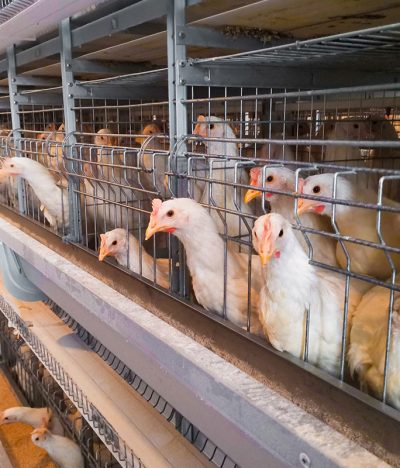
Cage rearing is a rearing method where broilers are raised in cages constructed of multiple layers of metal mesh. Different models of cages are designed according to the breed, sex, and age of the chickens. They can be broadly classified into two types: overlapping and tiered, with 3 or 4 layers.
Tiered cage rearing is currently the mainstream form of cage rearing. It uses a multi-layered stacked structure, increasing the stocking density per unit area by raising the height. Tiered cage rearing “folds” the space of the ground, achieving 4 to 8 layers of vertical rearing within a single chicken house. Stacked cage systems are equipped with automated feeding, watering, and manure removal systems, allowing one person to manage tens of thousands of broilers, significantly reducing labor costs.
Ladder cage systems use A-frame cages arranged in a stepped pattern, with sufficient space between each layer for ventilation and lighting. They are suitable for small to medium-sized farms or areas with relatively humid climates, and maintenance is relatively convenient.
3. Core Components of a Modern Cage System
Broker cage systems emphasize system integration, mainly including: cage bodies (stacked or ladder type), automatic feeding systems, automatic watering systems, automatic manure removal systems, environmental control systems (temperature, humidity, and ventilation regulation), and intelligent monitoring systems. High-quality cage bodies are typically made of hot-dip galvanized steel wire, possessing corrosion and aging resistance, with a service life of 15 to 20 years.
Comparison of Core Differences Between Cage Rearing and Floor Rearing Systems
| Comparison Dimensions: | Broiler cage rearing system | Broiler floor-raising system |
| Stocking Density | Extremely high efficiency, more than twice that of floor rearing | Low cost, 12-15 birds per square meter |
| Equipment Investment | High efficiency, requires a fully automated system | Low cost, ground litter or wire mesh is sufficient |
| Feed Ratio | Optimal efficiency, can improve feed efficiency by 5%-10% | Generally |
| Survival Rate | High efficiency, approximately 97%-98% | Highly susceptible to disease |
| Labor Costs | Extremely low efficiency, one person can manage tens of thousands of chickens | Higher risk |
| Disease Control | Chicken manure isolation, good disease prevention | Direct contact with feces, high risk of coccidiosis |
| Breast and Leg Diseases | Prone to breast cysts and leg diseases | Low incidence rate |
| Bedding Requirements | No bedding required | Requires large amounts of litter, higher cost |
| Manure Treatment | Easy to collect and process | Difficult to clean |
| Animal Welfare | Limited activity, controversial | Free movement, meets welfare requirements |
| Export to the EU | Restricted | Can be exported to the EU market |
1. Stocking Density and Space Utilization
The most significant advantage of cage rearing is the substantial increase in stocking density per unit area. Cage-raised broilers have a much higher stocking density than floor-raised and wire mesh-raised broilers, approximately twice as high, significantly reducing farm space requirements. Nationwide, in the same area of chicken house, cage rearing can hold about twice as many chickens as floor-raised or wire mesh-raised broilers. Floor-raised broilers have a stocking density of approximately 12 to 15 chickens per square meter. In the EU, welfare farming requires a reasonable reduction in density, while in my country, the suitable stocking density for environmentally controlled chicken houses is 32 to 34 kg body weight per square meter (approximately 13 to 14 broilers per square meter). The three-dimensional layout of cage rearing achieves a several-fold increase in output per unit of land, which has significant economic implications in today’s increasingly scarce land resources.
2. Growth Performance and Feed Efficiency
Cage-raised broilers minimize exercise expenditure, converting more feed intake into weight gain. Cage rearing results in significantly higher growth rates and feed conversion rates than floor-raised and wire mesh rearing, reducing feed intake by 160 grams per kilogram of live chickens produced. Experimental data shows that cage-raised broilers can improve feed conversion ratio by 5% to 10% and reduce total costs by 3% to 7%. Studies have shown that the feed conversion ratio of cage-raised broilers can reach 1.8 to 2.0, significantly better than floor-raising.
However, some foreign studies suggest that when litter conditions are well managed, floor-raising systems may outperform cage-raising systems in terms of final body weight, weight gain, and feed conversion ratio. This implies the decisive role of management level in different farming models—excellent floor-raising management can narrow or even reverse the efficiency gap with cage-raising, but this also places higher demands on the technical and management capabilities of farmers.
3. Health Management and Disease Control
Cage-raising has significant advantages in disease control. Chickens do not come into contact with feces, effectively controlling the spread of pullorum disease and coccidiosis. Cage-raising reduces the concentration of ammonia in the environment, reducing the triggers for respiratory diseases. Actual farming data shows that the average survival rate of cage-raised broilers can reach 97.33%. The survival rate of modern welfare-oriented cage-raised broilers can reach over 95%.
In contrast, floor-raised chickens come into direct contact with feces, and the damp bedding easily breeds bacteria, increasing the risk of coccidiosis, E. coli, and other diseases. Coccidiosis outbreaks are particularly common in summer or when bedding management is poor, causing significant economic losses.
However, cage rearing also has its health drawbacks. In traditional cage rearing, the broiler’s breast is in prolonged contact with the hard mesh bottom, leading to a higher incidence of breast cysts and leg diseases. However, effective solutions have been developed in recent years—using elastic plastic mesh instead of metal mesh, or adding a layer of soft rubber strips, can significantly reduce the occurrence of breast cysts and leg diseases.
Regarding meat safety, the integrated automatic manure removal system in cage rearing creates more controllable conditions for achieving drug residue and antibiotic-free farming standards in chicken meat. Meat safety is becoming a new dimension determining export pricing power, and the advantages of cage rearing in this regard deserve attention.
4. Manure Treatment and Environmental Impact
Cage rearing systems are equipped with conveyor belt manure removal equipment. Chicken manure is promptly transported outside the shed for centralized treatment via conveyor belt, preventing manure from touching the ground, and resulting in significantly lower ammonia concentrations inside the shed compared to floor rearing. This method of manure treatment improves air quality in chicken houses and facilitates the resource utilization of manure. Manure can be used to make organic fertilizer or for biogas power generation, realizing a circular economy model of “breeding-fertilizer-planting”.
Manure treatment for floor-raised chickens is much more difficult. After each batch of broilers is sold, a large amount of bedding and manure mixture needs to be removed at once, resulting in high treatment costs. Furthermore, used bedding often becomes a source of pathogens, posing a risk of cross-infection in the next breeding cycle.
| Farming scale: | Recommended Modes | Reasons |
| Below 10,000 birds | Floor rearing | Low investment, low technical barriers, high flexibility |
| 10,000-50,000 birds | Net floor rearing or basic cage rearing | Balancing efficiency and investment |
| Above 50,000 birds | Stacked automated cage rearing | Leveraging economies of scale, significant long-term benefits |
For small-scale farms with limited funds, floor rearing or wire mesh rearing is a reasonable choice for the initial stage. Medium-sized farms can consider gradually transitioning to automated cage rearing, investing in a portion of cage units first and then gradually expanding. Large-scale farms are advised to go all-in from the start, directly adopting a stacked automated cage rearing system to maximize unit productivity and long-term benefits.
Bottler cage rearing equipment and floor rearing systems each have their advantages and disadvantages; the choice depends on the farm’s size, capital, technical capabilities, and market positioning. Cage rearing, with its advantages of high efficiency, low labor, and excellent feed conversion ratio, has become the dominant mode for commercial white-feathered broiler chickens in China. However, the value of floor rearing in terms of animal welfare, export markets, and meat quality cannot be ignored. In the future, advancements in both equipment and management will drive the deep integration of the two modes towards “high efficiency, low cost, and high welfare.” Farmers should make the most suitable equipment selection decision based on a comprehensive return on investment analysis and their own specific circumstances. Particular attention should be paid to the total life cycle cost of equipment, including initial purchase, installation and commissioning, daily maintenance, energy consumption, and replacement costs. Meanwhile, the supporting environmental control system, feed and water lines, manure removal processes, and biosecurity design must be synchronized with the farming model to avoid limiting overall efficiency due to local shortcomings. In addition, the reserve of technical personnel and digital management capabilities are increasingly becoming key supports for the implementation of the model.