Temperature stratification: The most hidden energy waste in chicken houses?
In chicken coop ventilation management, we often focus on matching the air intake area with the fan, but easily overlook another crucial issue affecting energy consumption and environmental uniformity—temperature stratification.
Especially today, with soaring heating costs and shrinking profit margins, reducing fuel consumption has become a common focus for farms. However, instead of thinking about “how to reduce fuel consumption,” we should redefine the problem: how to improve energy efficiency.
Lowering heating costs ≠ Turning off heaters
Anyone can reduce heating costs; the simplest way is to turn off brooder heaters. However, this often comes at the cost of a significant drop in productivity, with the losses far outweighing the fuel savings.
Records show that producers who “refuse to conserve fuel” consistently produce higher-quality flocks (especially in free-range chicken houses). This illustrates that blindly pursuing energy conservation may be counterproductive; what truly needs improvement is energy efficiency.
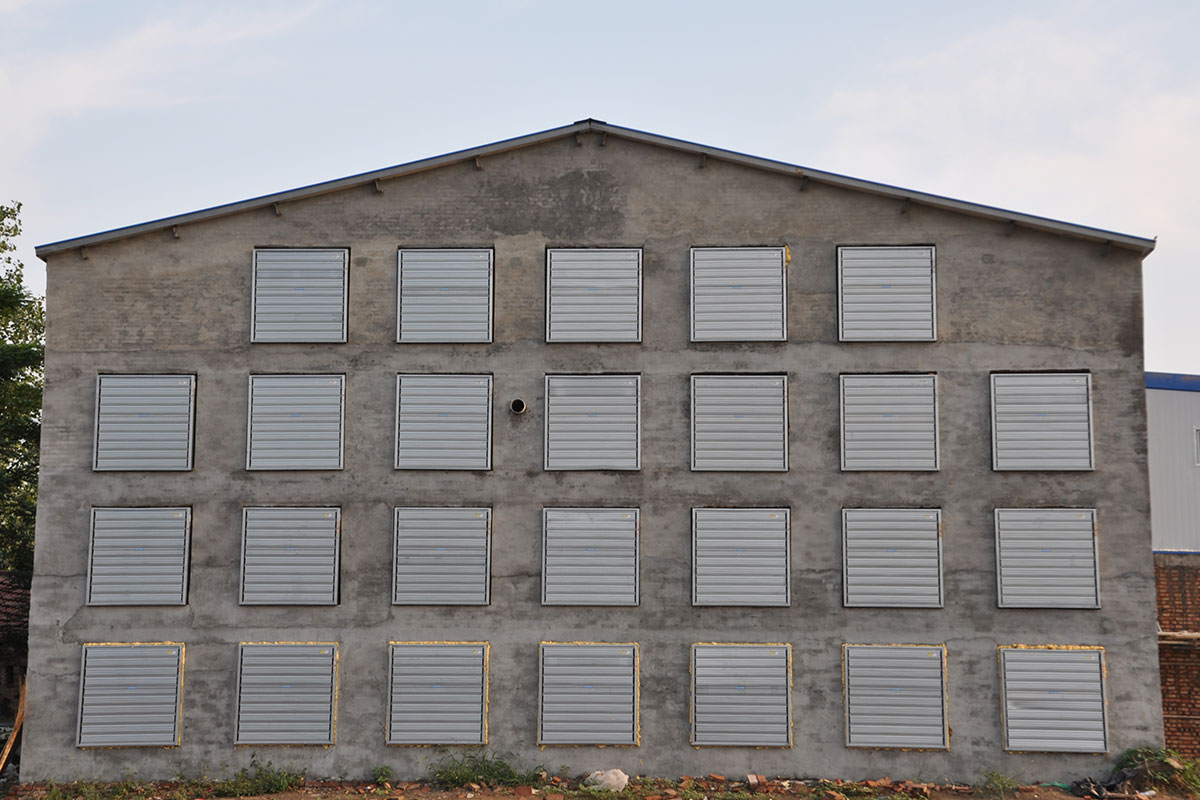
Insufficient air intake area leads to a precipitous drop in fan performance.
Many professionals designing ventilation systems consider negative pressure, but often lack a precise understanding of the optimal number of fans to accommodate a small window area.
If the air inlet is too small, the fan will not operate smoothly, resulting in a significant performance drop. Actual exhaust volume may decrease by 30% or more. A simple analogy can illustrate this: the load on an exhaust fan is like sipping coffee through a thin straw. The more you try to sip it quickly, the harder it is to inhale. No matter how hard you try, you can’t finish it quickly. Using a wider straw, however, makes everything easier and more efficient.
Similarly, when a fan is forced to draw air in through a narrow inlet, the efficiency of indoor and outdoor air exchange is greatly reduced, while power consumption increases significantly.
Where did the hot air go? — The formation of temperature stratification
Heated air becomes lighter and rises; the higher the temperature, the faster it rises. The air emanating from broiler brooders can reach temperatures of 150℉ (approximately 71℃), moving towards the ceiling at a speed of 100 feet per minute (approximately 0.5 meters per second).
Heated air during the brooding period reaches the vicinity of the ceiling in just a few seconds. If you carefully observe the dust and cobwebs adhering to the ceiling, you can even see traces of this airflow. The heat continuously accumulates upwards, eventually forming a sustained heat wave from the ceiling to the ground.
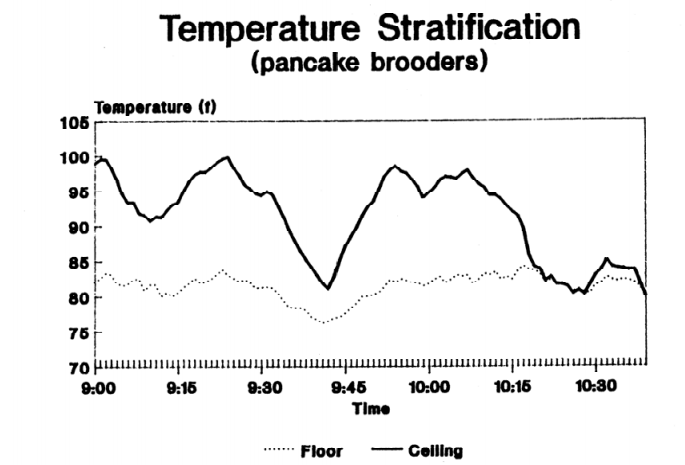
This results in a typical temperature stratification phenomenon: the temperature near the ceiling is much higher than the temperature in the area where the chickens are active on the ground.
Main channels of heat loss
If the ceiling insulation is poor, or if there are holes or drafts in the roof, the heat generated by the brooder will quickly dissipate through the ceiling. In this case, the chickens on the ground will not receive enough heat, resulting in fuel waste and directly affecting their growth environment.
Solution: Bringing Heat "Back to the Ground"
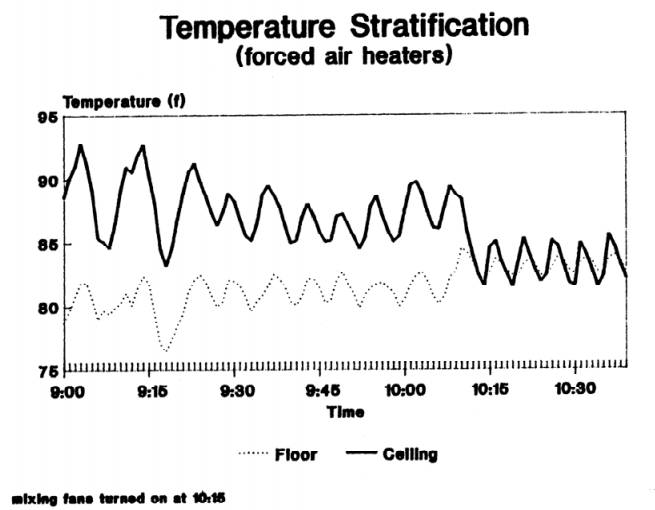
Temperature stratification is not insurmountable. By using hybrid fans, hot air accumulated near the ceiling can be directed downwards, allowing the heat to actually reach the chickens.
Actual tests show that during brooding, the temperature near the ceiling is 20°C higher than the floor temperature.
Regardless of the type of heater used, a significant temperature difference exists between the floor and the ceiling.
By improving roof airtightness and using fans to deliver hot air to the ground, fuel consumption can be reduced by 20%, while simultaneously raising the temperature of the area where the chickens are located by 10-20°F.
Key Points for Using a Mixer Fan
There are many ways to introduce warm air downwards from the ceiling, and a fan-shaped fan is a common method. When using it, please note the following:
Avoid strong airflow directly onto the chickens
The mixer fan should not create excessively strong airflow above the chickens to avoid causing stress.
Set appropriate running time
Ensure the fan has sufficient running time to break laminar flow. It is generally recommended to run it for 1 minute every 10 minutes to effectively mix the air.
Small fans are better than large fans
Using multiple small fans distributed throughout the fan is more effective than a single large fan, ensuring even air mixing without impacting the chickens.
Focus on Key Achievements for Greater Efficiency
Energy conservation has become a crucial factor to consider in poultry farming. Temperature stratification, a hidden form of energy waste, is often overlooked. By understanding the main channels of heat loss and implementing a combination of measures, such as improving roof airtightness and rationally configuring hybrid fans, energy efficiency can be effectively improved, ensuring the health of the flock while achieving tangible fuel savings.