A Comprehensive Comparison Between Egg-Laying Hen Cages and Broiler Cages
Although both layer hen cages and broiler cages belong to the category of chicken cages, they differ significantly in design concepts, structural parameters, usage requirements, and management models. As the poultry farming industry accelerates its transformation towards large-scale, intensive, and intelligent operations, a systematic understanding of the characteristics and selection strategies for these two types of cages is crucial for farmers to make informed decisions.
Basic Concepts of Chicken Cages
Chicken cages are metal mesh fencing systems used in large-scale layer or broiler chicken farming to limit activity space, increase stocking density, and improve management efficiency. They are typically made of welded galvanized steel wire and equipped with automatic feeding, watering, manure removal, and egg collection devices. Currently, the mainstream stacked chicken cages emphasize a balance between structural strength, corrosion resistance, and animal welfare. Some countries are promoting enrichment-type chicken cages, which add perches, laying boxes, and sand baths to meet the behavioral needs of chickens.
1. Definition and Core Functions of Layer Hen Cages
Laying hen cages are a widely used facility for raising laying hens both domestically and internationally. The design of layer hen cages provides chickens with a relatively comfortable confined environment, allowing them to achieve better egg production performance during rearing. Their design advantages are mainly reflected in the design of the front mesh and cage door, cage density, and optimization of the egg rolling angle.
Laying hen cages are usually made of hot-dip galvanized raw materials, which are corrosion-resistant and aging-resistant, with a service life of 15-20 years. In terms of specifications, a single cage is typically 40 cm long, 45 cm deep, 45 cm high at the front, and 38 cm high at the back. The bottom slope is 6°–8°, concave to serve as the egg collection cage; the egg collection trough extending outside the cage is 12–16 cm. Each single cage can hold 3–4 chickens.
2. Comparison of Main Types
Ladder-type layer hen cages (Type A cages): The cages in each layer are arranged in an A-shape. This is one of the earliest types of layer hen farming equipment used. Advantages include large open areas on each floor, good ventilation and lighting, making it suitable for small and medium-sized farms in humid or high-temperature climates, and easy maintenance. Disadvantages include relatively low stocking density and large footprint.
Stacked Layer Cages (H-type cages): These cages are stacked like buildings, and have become the mainstream choice for large-scale farms in recent years. For farms with more than 50,000 birds, H-type stacked cages are the best choice. The hot-dip galvanized material is durable and rust-proof. A single unit can have 4-8 layers, with a stocking density of over 60 birds/square meter, and the broken egg rate can be controlled below 0.5%. However, it is worth noting that some H-type systems may experience frame tilting after three years of operation due to insufficient structural design, affecting the accuracy of the automatic egg collection line. Therefore, it is essential to pay attention to the structural mechanics design and material quality of the equipment when purchasing.
3. Market Prices and Selection Strategies
The price gradient for equipment for the two main categories of laying hens and meat poultry is clear, with price differences of 30%-50% for different configurations within the same category. Taking large-scale egg-laying farms as an example, the overall price difference between basic stacked cage systems and a complete system including AI inspection, intelligent environmental control, and intelligent egg processing is several times greater. Therefore, rational procurement should focus on the total life-cycle cost, i.e., the equipment purchase price plus installation and commissioning fees, operation and maintenance fees, and energy costs minus residual value.
General purchasing recommendations: For large-scale farms with more than 50,000 birds, stacked (H-type) cages are the best choice; for medium-scale farms with 10,000 to 50,000 birds, tiered (A-type) cages are more suitable.
1. Definition and Core Functions of Broiler Cages
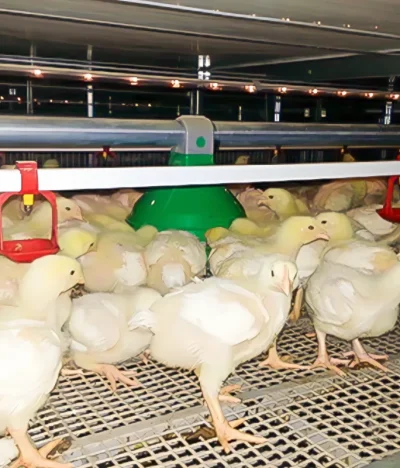
Broiler cages are specifically designed for intensive broiler farming. They are constructed from galvanized cold-drawn steel or high-quality plastic, using a multi-layered stacked structure (mainly 3-4 layers) to achieve high-density rearing. They are equipped with automatic feeding, watering, and manure removal systems. Cage rearing eliminates the need to move chicks from cage to market, reducing stress from handling and lowering disease rates through centralized management.
A single broiler cage measures approximately 140×70×28 cm. Hot-dip galvanizing ensures a lifespan of 15-20 years. Unlike layer cages, broiler cages have a flat bottom mesh without any angled slope, effectively preventing breast cysts. Broiler cages generally hold more chickens than layer cages, with 10-20 broilers per cage. The cage dimensions are 800-1000 mm long, 500-600 mm wide, and 300-400 mm high.
2. Main Types and Technical Standards of Broiler Cages
Stacked Broiler Cages (Layer Cages): Currently the mainstream choice for white-feathered broiler farming. Using stacked cages efficiently utilizes space, increasing the capacity of a single chicken house from the traditional 10,000-20,000 to 30,000-60,000, and the capacity per person from 5,000 to a maximum of 100,000, significantly improving efficiency and profitability. Stacked cages are recommended, generally 3-5 layers are suitable. The material should be galvanized for rust prevention, structural stability, and a service life of over 15 years. The layer height should be no less than 35 cm, and a single cage can bear a weight of up to 15 kg, suitable for broilers with a slaughter weight of 2.5-3 kg.
Tiered Broiler Cages: One of the early three-dimensional farming models, generally with 3 or 4 layers, arranged in a stepped pattern. Suitable for farmers and small farms, but with low land utilization and limited automation.
3. Stocking Density and Space Requirements
In the three-dimensional broiler farming model, each adult chicken should occupy no less than 0.05 square meters of space, meaning the number of chickens per square meter of cage floor area should be less than 20, ensuring adequate space until slaughter. Stocking density should be appropriately reduced during hot seasons. The chicken house should generally be 80-90 meters long and 15-18 meters wide, with a 0.9-1.5 meter aisle between each group of cages. A 0.35-0.5 meter ventilation duct should be provided between the two rows of cages in a single group. Individual cages should be 0.7-0.9 meters wide and 1.1-1.4 meters long.
4 Core Advantages of Broiler Cages
Compared to free-range farming, broiler cage farming has significant advantages: High degree of automation, with automatic feeding, watering, and manure removal reducing labor costs; better disease prevention, as chickens do not come into contact with feces, and the clean growing environment effectively prevents infectious diseases; space saving, with cage-raising density being more than 3 times higher than free-range; and reduced feed consumption, as cage-raised chickens require less movement and consume less energy, saving over 25% in farming costs.
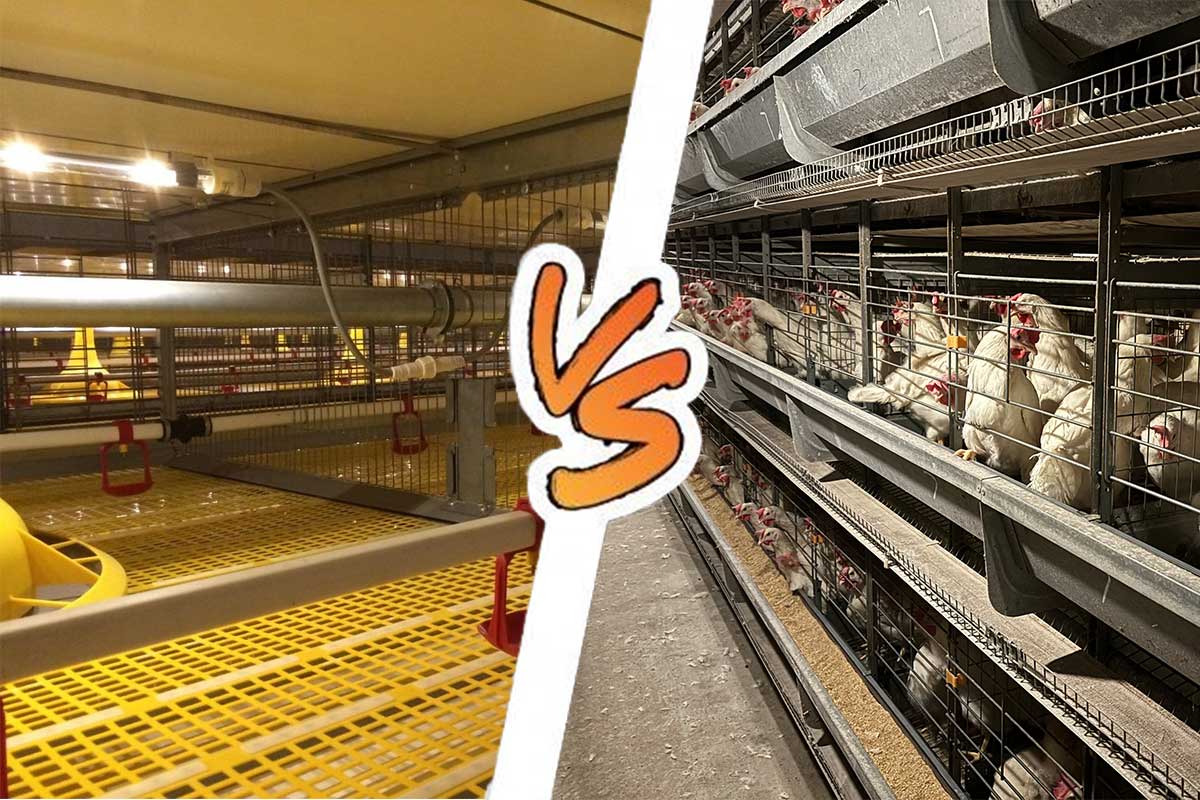
Comparison of the Core Differences Between Layer Chicken Cages and Broiler Chicken Cages
| Comparison Dimensions | Laying hen cages | Broiler cages |
| Design Objectives | Focus on egg production rate and egg quality | Focus on weight gain rate and feed conversion ratio |
| Bottom Mesh Structure | Surrounded by an incline (6°-8°) and equipped with egg collection troughs | Flat bottom mesh, no egg collection device |
| Stocking Density | 3-4 birds per cage, relatively low density | 10-20 birds per cage, high density |
| Rearing Cycle | 400-600 days (long-term rearing) | 42-100 days (short-term market size) |
| Single Cage Size | Approximately 40×45×45cm | 80-100×50-60×30-40cm |
| Load-Bearing Requirements | Relatively lightweight, focus on durability | Higher weight-bearing requirements (market weight 2.5-3kg) |
| Key Performance Indicators | Breakage rate, egg production rate | Fed-to-meat ratio, growth rate, survival rate |
The fundamental difference between the two types of cages stems from different breeding objectives: broilers grow and develop quickly with a short rearing cycle, so the focus is more on weight gain efficiency and feed conversion ratio; laying hens, on the other hand, require long-term rearing, so the focus is more on egg production frequency, egg quality, and equipment durability. The design and construction of broiler cages are generally similar to those of laying hen cages, but there are significant differences in bottom mesh slope, number of chickens per cage, and size specifications.
Regarding material requirements, both types of cages are recommended to be made of hot-dip galvanized steel wire or high-quality plastic to ensure corrosion resistance, aging resistance, and long service life. The mesh spacing of the bottom mesh in laying hen cages is approximately 2.2 cm, while the mesh size of the bottom mesh in broiler cages is adjusted according to the age of the chickens: approximately 10×10 mm for chicks and 18×28 mm for mid-stage chicks.
Although laying hen cages and broiler cages share some commonalities, their design details, structural parameters, and selection strategies differ significantly due to differences in breeding objectives, physiological needs, and production models. When choosing cages, farmers need to make rational investment decisions based on the full life-cycle value, taking into account their own farming scale, financial strength, regional climate conditions, and future intelligent transformation plans. Looking ahead, with the continuous development of AI, IoT, animal welfare policies, and green materials, chicken cages will be upgraded from simple feeding containers to precision livestock management platforms, seeking a higher technological balance between sustainable protein supply and animal welfare consensus.