Centralized Egg Collection Line: A Key System for Large-Scale Egg Farms
In modern egg-laying hen farming, simply relying on egg-collecting machines within the henhouses to remove eggs from cages is far from sufficient. The key to reducing labor costs and improving fresh egg quality lies in how to quickly and safely transport eggs from multiple henhouses to the egg storage facility. We will systematically introduce the function, composition, specifications, and operating parameters of a central egg collection line to help you build an efficient and labor-saving egg transport network across the entire farm.
I. The Role of a Centralized Egg Collection Line
A centralized egg collection line primarily addresses two major pain points: high costs associated with manual egg collection and breakage due to frequent transfers.
It directly transports eggs from the chicken house (single or multiple houses) to the egg storage facility, eliminating the need for manual trolley transport.
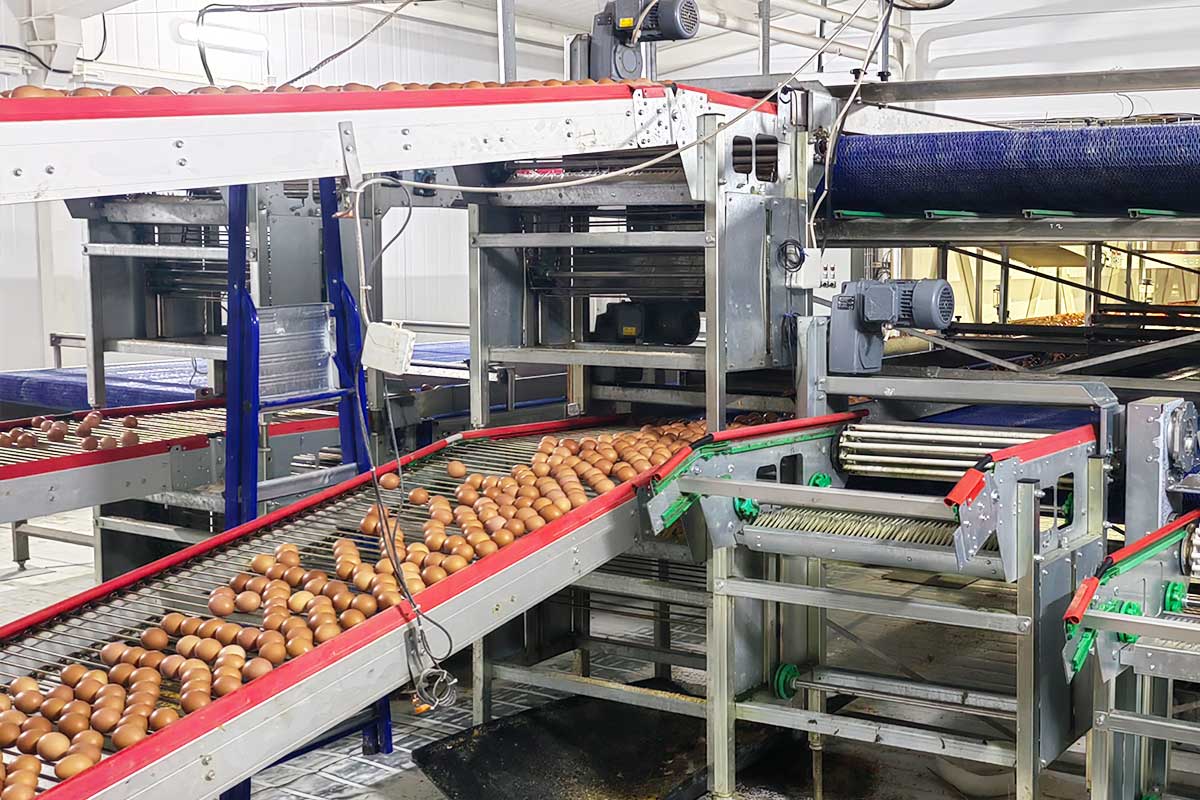
It connects to the exit egg conveyor belt of the front-end egg collection machine, achieving full automation of “egg collection → aggregation → grading → packaging.”
It significantly reduces labor costs: 10,000 chickens require approximately 8,000 eggs to be collected daily, necessitating multiple trips for manual handling. A centralized egg collection line, once built, provides benefits for many years.
This solution is currently widely used in single or multiple chicken houses with stacked layer cage systems for egg production.
II. Core Components of a Central Egg Collection Line
A complete central egg collection line consists of the following key components, none of which can be omitted:
| Components | Functional Description |
| Front drive | Located at the beginning of the egg conveyor, providing the main power, typically connected to the outlet of the egg collection machine in the henhouse. |
| Incline adjustment | When the egg conveyor crosses different height differences (such as steps or pipes from the henhouse to the egg storage), a slope adjustment device ensures a smooth transition for the eggs. |
| Intermediate drive | When the egg conveyor length exceeds 80 meters, an intermediate drive is added to compensate for power attenuation and prevent the chain from sagging. |
| Arch | Achieves horizontal or vertical turns, allowing the egg conveyor to bypass obstacles such as pillars and passageways. |
| Tail end | Located at the end of the egg conveyor, connecting to the grading or washing machine inlet in the egg storage, including a tensioning device. |
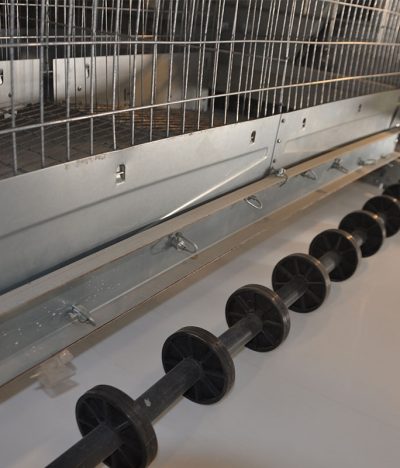
| Guide rail | C-shaped or L-shaped tracks that carry the chain and eggs, with a smooth and wear-resistant surface. |
| Chain | Dedicated plastic roller chain, each link equipped with egg claws or push plates, directly propelling the eggs forward. |
All components are made of hot-dip galvanized or stainless steel, making them suitable for the high humidity and slightly acidic environment of poultry houses.
III. Two Mainstream Specifications: Model 540 and Model 750
Based on the size of the chicken coop and the transmission distance, central egg collection lines are mainly divided into model 540 and model 750. The core differences between the two are as follows:
| Comparison Items | Model 540 | Model 750 |
| Applicable Scenarios | Short-distance transfer within a single building or between two buildings | Long-distance egg transport from multiple sheds in large-scale farms to a central egg storage facility |
| Typical Width/Size | Smaller, suitable for single-building egg production | Larger, with wider chains and rails, resulting in greater load capacity |
| Theoretical Maximum Egg Collection (eggs/hour) | 30,000 eggs | 50,000 eggs |
| Recommended Matching Chicken House Size | Single building with up to 30,000 birds | Multiple sheds can be used simultaneously for farms with a capacity of 50,000 or more birds. |
Selection Recommendation: If you only have one chicken house and your daily output is less than 30,000 eggs, the 540 model is sufficient; if you plan to expand to multiple houses in the future or directly supply large egg processing plants, please choose the 750 model to reserve a margin.
IV. Operating Speed and Theoretical Capacity
Unified Operating Speed: 7 meters/minute
This speed has been extensively tested and proven to ensure sufficient egg transport per hour while preventing eggs from colliding with each other on the guide rails due to excessive speed.
Theoretical Egg Collection Capacity:
Type 540: 30,000 eggs/hour
Type 750: 50,000 eggs/hour
Actual egg collection capacity is affected by factors such as egg size, smoothness of the egg conveyor belt connection, and number of turns. It is generally recommended to schedule daily operations at 80% of the theoretical value.
V. Installation and Maintenance Points
Slope Control: The maximum allowable slope is 15° per 10 meters; if it exceeds this, a slope adjustment plate must be installed and the chain speed reduced.
Turning Radius: The radius of a circular turn should be ≥1.5 meters to prevent eggs from accumulating at bends.
Chain Tension: Check the end tensioner monthly to ensure the chain sag does not exceed 20mm.
Daily Cleaning: Use a soft brush to remove dust from the chain and guide rails to prevent roller jamming.
VI. Frequently Asked Questions (FAQ)
Q: Can a central egg collection line connect multiple chicken houses simultaneously?
A: Yes. Using the 750 model, multiple front or intermediate drives can be connected to the egg collection machine outlets of different chicken houses, ultimately converging into a single main egg collection line to deliver eggs to the egg storage.
Q: What if there is a power outage or motor failure?
A: It is recommended to configure a manual crank interface, allowing temporary manual cranking of the drive to empty the eggs on the line and prevent spoilage.
Q: Can the guide rails of the 540 and 750 models be used interchangeably?
A: No. The chain pitch and guide rail cross-sections of the two models are different; standardized specifications must be used when selecting models.
From egg collection machines in single chicken houses to a central egg collection line covering the entire farm, this is an essential step in the industrialization of egg-laying hen farming. The 540 model is suitable for small to medium-sized single-house precision egg delivery, while the 750 model provides a cost-effective solution for multi-house linkage in large-scale farming groups. With a golden speed of 7 meters per minute and a theoretical production capacity of up to 50,000 eggs per hour, your eggs arrive at the egg storage facility “without touching the ground, without backlog, and without breakage.” For on-site surveys or customized layout designs, please feel free to contact us.