Should Intermittent Ventilation or Continuous Low-Volume Ventilation Be Used for Poultry Houses in Winter?
In winter, poultry house ventilation is not merely a choice between “intermittent” and “continuous low-volume” modes; rather, it depends on factors such as the building’s airtightness, the pressure-handling capacity of fans operating at low speeds, and the airflow patterns and control precision of the air inlets. For houses that utilize negative-pressure ventilation via air inlets—where winter ventilation requirements are low and some air leakage is inevitable—well-managed intermittent ventilation is often more effective. It ensures that the limited volume of incoming fresh air follows a predetermined path, mixes thoroughly, and reaches the area surrounding the flock.
However, for intermittent ventilation to be successful, it must be integrated with efforts to seal air leaks, precise adjustment of air inlets, and proper controller settings. Furthermore, one must observe the behavior of the flock and the internal environment throughout a complete ventilation cycle to effectively minimize the risk of the birds becoming chilled and to reduce temperature variations within the house.
For poultry houses with significant air leakage, low winter ventilation requirements, and air intake via small, negative-pressure-operated inlets: Intermittent ventilation is generally more effective for establishing sufficient negative pressure. This allows the inlets to generate proper air jets, ensuring that the limited supply of fresh air reaches the vicinity of the flock.
For poultry houses with good airtightness—where fans can maintain adequate pressure even at low speeds, and air inlets provide effective airflow distribution even at low flow rates: Continuous, low-volume ventilation is also a viable option. However, this approach places higher demands on the fans, the air intake system, and the level of control.
Regardless of the method chosen, the first step in adjusting winter ventilation is to check for and seal any air leaks. Intermittent ventilation is not a substitute for sealing leaks.
Running the Fan at a Low Speed Continuously May not Necessarily Deliver Fresh Air Effectively
In an ideal winter ventilation scenario, cold air enters through small wall inlets, travels along the ceiling, mixes with the warmer air above—gradually increasing in temperature—and only then reaches the area occupied by the birds. Achieving this requires the incoming air to have the appropriate velocity, direction, and jet thickness.
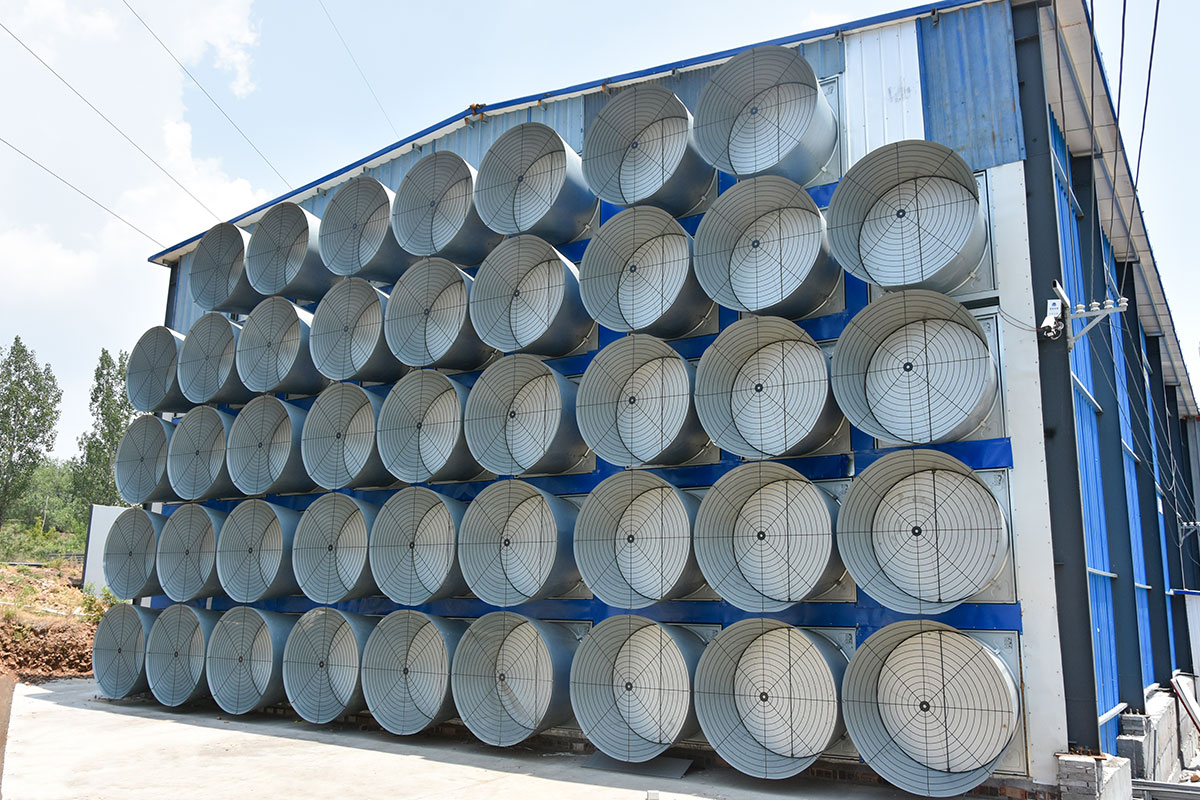
In practice, however, it is difficult to make a poultry house completely airtight. Gaps around doors, joints in the walls, louvers on idle exhaust fans, and areas where evaporative cooling pads are sealed can all become unintended air inlets. When the total exhaust rate is low, these leaks can account for a significant portion of the total airflow. Consequently, even though the exhaust fans remain in operation, the house fails to develop the necessary negative pressure, and the air entering through the designated inlets lacks sufficient velocity. Cold air may enter directly through low-level gaps or sink immediately upon entering through the wall inlets, reaching the birds before it has had a chance to mix and warm up.
Technical resources from the University of Georgia also note that air leakage is a major reason why it is difficult to maintain proper airflow patterns through wall inlets when exhaust fans are running at low, continuous rates. While the average ventilation volume may appear modest, the birds may still be subjected to significant, localized cold drafts.
The Value of Intermittent Ventilation
The concept of intermittent ventilation involves providing sufficient exhaust capacity when the fans are running—ensuring that air enters through small, appropriately opened inlets to create effective air jets—while controlling the average ventilation rate by adjusting the ratio of fan run-time to off-time.
To illustrate: Suppose a set of fans delivers an airflow of 30,000 cubic meters per hour under actual operating negative pressure. If these fans run for 1 minute and remain off for 4 minutes in a 5-minute cycle, the theoretical average ventilation rate is 6,000 cubic meters per hour. While this yields the same average ventilation volume as a fan running continuously at 6,000 cubic meters per hour, the conditions at the air inlets during operation may differ significantly.
Intermittent ventilation effectively separates two distinct tasks:
Using the airflow during the “on” phase to manage air distribution (airflow patterns).
Using the cycle of operation and downtime to regulate the average ventilation rate.
Operating a larger fan capacity for shorter intervals allows for the establishment of the required negative pressure while maintaining an optimal opening size for the air inlets. However, it is crucial to note that intermittent ventilation cannot serve as a substitute for sealing air leaks. If a poultry house has significant air leaks, simply increasing fan capacity will only result in more cold air being drawn in through those gaps.
High Negative Pressure Does not Necessarily Mean a Longer Jet Reach
When poultry farmers notice cold air descending too early, their first instinct is often to narrow the air inlets and increase negative pressure. However, this does not always solve the problem. While narrowing the inlets may increase air entry velocity, it also results in a thinner air jet. If the opening is too small, the direction of the incoming airflow may shift, disrupting its intended path along the ceiling.
Determining the reach of an air jet requires looking beyond just negative pressure; one must also consider:
The actual opening size of the inlets and the resulting thickness of the air jet.
The orientation of the deflectors and the positioning of the air inlets relative to the ceiling.
The temperature differential between the inside and outside, the width of the poultry house, and any obstructions along the ceiling.
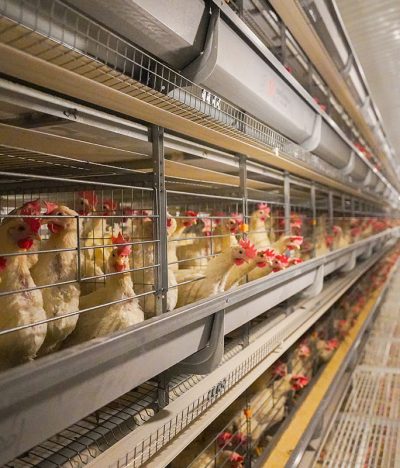
During periods of low ventilation, the system can be configured to open only a specific, evenly distributed subset of inlets. This allows the active inlets to maintain an appropriate opening width, rather than forcing all inlets to be narrowed down to a mere slit. It is essential, however, to ensure that air distribution remains uniform throughout the entire house to avoid “dead zones” with poor ventilation. In cage-rearing facilities, special attention must be paid to how the upper tiers of cages, structural beams, and equipment affect airflow. Even if the temperature at floor level appears normal, the birds in the upper tiers may still be exposed to direct, cold drafts.
FAQ
Q1: For winter ventilation in a poultry house, should one choose intermittent ventilation or continuous low-volume ventilation?
It depends on the conditions of the poultry house. For houses with significant air leaks, low winter ventilation requirements, and air intake via negative-pressure wall inlets, intermittent ventilation is often more effective for managing airflow. For well-sealed houses—where fans can maintain sufficient pressure at low speeds and wall inlets are configured to ensure proper airflow distribution—continuous low-volume ventilation is also a viable option.
Q2: Is intermittent ventilation as simple as connecting a timer to the exhaust fans?
No. Because fans start up quickly while wall inlets adjust slowly, a controller is required to coordinate the process: setting the inlet positions before the fans start, adjusting based on negative-pressure feedback during operation, and managing the return of inlets to their default positions and the engagement of fan backdraft shutters when the fans stop. This helps minimize undesirable airflow patterns.
Q3: Does higher negative pressure always result in a longer “throw” (reach) for the incoming cold air jet?
Not necessarily. While reducing the opening of a wall inlet may increase air velocity, it also thins the air jet; if the opening becomes too small, it may even alter the direction of the incoming airflow. The actual reach depends on a combination of factors: the inlet opening size, the thickness of the air jet, the orientation of any deflectors, the configuration of the ceiling, the temperature differential between the inside and outside, and the width of the poultry house.
Q4: Is a 5-minute cycle a fixed standard for intermittent ventilation?
A 5-minute cycle—comprising the total duration of both the “on” and “off” phases—is a common reference, not a rule that the system must remain off for 5 minutes. In practice, the cycle should be adjusted based on the specific poultry house, the fan-inlet configuration, the response time of the inlets, and air quality; it should not be applied rigidly.
Q5: Can intermittent ventilation serve as a substitute for sealing air leaks in a poultry house?
No. If a poultry house has significant air leaks, simply increasing fan capacity will only draw more cold air in through the gaps. When managing ventilation in winter, the first step must always be to check and ensure the building is properly sealed.