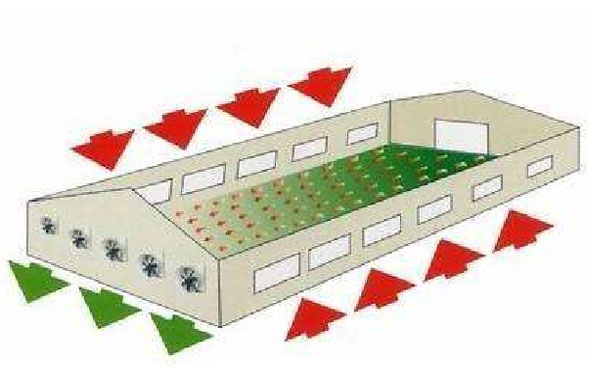
Natural ventilation relies on the wind pressure of natural wind and the heat pressure of the temperature difference inside and outside the chicken house to form a natural flow of air so that the air inside and outside the house can be exchanged. Generally, open chicken houses use natural ventilation, and the air is circulated and exchanged through ventilation belts, windows, and air towers. It is difficult for natural ventilation to discharge the heat and harmful gases in the chicken house. Mechanical ventilation can rely on mechanical power to force the air inside and outside the house to exchange and generally uses axial flow fans. Ceiling fans or wall fans can only circulate the air in the chicken house, and cannot completely discharge the heat and harmful gases.
NO2 Negative Pressure Ventilation
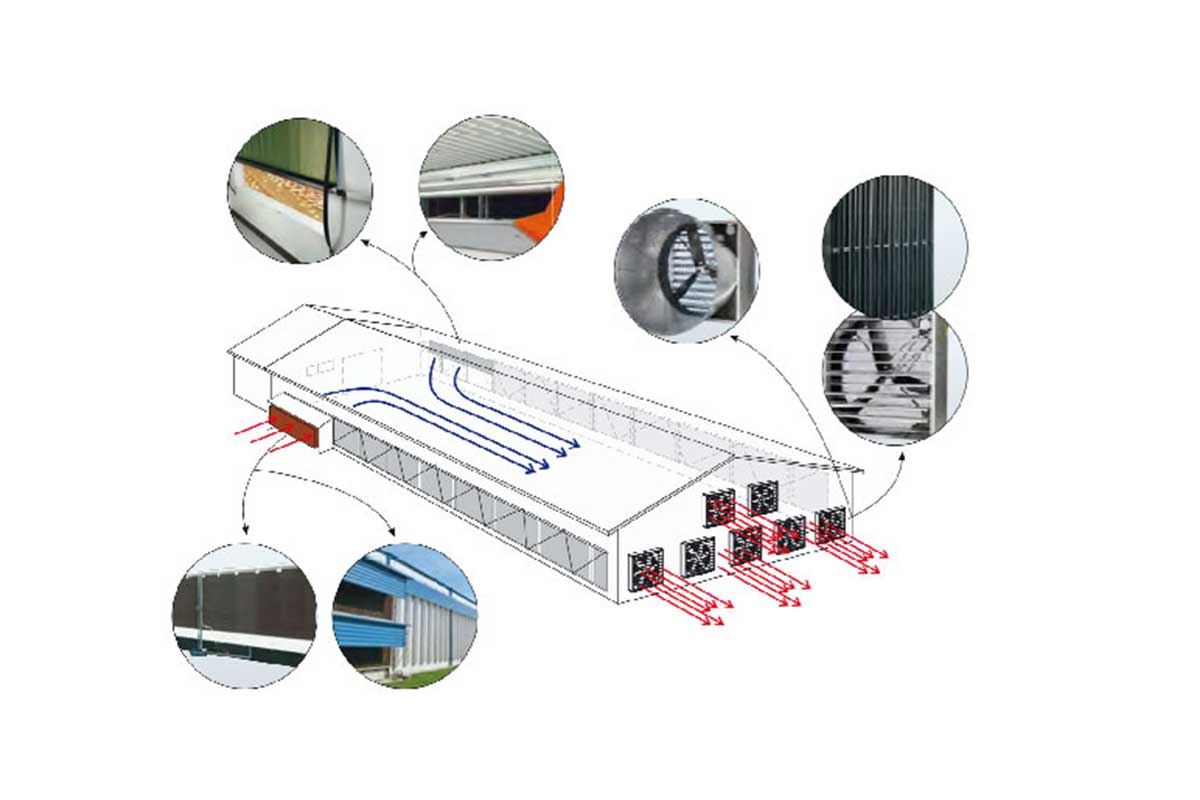
Negative pressure ventilation uses exhaust fans to forcibly discharge the dirty air out of the chicken house, creating negative pressure in the building, so fresh air enters the chicken house from the air inlet. Negative pressure ventilation requires less investment and is relatively simple to manage. The airflow speed entering the chicken house is slower, and the chickens feel more comfortable. Therefore, it is widely used in the ventilation of closed chicken houses. Positive pressure ventilation uses a fan to force air into the chicken house, and the air outlet is adjusted accordingly so that the air outlet is slightly less than the air inlet so that a small positive pressure is generated in the chicken house. Air is usually delivered to various points in the chicken house through the ducts installed longitudinally in the chicken house.
NO3 Longitudinal Ventilation
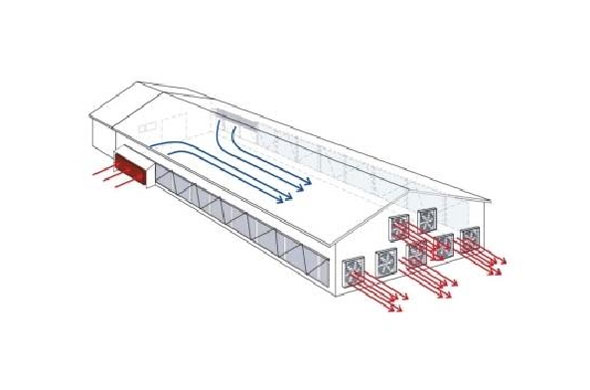
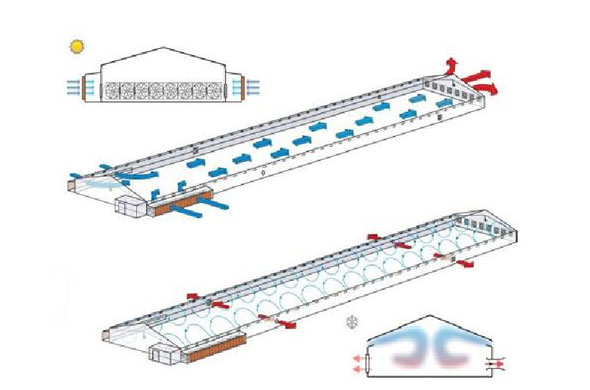
Longitudinal ventilation is to install all the exhaust fans on the gable at one end of the chicken house, or on the two side walls near the gable, and the air inlet is on the other side of the gable or the two side walls close to the gable. There are no doors and windows in different parts of the chicken house or the doors and windows are closed, and the air flows along the longitudinal axis of the chicken house. To prevent light transmission, the air inlet of the closed chicken house is equipped with a light shield, and the exhaust outlet is equipped with a bend or a brick-built light shielding hole. The air inlet wind speed is generally required to be 2.5-5.0 m/s in summer and 1.5 m/s in winter. The airflow in the chicken house with horizontal ventilation is not uniform, the airflow speed is low, and there are many dead corners, so the air is not fresh enough, so it is rarely used.
The best ventilation method is pressure longitudinal ventilation
The most widely used and effective ventilation method is negative pressure longitudinal ventilation. This ventilation method combines the advantages of negative pressure ventilation and longitudinal ventilation, so there are no ventilation dead corners in the chicken house, which can reduce the temperature inside the house and discharge harmful gases out of the house.