Fully automatic feeding system for laying hen cage equipment
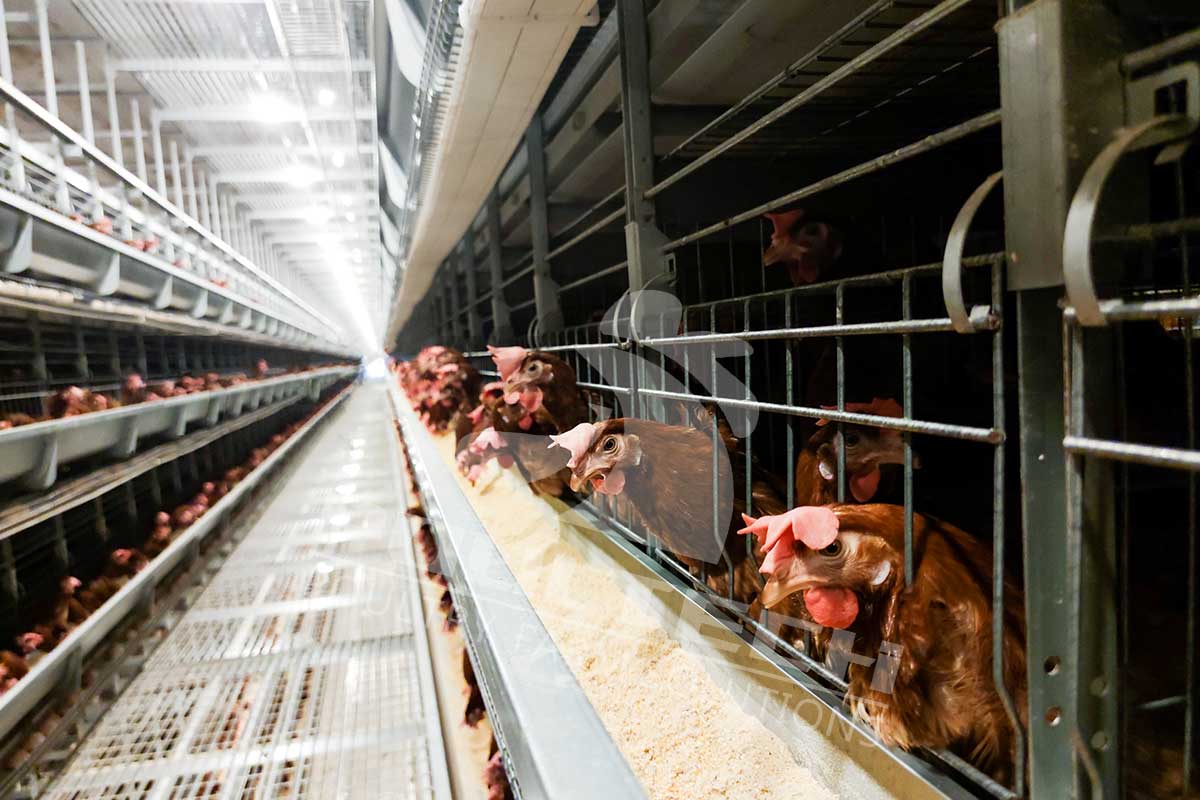
The feeding system of fully automatic laying hen cage equipment can be divided into chain feeding system and driving feeding system. With its advantages of high space utilization, strong environmental controllability and significant production efficiency, it has become the mainstream choice for modern laying hen farming. As the core equipment to ensure the nutritional supply of the flock, the rationality of the design of the feeding system directly affects the feed conversion rate, the health of the flock and the breeding benefits.
Taking a 4-row 6-layer stacked chicken house as an example, a single chicken house can raise 60,000 laying hens. The feeding system needs to achieve precise indicators such as 8-12 meters per hour feed line speed, powder residue ≤4.7%, and feeding uniformity error ±0.3 mm. After the upgrade of a 9-layer ladder cage, the feed waste per batch was reduced by 11%, and the peak feeding power was reduced from 2.5kW to 1.8kW, which fully verified the economic value of the efficient feeding system.
Feeding system structural design principle
The structural design of the cage feeding system needs to take into account mechanical efficiency, feed distribution uniformity and animal behavior requirements. The core modules include:
1. Power transmission system
● A permanent magnet motor + light sprocket combination is used, equipped with an independent shock-absorbing base to achieve low noise (≤65 decibels) and low energy consumption operation.
● The spiral blade is designed as a gradient density structure: 18 blades are arranged per meter in the front 40 cm area for arch-breaking transportation, and 24 blades are arranged in the rear section for fine material distribution to ensure the fluidity of the powder.
2. Feeding pipeline and partition control
● The pipeline is embedded with infrared sensors to detect the material level in real time. When the material volume reaches the threshold, the diversion valve is automatically closed to avoid overflow.
● The tower feeding guide rail is equipped with a two-way anti-shake buckle, and the pipe diameter is dynamically adjusted to 8-12 cm according to the step slope to adapt to different floor height requirements.
3. Cage adaptation and anti-waste design
● The diamond grid bottom plate is tilted 8 degrees, and the front serrated edge is folded to prevent picky chicken chop material.
● In view of the differences in body sizes of young chickens and laying hens, we have launched telescopic slide rail and fixed depth feeding troughs. The adjustment components are equipped with color-coded nut handwheels to facilitate quick maintenance.
Working principle
The cage feeding system realizes full automation through the three-level linkage of “central control host-conveyor belt-partitioned feed trough”:
1. Feed storage and transportation
● The bulk feed truck transports the feed to the feed tower outside the chicken house, and the horizontal feed device delivers the feed to the feeding hopper of each row of cages at the set time.
2. Dynamic feeding control
● The feeding trolley runs backward at the set time, and each layer of hopper corresponds to a feed trough, and the spiral blades evenly drop the feed.
● After the chickens finish eating the feed, the trolley automatically returns to the front end to reload the feed, completing a feeding cycle (the number of daily feedings is adjusted according to the process).
3. Environmental adaptability adjustment
● When the temperature is high in summer, the system automatically switches to the thin feeding mode, and cooperates with the wet curtain to reduce heat stress; when the temperature is low in winter, the feed tower is heated to prevent feed caking.
The intelligent upgrade of the feeding system for laying hens in high-rise cages has not only significantly improved the breeding efficiency (the feeding volume per unit area has increased by 3-5 times, and the feed conversion rate has been optimized by 15%-20%), but also promoted the transformation of the industry towards low-carbon, precise and sustainable development. Its technical path is replicable for small and medium-sized farms: