Precision Environmental Control for Single-Building Chicken Houses With a Capacity of 50,000 Birds
With the intensifying trend of global warming, extreme heat waves are becoming more frequent in summer. For large-scale egg-laying farms with tens of thousands of chickens per shed, the heat dissipation difficulties and heat stress caused by high-density rearing environments are amplified exponentially. If not properly managed, this can lead to a chain reaction of drastic drops in egg production, deterioration of eggshell quality, and increased mortality.
Laying hens are homeothermic animals, covered in feathers and lacking sweat glands, relying primarily on respiration, evaporation, and excretion for heat dissipation. Their optimal environmental temperature is 18–25℃, with a relative humidity of 55%–65%. Studies have shown that: When the temperature reaches 28℃: the flock experiences mild heat stress, with decreased feed intake and increased respiratory rate.
When the temperature exceeds 32℃: the flock enters a severe heat stress stage, with egg production decreasing by 0.5%–1% daily, and the proportion of broken eggs doubling.
Sustained temperatures above 35℃: can trigger widespread acute heatstroke deaths.
For example, a single shed housing 50,000 chickens can produce over 45,000 eggs per day. A 1% decrease in egg production rate translates to a direct loss of hundreds of eggs per day. Coupled with mortality and reduced feed conversion rates, the economic losses are magnified exponentially.
Therefore, large-scale egg farms must establish a systematic, standardized, and parameterized high-temperature control system.
I. Environmental Control System: Constructing a Physical Barrier for Precise Temperature and Humidity Control
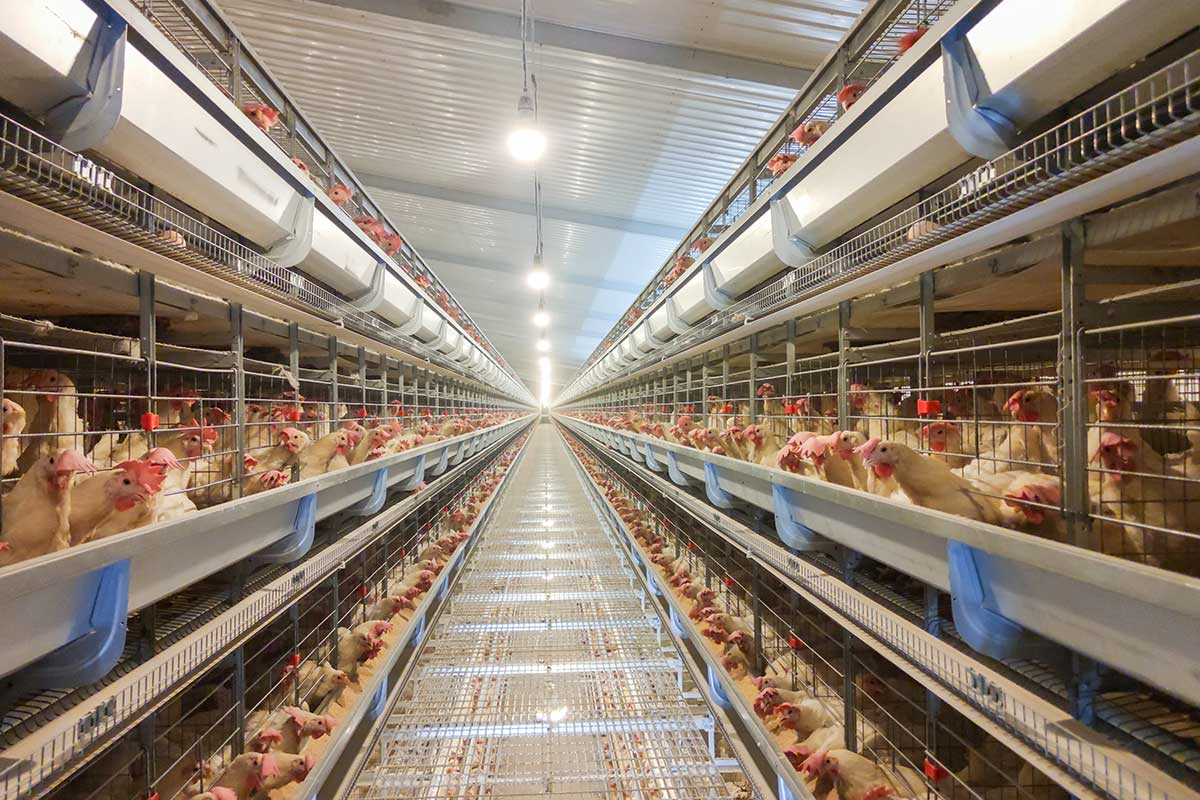
Environmental control is the first line of defense against heat stress. For enclosed, multi-tiered cage chicken houses, mechanical ventilation and evaporative cooling are essential engineering methods to stabilize the indoor environment within safe thresholds.
1. Longitudinal Ventilation
Longitudinal ventilation is the standard practice in large-scale chicken houses during the summer. Its principle is to reduce the perceived temperature of the chickens through the wind-cooling effect generated by high wind speeds.
Fan Configuration Standard: For well-sealed commercial layer chicken houses, one 1400-type fan (rated air volume approximately 52,000 m³/h) is required for every 1500-2000 laying hens. For a scale of 50,000 chickens, 25-35 fans are needed to ensure an air velocity of 1.8-2.5 m/s in the central aisle of the chicken house.
Key Data: When the wind speed reaches 2 m/s, the perceived temperature for chickens can be reduced by 4-6℃; if the wind speed is less than 1.5 m/s, the cooling effect will be significantly reduced.
Graded Start-Stop Strategy: Establish a dynamic mechanism based on house temperature.
Daytime ≥28℃: Turn on all longitudinal fans, providing negative pressure ventilation throughout.
Nighttime below 24℃: Keep 1/3 of the fans running at low speed to prevent heat buildup in the shed.
It is strictly forbidden to operate only some fans during high-temperature periods, otherwise the temperature difference between the front and back of the chicken house will exceed 5℃, creating a “sauna-like” environment at the front and a “cold” environment at the back.
Daily Maintenance Points: 1 mm of dust accumulation on the fan blades can reduce airflow by more than 10%. Dust on the louvers must be cleaned daily, and belt tension checked. At the same time, all air leaks in doors, windows, and openings must be sealed—for every 10% increase in air leakage, the effective wind speed decreases by approximately 15%.
2. Evaporative Cooling
Under normal operating conditions, an evaporative cooling pad-fan system can lower the temperature in the chicken house by 4-8℃, but improper use can have the opposite effect.
Selection and Ratio: In hot and humid southern regions, a 15cm thick evaporative cooling pad is recommended; in drier northern regions, a 10cm thick pad is suitable. The ratio of fan area to evaporative cooling pad area should be controlled at 6-8:1.
Temperature and Humidity Linkage (Crucial): Strictly adhere to the principle of “ventilation first, water supply later.”
Activate the evaporative cooling pads when the outside temperature is ≥30℃ and the humidity is below 70%.
When the outside humidity exceeds 75%, the evaporative cooling pads must be turned off, and only the fans should be turned on to avoid creating a “high temperature and high humidity” environment that inhibits heat dissipation from the chickens’ respiration.
Using an intermittent water supply mode (3 minutes of water supply, 5-8 minutes of water stoppage) is more water-efficient and has a better cooling effect than continuous water supply.
Water Quality Maintenance: It is recommended to use deep well water at 20-25℃ for the evaporative cooling pads. Clean the pool weekly and add antibacterial agents to prevent algae from clogging the paper structure.
3. Passive Insulation
Building insulation can significantly reduce the load on fans and evaporative cooling pads.
Roof Insulation: Cover the entire roof of the chicken coop with shade netting, installed at 50-80 cm intervals to form an air insulation layer, which can reduce the roof temperature by more than 10°C and lower the base temperature inside the coop by 2-3°C.
White roofs have a surface temperature 15-20°C lower than dark-colored roofs.
Wall Shading: Apply heat-insulating paint or install sunshades on the west and south walls. Do not pile up debris near the air inlets to obstruct airflow.
II. Feeding Management
While environmental cooling addresses the “external factor,” scientific feeding management addresses the “internal factor”—reducing the chickens’ own heat production and improving their heat tolerance.
1. Feeding Plan: Avoid High Temperatures, Provide Supplemental Light at Midnight
High temperatures generally reduce feed intake by 10%–20%, a direct trigger for decreased egg production.
Staggered Feeding System: Eliminate feeding during the high-temperature period of 11:00–16:00. It is recommended to feed four times daily, concentrated at 5:00 AM, 9:00 AM, 18:00 PM, and 22:00 PM. Feeding in the early morning and evening should account for more than 70% of the total daily intake.
Midnight Supplemental Lighting (Golden Operation): Utilize the nighttime cooling window by turning on lights for 1–2 hours between 0:00 and 2:00 AM to encourage the flock to drink and eat. This measure can increase daily feed intake by 5–8 grams per bird and significantly improve eggshell quality. Note that the flock must have at least 8 hours of continuous darkness.
Feed trough management: Clean the feed troughs around 2:00 PM to prevent feed from accumulating in the troughs for more than 6 hours, which can lead to mold growth.
2. Water system
Water is the most important cooling medium for laying hens. When the drinking water temperature drops from 30℃ to 15℃, the frequency of heat panting can decrease by 50%.
Water temperature control: Ensure the water temperature at the nipple outlet is maintained between 15 and 20℃. Exposed water pipes and tanks must be insulated and covered with shade. When watering for the first time each morning, drain the overnight water from the pipes.
Water volume and pressure: In summer, water consumption is 2.5 to 3.5 times the feed intake. A 50,000-hen house requires 15 to 20 cubic meters of water per day. The nipple outlet flow rate should reach 60 to 80 ml/minute.
Water quality safety: During high-temperature periods, bacteria in the water multiply exponentially. Disinfect the water line weekly. Add an appropriate amount of acidifier to the drinking water to maintain a pH of 6.0–6.5, inhibiting bacteria and improving intestinal health.
3. Density and Lighting
Density Control: In summer, the cage area per laying hen should not be less than 400 square centimeters. In tiered cage systems, the temperature at the top layer should be 2–3°C higher than at the bottom, requiring close monitoring.
Light Intensity: Maintain 5–10 lux. Excessive light will increase heat production from activity. During periods of extreme heat, suspend stress-related procedures such as flock relocation and immunization.
Raising laying hens in high temperatures is far more complex than simply “turning on a water curtain and adding baking soda.” For large-scale chicken farms with tens of thousands of birds per facility, environmental control is fundamental, feeding management is crucial, and equipment maintenance is vital.
The core principle remains the same: maintaining a comfortable temperature for the flock, ensuring adequate feed intake and water quality, and comprehensively mitigating the impact of heat stress. Only by parameterizing and standardizing all measures and implementing them in every operational detail can the health of the flock be protected under extreme heat, maximizing the profitability of summer farming.