Broiler Farm Design and Equipment Selection
Whether building a new large-scale broiler farm or renovating old sheds, proper chicken house design and equipment configuration are fundamental to achieving efficient production. Many farmers easily fall into the trap of “relying on experience without proper guidance” when planning.
Especially when it comes to choosing between open and closed chicken houses, cage parameters, and feed and water systems, insufficient attention to detail often affects subsequent feeding and management.
Chicken House Design: Type Selection and Key Structural Considerations
Open-Type Chicken House
The most common type has four walls, a large window on the south side, and a small window on the north side, relying primarily on natural ventilation and lighting. This type of chicken house requires less investment, but the internal environment is greatly affected by the external climate. To compensate for the lack of natural conditions, modern open-type chicken houses are usually equipped with auxiliary ventilation equipment and supplemental lighting systems to maintain a relatively stable internal environment even during the spring and autumn transition seasons.
Closed-Type Chicken House
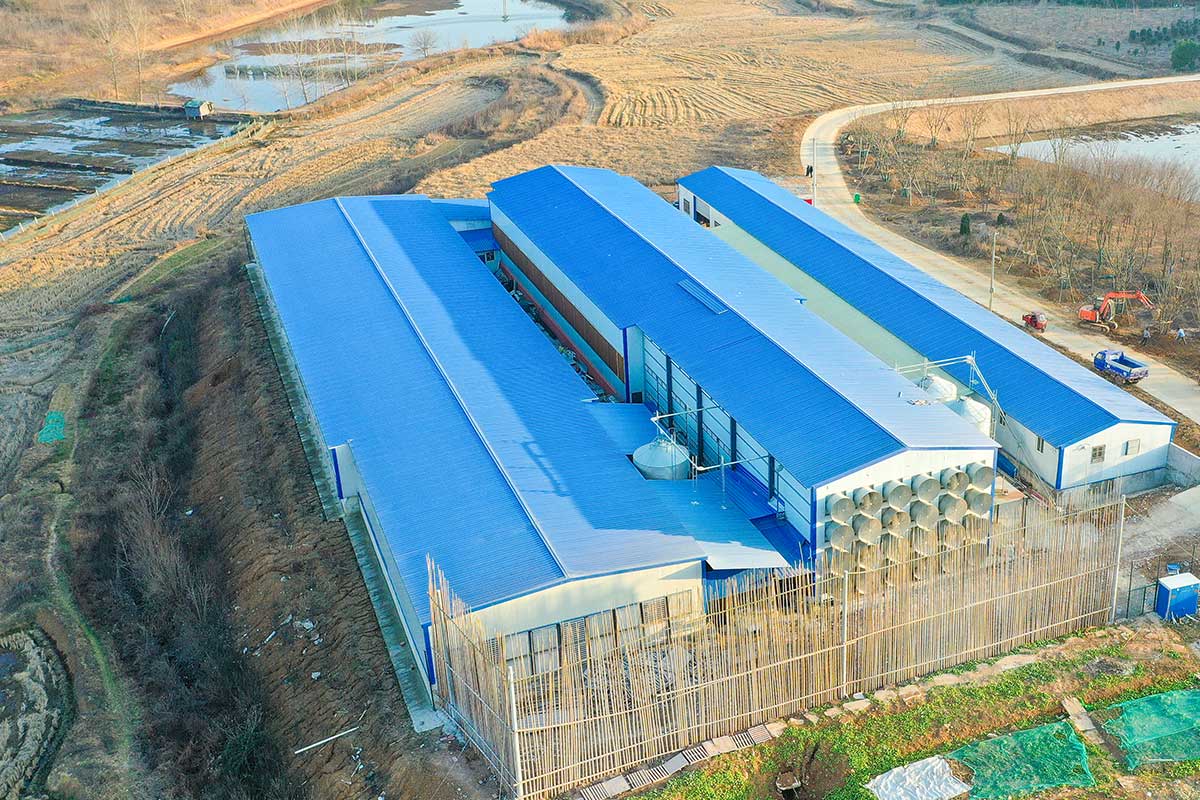
Also known as an environmentally controlled chicken house, the roof and walls use high-quality insulation materials. It has no windows on four sides and relies on artificial ventilation, evaporative cooling pads, automatic lighting, and a temperature control system to precisely regulate temperature, humidity, and air quality. Closed-type houses require a higher initial investment, but they minimize the impact of seasonal changes on broiler growth, making them suitable for large-scale intensive production.
Selection Recommendations: For small to medium-sized farms or dry northern regions, consider an open-type house with auxiliary equipment; for large-scale farming or hot and humid areas, closed-type chicken houses offer more significant long-term benefits.
Chicken Farming Equipment and Utensils: Cages, Feeding and Watering Systems
1. Chicken Cages – The Core Carrier for Cage Raising
Cages are classified into three types according to the age of the chickens, with overlapping, stepped, and semi-stepped configurations.
(1) Chick Cages (Brooding Period)
Mostly 3-4 layer overlapping structures. The size of each individual cage is designed for easy handling, feeding, and observation. The cage door is at the front for easy adjustment of the opening and closing gap to accommodate chick growth. The bottom mesh aperture should be smaller than the chick’s foot to prevent injury; the side and top mesh gaps should be moderate to ensure good ventilation. The number of chicks per cage is dynamically adjusted according to their age.
(2) Growing Chicken Cages (Middle-aged Chicken Stage)
Also using a multi-layer overlapping structure, the overall width and height are designed to meet the chickens’ activity space and operational convenience. The cage door size is appropriate, and the bottom mesh aperture is slightly larger than that of the chick cage to facilitate manure leakage; the number of chickens per cage gradually decreases according to their weight gain during the growing period.
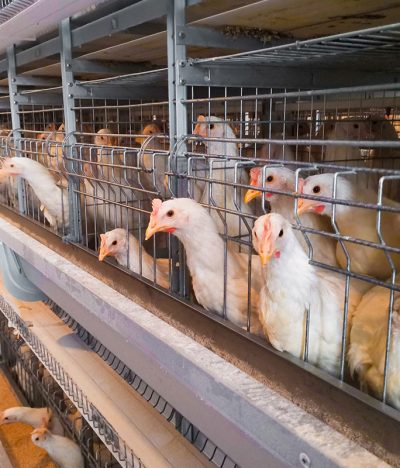
(3) Laying Hen/Breeder Cages (Laying Period)
Commonly, tiered or semi-tiered layouts are used. Each cage has a sloped bottom mesh, higher at the front and lower at the back, to facilitate eggs rolling out to the egg collection trough. The cage door opens at the front, with a suitable gap between the lower edge and the bottom mesh to ensure eggs slide out smoothly while preventing chickens from escaping. The size of the mesh openings and the spacing between the warp and weft threads are designed to prevent head and leg obstruction and to avoid manure accumulation. The number of chickens per cage is determined reasonably based on the size of adult chickens.
General recommendations for cage selection: Regardless of the type of cage, the material should be corrosion-resistant and burr-free; the height between layers should ensure smooth manure removal and ventilation; the cage door should be easy to operate; and the water and feed troughs should be reasonably positioned.
2. Feeding Equipment – Mechanization and Trough Selection
Large-scale chicken farms generally use mechanized feeding systems, while small and medium-sized farms can use simple troughs.
(1) Chain Feeder
One of the most widely used feeding machines in my country, suitable for floor and cage rearing. It consists of a feed bin, chain, drive unit, corner wheels, and a long feed trough. Some models are equipped with a feed cleaner. It can circulate dry powder or pellet feed and operates smoothly.
(2) Disc Feeder
Designed specifically for dry-rearing chicken houses, suitable for conveying dry powder complete feed. It has a compact structure, including a drive unit, feed bin, conveying components, feed trough, corner wheel, and support frame. This system has good sealing properties, preventing feed spillage and is suitable for long-distance feeding.
(3) Trough Types
Long Trough: Arranged along the length of the chicken cage or chicken house, providing a long feeding surface, suitable for mechanized feeding. Hanging bucket-style round feeder: Suspended in the air, feed is dispensed by gravity or a rotating mechanism. Suitable for floor-raised or free-range chickens, it has a lower cost.
Selection points: The depth and width of the feeder should prevent chickens from scrambling for food and wasting it; the edges should be smooth to avoid injuring their beaks; each chicken must have sufficient effective feeding length to avoid competition between stronger and weaker chickens that leads to a decrease in uniformity.
3. Drinking Equipment – Three Main Types
(1) Trough-type Drinker
The cross-section is “V” or “U” shaped, with moderate depth and top width. For floor-raised chickens, the length of each trough section facilitates cleaning and water changes. Sufficient total trough length must be ensured based on the number of chickens, and regular cleaning is necessary to prevent the growth of pathogenic microorganisms.
(2) Tower-shaped Vacuum Drinker
Composed of a cylindrical barrel and a water tray, it automatically replenishes water using the vacuum principle. Its simple structure makes it particularly suitable for floor-raised chicks. Available in galvanized iron and plastic, it is easy to transport and clean, but the height of the water tray should be adjusted according to the age of the chickens.
(3) Nipple-type Drinker
Constructed of a stainless steel or copper valve body and a needle switch, it is directly installed on the water pipe and uses gravity or a spring to control the water droplets. Water is dispensed when the chicken pecks at the needle and automatically shuts off after drinking. It is water-saving, hygienic, and leak-proof, making it the preferred choice for modern intensive chicken houses. Chickens are categorized into chick and adult types based on size. The spacing and height of the nipples should be dynamically adjusted as the flock grows to ensure that every chicken can easily drink.
Key principles of the drinking system: It’s better to have too many nipples than too few to ensure no overcrowding during peak drinking periods; the water pipe layout should facilitate rinsing and disinfection; and the water pressure should be stable to prevent air bubbles or leaks.
III. Overall Planning Recommendations: Data is a Tool, Suitability is Key
All design parameters and equipment specifications mentioned above should be comprehensively adjusted based on the actual chicken house size, stocking density, local climate conditions, and level of automation. For example:
In hot and humid areas, ventilation and evaporative cooling pad area should be increased;
In cold seasons, emphasis should be placed on insulation and minimum ventilation control;
High-density rearing areas require increased feed troughs and nipples to ensure each chicken is adequately fed and watered.
It is recommended to draw a detailed floor plan before construction, marking equipment locations and operational routes, and consult experienced equipment manufacturers or livestock engineers to avoid rework later. Furthermore, regardless of the equipment chosen, routine maintenance and regular disinfection are far more crucial to the success or failure of the farm than the initial equipment selection.