Chicken House Fan Performance and Inlet Area Calculation
In modern chicken farming, the design of the ventilation system directly affects the health of the flock and production efficiency. In recent years, an increasing number of traditional curtain-style chicken houses have been converted into tunnel-style ventilated chicken houses. However, many farmers have found that after the conversion, while the number of fans has increased and small air inlets have been added, the actual exhaust effect is far from what was expected.
This reveals a key issue: the matching of air intake area with fan performance. If the air intake area is insufficient, even adding more fans will not achieve the desired ventilation effect and may even lead to energy waste and equipment damage.
Insufficient air intake area leads to a precipitous drop in fan performance.
Many professionals designing ventilation systems consider negative pressure, but often lack a precise understanding of the optimal fan size for a small window area.
If the air intake opening is too small, the fan will not operate smoothly, resulting in a significant performance decrease. Actual exhaust volume may drop by 30% or more. A simple analogy can help: The load on an exhaust fan is like sipping coffee through a thin straw. The more you try to sip it quickly, the harder it is to inhale. No matter how hard you try, you can’t finish it quickly. Using a wider straw, however, makes everything easier and more efficient.
Similarly, when a fan is forced to draw air in through a narrow intake, the efficiency of indoor and outdoor air exchange is greatly reduced, while power consumption increases significantly.
Airflow velocity is a key indicator
The speed at which air passes through the air inlet depends on the size of the fan and the number of inlets. The smaller the opening, the higher the airflow velocity.
Based on practical experience: Sidewall inlets: Exhaust fan operation is largely unaffected when the airflow velocity is controlled below 900 feet per minute (approximately 4.5 meters per second).
Once an attempt is made to increase the airflow velocity above 900 feet per minute, fan performance will significantly decrease.
Different inlet types have different maximum permissible airflow velocities: Inlets with shades or tunnel ventilation inlets: Airflow velocity should not exceed 500 feet per minute (approximately 2.54 meters per second).
4-inch (10-centimeter) water curtains: Airflow velocity needs to be controlled below 300 feet per minute (approximately 1.52 meters per second), otherwise flow resistance will increase dramatically.
Real-world data shows you: More air inlets mean higher fan efficiency


In actual testing, using a 48-inch (1.2-meter) fan for comparison, the results are very clear:
With the same air inlet area, as the number of fans increases, the exhaust volume of a single fan begins to decrease once the intake velocity exceeds 900 feet per minute.
To achieve an exhaust volume of 80,000 cubic feet per minute:
With insufficient air inlet area, 6 fans are needed to barely achieve this.
By increasing the number of air inlets, only 4 fans are needed to easily achieve the same exhaust volume.
This data clearly demonstrates that increasing the number of air inlets not only improves ventilation efficiency but also reduces the number of fans, lowering equipment investment and operating costs.
Why is the wind speed at small windows calculated at 4.5 m/s?
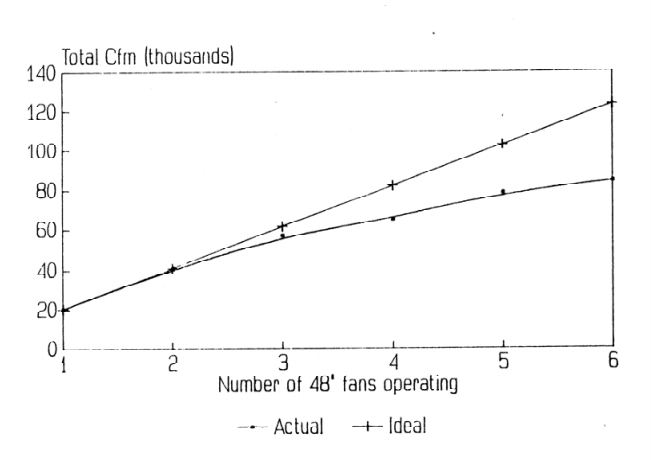
This article also explains a common design standard in the industry: the wind speed at small windows is often calculated at 4.5 m/s (approximately 900 feet per minute). The principle behind this is based on the matching relationship between fan performance and air intake velocity—exceeding this value will subject the fan to additional load, and its performance will begin to decline.
At the same time, it clearly explains why the air velocity through the evaporative cooling pad is unlikely to exceed 2 m/s, and the actual impact of the shading on the air intake. These details are crucial points that cannot be ignored in the design of efficient chicken house ventilation.
Avoid High-Resistance Ventilation for Energy Efficiency
When designing and modifying chicken house ventilation systems, it is crucial to ensure the proper matching of air intake area and the number of fans. Insufficient air intake area → excessively high wind speed → increased fan load → decreased exhaust volume → increased energy consumption → shortened equipment lifespan—this is a chain reaction.
By minimizing high-resistance ventilation and rationally configuring the number and area of air inlets, each fan can achieve its intended efficiency, resulting in a highly efficient, energy-saving, and stable chicken house environment.