Design Scheme for H-type Fully Automatic Egg-laying Hen Farming Equipment
The core of modern egg-laying hen farming lies in efficient space utilization and automated management. H-type stacked fully automated breeding equipment, with its high density, high efficiency, and ease of management, has become the preferred choice for large-scale egg-laying hen farming. This article will provide a detailed explanation of the chicken house design formulas and layout schemes for H-type equipment, offering a complete scientific planning guide for poultry farms planning to build or renovate chicken houses, covering numbers from 10,000 to 100,000 laying hens.
I. Core Design Principles of H-Type Fully Automated Poultry Farming Equipment
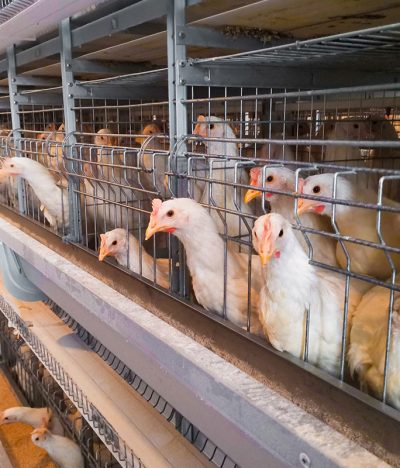
The H-type equipment adopts a high-rise, three-dimensional poultry farming model. Its design follows a set of standard calculation logic to ensure that each chicken receives adequate space while achieving full automation of feeding, watering, manure removal, and egg collection.
1. Key Design Parameters and Calculation Formulas
Chicken House Length Calculation: Effective Length = Total Chicken House Length (within 120 meters) – 9-10 meters (equipment space). Number of Cage Groups = Effective Length / Length of a Single Cage Group.
Chicken House Width Planning: The width is determined by the number of equipment rows. For each additional row, approximately 1.4-1.5 meters of aisle space must be reserved. The standard correspondence is: 1 row requires 5 meters, 2 rows require 7-8 meters, 3 rows require 10 meters, 4 rows require 12 meters, 5 rows require 15 meters, and 6 rows require 18 meters.
Chicken House Height Calculation: Chicken House Height = Number of Layers × 0.7 meters + 0.2 meters + 1 meter. Of these, 0.7 meters is the vertical spacing (layer spacing) between each cage layer, 0.2 meters is the height of the anchor bolts or support foundation, and 1 meter is the operating space reserved for the top feeding trolley.
2. Cage Selection
The solution generally uses two sets of standard cages: the mainstream 5-layer 1.8-meter-long cages with 270 cages per layer, and the 8-layer 1.2-meter-long cages used for ultra-large-scale operations (hundreds of thousands of cages). The latter usually requires a two-layer platform for management.
II. Scientific Layout Schemes for Different Breeding Scales (Taking 5-layer, 270 birds/group as an example)
The following are verified, highly efficient layout schemes calculated based on the core formula, directly corresponding to different investment and production goals.
| Farming Scale | Recommended chicken coop dimensions (length × width × height) | Layout method (columns × layers) | Number of cage groups (total groups) | Theoretical breeding capacity (units) |
| 10,000 Birds | 78m × 5m × 4.8m | 1 column × 5 layers | 38 groups/column, total 38 groups | 10,260 |
| 20,000 Birds | 78m × 7m × 4.8m | 2 columns × 5 layers | 38 groups/column, total 76 groups | 20,520 |
| 30,000 Birds | 110m × 10m × 4.8m | 2 columns × 5 layers | 56 groups/column, total 112 groups | 30,240 |
| 40,000 Birds | 100m × 10m × 4.8m | 3 columns × 5 layers | 50 groups/column, total 150 groups | 40,500 |
| 50,000 Birds | 94m × 12m × 4.8m | 4 columns × 5 layers | 47 groups/column, total 188 groups | 50,760 |
| 100,000 Birds | 105m × 15m × 8m | 5 columns × 8 layers | 79 groups/column, total 395 groups | 101,120 |
Solution Notes:
Solutions for farms with 10,000 to 50,000 birds all utilize 5-layer cages (270 birds per layer) at 1.8 meters per unit, a mature technology that is easy to manage.
Solutions for farms with 100,000 birds utilize 8-layer cages at 1.2 meters per unit, equipped with a two-layer operating platform to address the challenges of ventilation, lighting, and daily management in ultra-high-density farming. This is a key design feature for achieving ultra-large-scale farming.
III. Advantages and Economic Benefits of the Solution
High Land Utilization: The H-shaped tiered design increases stocking density several times higher than traditional floor-raising, significantly saving land costs.
High Automation Integration: This layout perfectly integrates with automatic feeding systems, nipple drinking lines, tiered manure removal belts, and central egg collection lines, saving approximately 70% or more in labor costs.
Precise and Efficient Management: The closed, standardized environment facilitates precise control of temperature, humidity, and ventilation, thereby improving flock health and egg production.
Clear Return on Investment: The tiered solution, ranging from 10,000 to 100,000 birds, provides farms with a clear expansion path and investment budget basis.
A scientifically designed H-shaped fully automated layer hen farming system is the cornerstone of stable profitability for modern chicken farms. By precisely applying calculation formulas for length, width, and height, and selecting the corresponding number of columns, layers, and cage groups based on the target scale, farms can construct a highly efficient production unit with maximized space utilization and the smoothest automated processes. It is recommended to make minor adjustments to the final design based on specific site conditions, climate factors, and the model of automated equipment. Consulting professional equipment suppliers for on-site planning is also recommended to ensure that the solution achieves the best results.