Design Scheme for Type A Layer Hen Cage (Pyramid Cage) System
What is an A-type pyramid cage system?
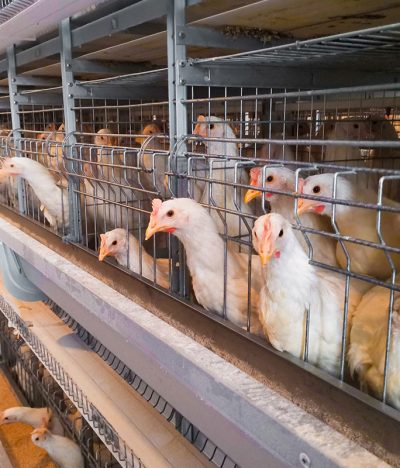
A-type layer hen cages, often referred to in the industry as “pyramid cages,” are named for their symmetrical “A”-shaped (A-type) cage structure. This tiered layout creates natural ventilation and lighting for each level of the cage, making it one of the mainstream choices for medium to large-scale layer hen farms that prioritize environmental friendliness and animal welfare.
I. Core Design Principles and Calculation Formulas
A scientific A-type cage design scheme follows precise calculations in the following three dimensions to ensure maximum space utilization and a rational breeding process.
1. Chicken House Length Design
Formula: Effective Installation Length = Total Chicken House Length – (8~9 meters) Equipment Space
Calculation: Number of Cage Groups = Effective Installation Length ÷ Length of Single Cage Group
Explanation: The 8-9 meters of space at both ends is used to place the main unit, egg collection equipment, and reserve operating space.
2. Chicken House Width Design
The width is mainly determined by the number of cage rows. The core principle is to ensure a 1.4-1.5 meter central aisle between two rows of cages back-to-back for manure removal, maintenance, and personnel passage.
Standard Column Width Correspondence (Unit: meters):
Column 1: Approx. 5 meters
Column 2: Approx. 8 meters
Column 3: Approx. 12 meters
Column 4: Approx. 15 meters
Column 5: Approx. 18 meters
Column 6: Approx. 20 meters (May slightly exceed the 18-meter limit to meet aisle requirements)
3. Chicken House Height Design
The structure is relatively simple, with height primarily meeting cage installation and overhead space requirements:
3-tier cages: Recommended net height ≥ 3.0 meters
4-tier cages: Recommended net height ≥ 3.5 meters
4. Standard Cage Parameters (Baseline of this Solution)
Typical Configuration: 4-tier tiered layout
Single Group Dimensions: Length 2.15 meters
Stocking Density: 160 birds/group (Complies with industry-standard animal welfare and production performance balance)
II. Standardized Layout Schemes for Different Aquaculture Scales
The following is a mature design scheme calculated based on a Type A cage with 4 layers, 2.15 meters in length, and 160 birds per group.
| Farming Scale | Recommended Chicken House Dimensions (L×W×H) | Layout (Columns × Layers) | Number of Cage Groups per Row | Total Number of Cage Groups | Theoretical Stock Capacity (Chickens) |
| 10,000 | 78m × 8m × 3.5m | 2 columns × 4 layers | 32 groups | 64 groups | 10240 |
| 20,000 | 100m × 12m × 3.5m | 3 columns × 4 layers | 42 groups | 126 groups | 20160 |
| 30,000 | 112m × 15m × 3.5m | 4 columns × 4 layers | 47 groups | 188 groups | 30080 |
Solution Explanation:
Expansion Logic: The increase in scale is mainly achieved by increasing the number of rows and appropriately extending the chicken house. This ensures that each row of cages is not excessively long, facilitating management.
Significance of Size: For a 30,000-chicken-per-house plan, a length of 112 meters is close to the design limit. A width of 15 meters corresponds to a 4-row layout, representing a balance between space and efficiency.
III. Core Advantages of the A-Type Pyramid Cage System
Superior Indoor Environment: The unique A-type structure creates natural ventilation channels, preventing the accumulation of harmful gases and resulting in better air quality than sealed stacked cages.
Good Animal Welfare: The tiered design protects lower-level chickens from dripping manure from upper-level chickens, and provides more even lighting, helping to reduce stress in the flock.
Balanced Investment and Operating Costs: Compared to the fully automatic H-type stacked cage system, the A-type cage has a simpler structure, lower initial investment, a simpler manure removal system, and controllable maintenance costs.
Intuitive and Convenient Management: Chicken status, feeding and drinking activities are clearly visible, facilitating daily inspections and precise management.
IV. Selection and Application Recommendations
Suitable Scenarios: Suitable for medium to large-scale farms that prioritize flock health and egg quality, have a moderate budget, and do not require extremely high levels of automation.
Comparison with the H-Type System: If land costs are extremely high and the farm prioritizes maximum labor savings and full automation, the H-type stacked cage is a better choice. If flock welfare, disease control, and initial investment are prioritized, the Type A pyramid cage is a durable and reliable option.
Key Recommendation: Before actual construction, it is essential to engage the equipment supplier for a joint on-site survey and airflow simulation. The plan should be fine-tuned based on local prevailing winds and climate characteristics to achieve optimal production results.
The Type A layer hen cage (pyramid cage) system achieves a good balance between breeding efficiency and animal welfare thanks to its scientific structural design. By precisely applying the design formula of “width determined by columns, grouping by length, and height determined by layers,” poultry farms can plan a chicken house that perfectly matches the equipment, forming the physical foundation for successful breeding and long-term stable profitability.