What are The Counterweight Methods for Small Windows in Laying Hen Houses?
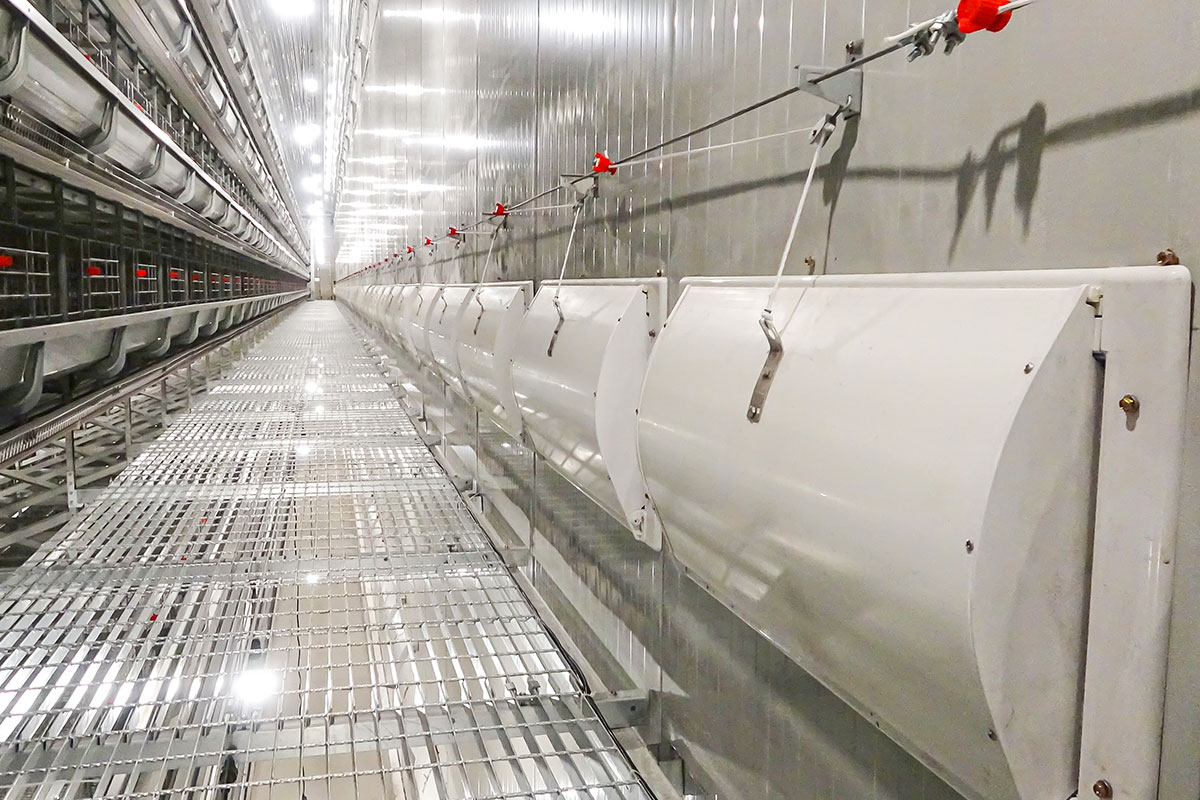
The counterweight system for the “small windows” on the side walls of a laying hen house essentially provides the force needed to close the windows or to facilitate automatic opening and closing. Working in conjunction with negative-pressure ventilation, this setup directs incoming cold air from the top of the window toward the roof ridge before it descends into the house, thereby preventing cold drafts from blowing directly onto the flock.
Common counterweight methods include: pulley systems using weights or counterweight blocks; spring-based return mechanisms; gravity-based designs (relying on the weight of the window sash itself); unified drive systems using rigid steel wire, cold-drawn wire, or linkage rods; and automated motor systems with backup counterweights or springs. Different methods are suited to varying house lengths, ventilation modes, and levels of automation.
The Function of Counterweights on Layer House Inlet Windows
Counterweights on inlet windows serve a purpose beyond merely closing the windows; they ensure the windows maintain a stable opening degree during negative-pressure ventilation and close reliably when required. Their key functions include:
Providing the closing force necessary to prevent incomplete closure or air leakage that could create harmful drafts.
Working in conjunction with the environmental controller to enable synchronized opening and closing of all inlet windows throughout the house.
Assisting the windows in returning to a safe position in the event of a power outage or motor failure.
Maintaining stable negative pressure, allowing incoming cold air to flow along the ceiling, thereby reducing cold stress on the flock.
Five Common Counterweight Methods for Small Intake Windows in Layer Farming
1. Counterweight/Weight Block + Pulley-and-Cable System
This is the most traditional manual, centralized control method.
Implementation:
A nylon or steel cable is attached to the lower or middle section of each small window flap.
The cables pass over fixed pulleys on the side wall and connect to a common horizontal cable or a rear-mounted weight.
A winch or lifting mechanism at the front controls opening and closing, while a counterweight at the rear provides the retracting force.
Operating the winch allows for the synchronized opening and closing of all windows in the house.
Counterweights can consist of concrete blocks, iron weights, or sand-filled cylinders; the “closing force” is adjusted by adding or removing weights.
When linking multiple windows, all cables are often connected to a single horizontal bar, with fixed pulleys aligned at the same height to ensure uniform opening across all windows.
Suitable for: Small farms, manual ventilation systems, and scenarios requiring automatic window closure via counterweights during power outages.
Disadvantages: Cable stretching and pulley wear can easily lead to inconsistent opening widths among the windows.
2. Spring Return: The Mainstream Solution for ABS Small Windows
Many standardized small windows use stainless steel return springs instead of hanging counterweights.
Principle:
The window flap is connected to the frame by springs.
A motor, winch, or cable pulls the window open.
Once the pulling force is released, the springs pull the window back to the closed position.
Some products utilize four springs or stainless steel tension springs, combined with plastic pulleys to reduce rolling friction.
Ventajas:
Does not require external space for counterweights.
Rapid return to the closed position.
Compatible with automatic opening adjustments via environmental controllers.
Suitable for frequent, fine adjustments required for minimum ventilation during winter.
Note: If spring fatigue occurs, replace the entire batch rather than just a few individual springs; otherwise, the opening widths across the house will become uneven.
3. Gravity-Closing/Self-Weight Type
In gravity-closing small windows, the window flap is hinged at the top and hangs shut tightly under its own weight.
Operación:
Negative pressure lifts the bottom of the window flap to allow air intake. The window sash closes automatically when the wind stops or the negative pressure trend shifts.
Some gravity-closing inlet windows are fitted with light springs or counterweights to adjust the opening pressure.
This prevents them from being forced open by strong winds or failing to return to the closed position after freezing shut.
Application scenarios: Simple housing structures and transitional ventilation. They are rarely used as the sole system in standardized layer houses, serving mostly as an auxiliary measure.
4. Unified drive using rigid steel wire, cold-drawn wire, or linkage rods
This is a “semi-counterweighted” approach that replaces flexible cables with rigid materials.
Implementation:
Use 5mm straightened cold-drawn steel wire or rigid pulley systems instead of flexible cables.
A single motor operates all the inlet windows.
Closing can be facilitated by springs or small counterweights.
Advantages: Rigid steel wire exhibits minimal elongation compared to standard steel cables. Flexible steel cables can stretch by tens of centimeters over a 100-meter span, causing discrepancies in opening widths between the front and rear windows.
Recommendation for long houses: For poultry houses exceeding 100 meters in length, rigid rods or solid steel bars (5–8mm) are recommended to minimize the reduction in opening width at the far end.
5. Automatic motor operation with counterweight/spring backup
This is a highly automated solution.
Principle:
An environmental controller drives the motor based on set negative pressure parameters to adjust the inlet window opening.
Counterweights or springs serve only to close the windows in the event of system failure or for manual backup.
In some sliding window designs, the motor opens the window, while gravity (via a weight) closes it.
During a power outage, the counterweight pulls the window back to a sealed position.
Winter maintenance priorities:
Inspect the motor, springs, and pull cables.
Calibrate inlet window openings.
Prevent issues such as spring failure, loose cables, or individual windows getting stuck, which could create unwanted drafts (“thief winds”).
Comparison of 5 Counterweight Methods for Small Windows
| Method | Operating Principle | Application Scenarios | Ventajas | Points to Note |
| Counterweight/balance weight + pulley | Counterweight retraction; winch for extending and retracting | Small-scale houses, manual ventilation | Windows close upon power loss | Cables are prone to stretching; opening alignment can easily drift |
| Spring return | Spring-assisted closing | Automatic ventilation, ABS small windows | Rapid return to position; suitable for fine adjustment | Replace the entire batch if spring fatigue occurs |
| Gravity-drop type | Closing via sash gravity | Simple housing, transitional ventilation | Simple structure | Avoid isolated use in standardized poultry houses |
| Rigid wire/linkage rod | Rigid drive + spring/counterweight for closing | Long poultry houses | Minimal attenuation of opening travel over long distances | High precision required for installation |
| Motor + counterweight/spring backup | Controller-driven; counterweight reset | High-standard automated houses | High level of automation; includes backup system | Frequent winter maintenance needed to prevent jamming |
How Do You Adjust the Counterweights on Small Air Inlets?
1. Measure airtightness and target negative pressure first
Close all air inlets and run one exhaust fan to check the static pressure. In winter, negative pressure settings for small inlets are often determined via smoke tests to ensure incoming cold air clings to the ceiling as it enters the house.
For a poultry house about 15 meters wide, a reference setting is approximately 15 Pa with a minimum opening of 3–4 cm; however, final adjustments should be based on the actual landing point of the smoke.
2. Adjust counterweights or spring tension
You can make a rough calculation using the formula: “Window panel weight × lever arm ≈ counterweight force × lever arm + wind pressure/negative pressure torque,” but there is no need to rigidly apply this formula on-site.
A more practical approach is:
Operate the winch to move the inlet from fully closed to fully open.
Monitor the negative pressure gauge.
If negative pressure is too high, the opening is insufficient or the counterweight is too heavy.
If negative pressure is too low, the opening is too wide, the counterweight is too light, or there is air leakage.
3. Fine-tune openings for inlets on the same side
Set inlets closer to the exhaust fans to open slightly less and those further away to open slightly more; this compensates for airflow distance and ensures more uniform air intake across the entire house.
4. Regular tightening and replacement
Periodically tighten fixed pulleys, cable clamps, and crossbars.
Nylon ropes tend to loosen, while steel cables are prone to rusting.
For long poultry houses, rigid wires or steel rods are preferable.
5. Winter freeze and wind protection
Prevent counterweight boxes from icing up and pulleys from freezing.
Install wind shields or light-blocking hoods on the exterior.
Seal the hinges and sides of the small inlets to prevent unwanted drafts.
There are five main counterweight methods for small ventilation windows in laying hen houses: counterweights (weights or blocks) with pulleys and ropes; spring-loaded return mechanisms; gravity-based (self-closing) designs; rigid wire rods or linkages; and motorized automation with counterweight or spring backups. The choice depends on factors such as the length of the poultry house, the ventilation system, the level of automation, and the requirement for the windows to close automatically during a power outage.
In practical management, the goal is not simply to use the heaviest counterweight possible; rather, the aim is to ensure uniform window openings, stable negative pressure, and airflow that hugs the ceiling (preventing cold drafts from dropping directly onto the birds), while ensuring the windows do not freeze shut or jam during winter. Once adjusted, components such as pulleys, ropes, springs, and seals require regular inspection to effectively minimize unwanted drafts and flock stress.