How to Choose Between A-Type and H-Type Cages for Raising 20,000 Laying Hens?
Basic Understanding of Two Types of Cages
Step-A Cage (Step-Type Layer Chicken Cage)
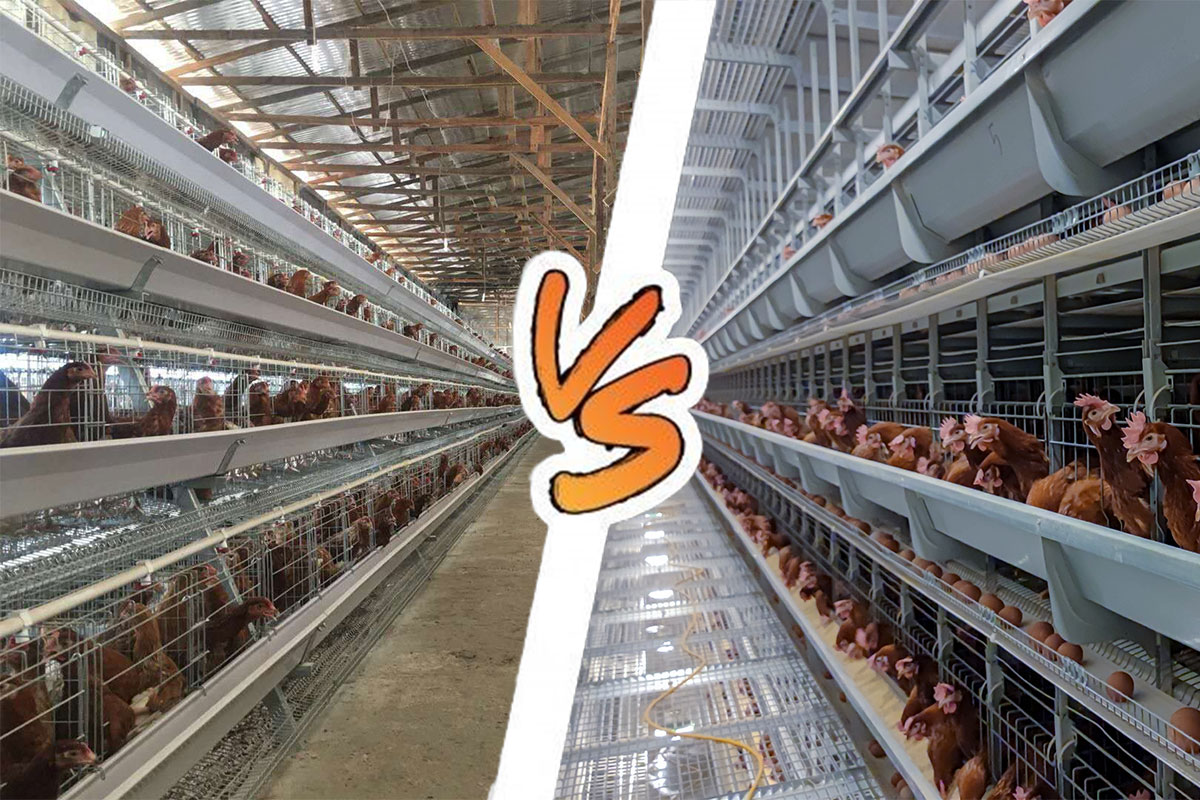
Step-A cages are chicken cages arranged in an A-shape, with the upper and lower layers completely staggered. Commonly, there are 3 to 4 layers. This type of equipment has been used in China for a long time, with mature technology, a simple and practical structure, easy and quick installation, and a high cost-performance ratio. Step-A cages are usually used in open chicken houses, utilizing natural ventilation and lighting.
Stacked H Cage (Stacked Layer Chicken Cage)
Stacked H cages are chicken cages stacked vertically like a building, with each layer aligned vertically. Commonly, there are 4 or more layers, and some even have 8 to 10 layers. This type of equipment is a recent trend, with high space utilization, suitable for fully enclosed automated farming models, and is the mainstream choice for large-scale farms.
Analysis of a 20,000-Horse Scale
20,000 hens represents a crossroads between two types of cage systems.
Industry experience suggests that if the number of laying hens is less than 30,000, a tiered system is suitable; if the number exceeds 50,000, a stacked system is more appropriate. 20,000 hens falls precisely below this dividing line. Meanwhile, some industry insiders point out that stacked cages are recommended for single-building stockings of 20,000 or more. These two statements seem contradictory, but they actually reflect different considerations—the former emphasizes operational feasibility, while the latter emphasizes long-term efficiency.
In fact, the “124” standardized laying hen farming model promoted in Hubei Province is a typical example of a single enclosed chicken house, stacked cages for over 20,000 hens, and four automated machines, demonstrating that the use of stacked cages at a scale of 20,000 hens is already quite mature in terms of both policy and technology.
Key Dimensions Comparison
1. Footprint and Space Utilization
This is the most significant difference between the two types of cages. The stepped A-type cage has a span of approximately 220cm per group (four layers), and each group can house about 128 chickens. Based on 20,000 chickens, approximately 156 groups would be needed, requiring a large chicken house area.
In contrast, the stacked H-type cage uses a vertical stacking design, allowing for more chickens to be housed in the same area. Data shows that the stacked type reduces the footprint by 60% and increases stocking density by over 30% compared to traditional stepped equipment. This is undoubtedly a huge advantage for farms with limited land resources. The “124” model in Hubei Province uses a 3-row, 4-layer stacked layout, requiring only about 800 square meters of chicken house to house over 20,000 laying hens. The same 20,000 chickens would likely require 1200-1400 square meters of chicken house area.
Conclusion: In areas with high land costs, the stacked H-type cage has a clear advantage.
2. Initial Investment Cost
This is a primary concern for many poultry farmers.
From an equipment cost perspective, the tiered A-type cage has a simple structure and uses less steel, resulting in significantly lower equipment costs compared to stacked cages. According to industry experience, using stacked equipment in a 20,000-hen laying shed can save approximately 15% on the total investment, including construction and equipment.
However, it’s important to note that stacked cages, due to their higher stocking density, have lower per-chicken costs. For the same scale of operation, using an economical four-layer stacked cage can save approximately 30% on the initial investment (equipment + infrastructure + land) compared to the traditional tiered system. This data reminds us that we shouldn’t just look at the unit price of the equipment, but rather at the “investment cost per chicken”—while stacked cages are more expensive per unit, the higher number of chickens per unit area can actually result in a lower cost per chicken.
Conclusion: Tiered A-type cages have a lower total investment, making them suitable for early-stage entrepreneurs with limited funds; stacked H-type cages offer better per-chicken cost amortization, making them suitable for long-term planning.
3. Ventilation and Environmental Control
This is a traditional advantage of tiered A-type cages. Because the upper and lower cages are completely staggered, each layer has a large open area, resulting in excellent ventilation and full utilization of natural light, reducing reliance on mechanical ventilation. Open-style chicken houses reduce dependence on fans, evaporative cooling pads, and other equipment, thus reducing electricity costs.
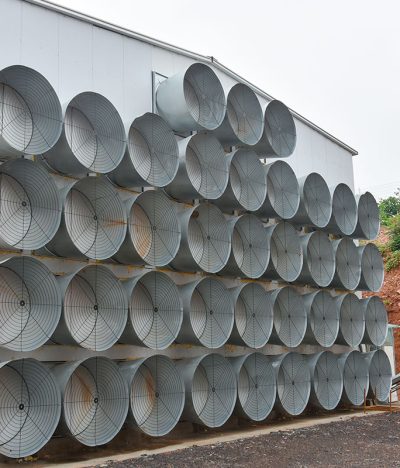
Layered H-type cages, due to their high number of layers and density, typically require fully enclosed chicken houses equipped with automatic ventilation and cooling systems and environmental control equipment; otherwise, temperature control within the chicken house is difficult. Modern layered cage systems use sensors to monitor temperature, humidity, and ammonia levels in real time, automatically adjusting ventilation volume, and controlling temperature differences within ±2℃.
However, fully enclosed environmental control means higher power consumption and more stringent equipment maintenance requirements. Automatic layered cages generally consume more power than tiered cages, but the cleaner environment and reduced flock stress usually offset these costs through higher egg production efficiency.
Conclusion: Tiered A-type cages have low ventilation costs and are suitable for areas with mild climates and unstable power supplies; stacked H-type cages rely on manual environmental control and are suitable for farms with reliable power supply and a focus on high output.
4. Manure Removal System and Environmental Hygiene
There are two main methods for manure removal in tiered A-type cages: scraper cleaning and belt cleaning. Early designs of tiered cages lacked manure scrapers at the bottom, and chicken manure fell directly into the manure pit or onto the ground, requiring manual or mechanical scraping for cleaning. The disadvantage of this method is that upper-layer chicken manure falls onto lower-layer chickens, causing cross-contamination and high ammonia concentrations, which are detrimental to the respiratory health of the chickens. Most modern tiered cages are equipped with manure belts, but some older designs still use open manure pits.
Stacked H-type cages are equipped with independent longitudinal manure removal belts at the bottom of each layer, allowing for layered cleaning of chicken manure and preventing it from falling onto lower-layer chickens. The operating frequency of the manure removal belts is adjustable, with a cleaning efficiency exceeding 95%, and combined with an exhaust gas collection device, it can effectively reduce ammonia emissions. Layered, cleaned chicken manure facilitates centralized processing and can be sold as organic fertilizer, creating additional income.
Conclusion: The stacked H-type cage is far superior in terms of environmental hygiene, significantly reducing disease risk.
5. Automation and Labor Costs
While the tiered A-type cage can automate feeding, watering, and egg collection, its automation level is relatively limited due to its structure, requiring manual intervention in many aspects. For example, manual checks are needed to ensure even distribution of feed on the top layer, and manure removal may require manual assistance.
The stacked H-type cage, on the other hand, is designed for full automation: automatic feeding, automatic watering, automatic manure removal, automatic ventilation and cooling, and automatic egg collection—the entire process can be completed with a single click. One person can easily manage over 20,000 laying hens, increasing labor efficiency by approximately two times compared to the traditional method. Data shows that the automation level of the H-type system can reduce the number of farm workers required by 30%-50% compared to the A-type system. Conclusion: The stacked H-type cage significantly saves labor and is suitable for areas with high labor costs and limited manpower.
6. Feed Conversion Ratio and Production Efficiency
Cascade cage rearing offers advantages in reducing the feed conversion ratio and egg production costs, primarily due to significant reductions in feed, water, electricity, and labor costs. The automatic feeding system of cascade cages achieves a uniform feed distribution error of ≤5%, and the extended feed trough design reduces feed waste, improving feed conversion rate by 8%-10%. Case studies show that standardized cascade cage rearing using the “124” model results in an average egg production of approximately 20 kg at 500 days of age, with a feed conversion ratio controlled at 2.1-2.15:1 and a mortality rate below 8% during the laying period, reaching internationally advanced production levels.
While tiered A-type cages typically have a slightly higher feed conversion ratio, the difference is not substantial. For well-managed farms, tiered cages can also achieve excellent egg production results.
Selection Recommendations for Different Scenarios
Scenario 1: New to the Poultry Industry, Limited Funds
Recommendation: Tiered A-Type Cage
Tiered A-type cages have a low investment threshold, simple structure, easy maintenance, and mature and reliable technology. Even in case of malfunction, repairs are relatively easy. At a scale of 20,000 birds, tiered cages can achieve semi-automated operation, meeting production needs. Suitable for entrepreneurs new to egg-laying hen farming who want to control early-stage risks.
Scenario 2: High Land Costs, Difficulty in Recruiting Labor
Recommendation: Stacked H-Type Cage
If your land is extremely valuable, or local labor costs are high and recruitment is difficult, stacked H-type cages are a better choice. Although the equipment costs an additional 200,000-300,000 RMB, the annual savings in land and labor costs are enough to recoup the difference within 2-3 years. More importantly, the one-person-management-one-building model makes management simpler and more controllable.
Scenario 3: Pursuing High-Efficiency Production and Long-Term Development
Recommendation: Stacked H-Type Cage
If you plan to start with 20,000 birds and continue to expand in the future, then using stacked H-type cages from the beginning is more reasonable. Stacked equipment is easier to expand and upgrade, and its automation advantages become increasingly apparent as the scale increases. Even with a slightly higher initial investment, the overall cost of stacked H-type cages is lower and the benefits are higher over a lifecycle of 5 years or more.
Scenario 4: Unstable Power Supply and Weak Technical Maintenance Capabilities
Recommendation: Stepped A-type Cage
Stacked H-type cages are highly dependent on power supply and environmental control equipment. If the area experiences frequent power outages or lacks sufficient maintenance technical capabilities, the risk is significant. Stepped A-type cages have a lower dependence on power; even short-term power outages will not have a fatal impact.