Application of “W”-Shaped Evaporative Cooling Pads in Chicken House
In Africa, with the rapid development of large-scale, intensive poultry farming, environmental control in chicken houses has become a core factor determining flock health, production performance, and farming efficiency. Especially in regions like Nigeria, Kenya, and South Africa, where hot and humid summers are frequent, effective cooling has become a major challenge for poultry management. Traditional linear evaporative cooling pads have gradually shown their inadequacy in dealing with extreme heat and achieving uniform cooling. In recent years, the “W”-shaped evaporative cooling pad system, with its optimized structure, high cooling efficiency, and uniform airflow, has become a significant technological innovation in modern, high-yield poultry house environmental control, providing a brand-new solution for African farms.
Structural Principles and Spatial Layout: Achieving a Larger Evaporative Cooling Area Within Limited Wall Space
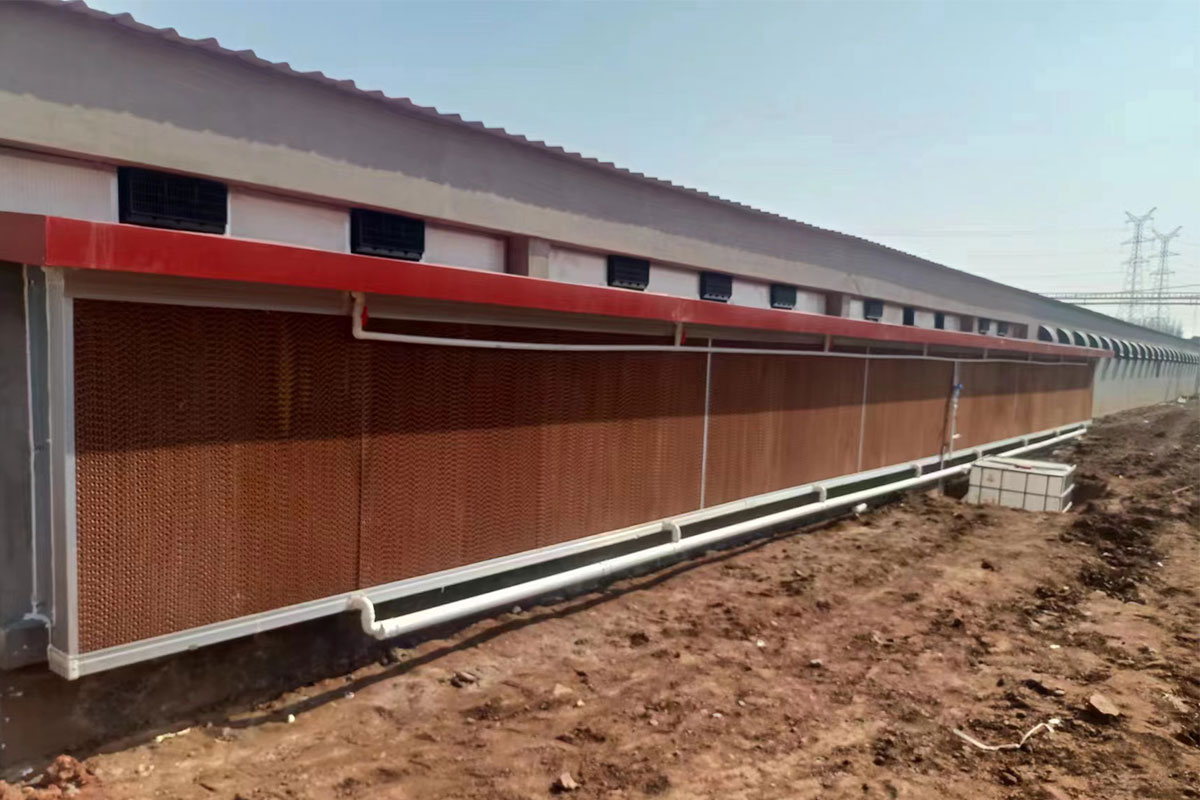
The “W”-shaped evaporative cooling pad doesn’t actually have a “W” shape in the material itself. Instead, it’s achieved through a special frame structure that folds and installs the evaporative cooling pad components, forming a continuous “W”-shaped cross-section. The system typically consists of three sets of inclined evaporative cooling panels, creating two air collection chambers and a central air intake channel. This ingenious design significantly increases the effective projected area of the evaporative cooling pad—within the same wall space, the coverage area can be increased by 40%–60%, greatly enhancing the contact time between air and the evaporative cooling pad and improving evaporative cooling efficiency. For many existing chicken houses in Africa, this significantly improves cooling capacity without needing to enlarge wall openings.
Cooling Efficiency and Heat Exchange Advantages: 2–4℃ Lower Temperatures Than Traditional Evaporative Cooling Pads
The “W”-shaped structure extends the airflow path, allowing hot air to pass through a longer cooling channel before entering the chicken house, resulting in more efficient evaporation and heat absorption. Experimental data shows that under the same wind speed conditions, “W”-shaped evaporative cooling pads achieve a 2–4℃ higher cooling rate than traditional flat-lay evaporative cooling pads, with an efficiency exceeding 85%. This evaporative cooling effect is particularly significant in many dry and hot regions of Africa (such as northern Nigeria and Sudan). During periods of high temperatures, its cooling stability far surpasses traditional designs, effectively reducing heat stress in chickens, maintaining egg production and feed conversion rates, and helping farms maintain stable production during hot seasons.
Airflow Organization and Environmental Uniformity: Temperature Difference Throughout the House Less Than 1.5℃
Traditional evaporative cooling pads often cause uneven airflow on both sides and insufficient cooling in the central area. The “W”-shaped structure, through multi-angle airflow design, creates a “guiding + converging” effect, allowing cold air to enter the house from multiple directions and mix thoroughly with the warm air inside, preventing localized cold air from directly blowing on the chickens and reducing cold stress. Combined with a well-placed negative pressure fan, the temperature gradient throughout the house can be less than 1.5℃, significantly improving environmental uniformity and chicken comfort. This is particularly important given the large diurnal temperature range and distinct wet and dry seasons in Africa.
Space Utilization and Installation Adaptability: Ideal Choice for Old Chicken House Renovation
For farms requiring upgrades, the “W”-shaped evaporative cooling pad can significantly increase the effective area of the cooling pad without increasing wall openings, making it particularly suitable for the numerous old chicken house renovation projects in Africa. Its modular design facilitates transportation and installation—a significant advantage for the relatively complex logistics conditions in the African market. The number of “W” units can be flexibly adjusted according to the width of the chicken coop, adapting to the breeding needs of different scales from thousands to hundreds of thousands of chickens. At the same time, the structural frame has good support, which can extend the service life of the evaporative cooling pads, reduce maintenance costs, and lower long-term operating expenses.
Optimized Water Circulation and Anti-Algae Clogging: Adapted to African Water Conditions
The “W”-shaped evaporative cooling pad system, equipped with an intelligent water circulation system, achieves uniform water distribution and intermittent spraying, avoiding uneven wetting and drying in certain areas. The unique “W” channel design facilitates gravity-fed water return, reducing water accumulation. Addressing the issue of high water hardness and scaling in some parts of Africa, the system combines ultraviolet sterilization and automatic cleaning programs to effectively inhibit algae growth and scale buildup, ensuring long-term efficient operation of the evaporative cooling pads. This significantly reduces the workload of daily maintenance in farms, making it particularly suitable for large-scale farms with high labor costs.
Application Cases and Economic Benefits: Real Data from Nigerian Layer Chicken Farms
Applications in multiple layer chicken farms with over 100,000 birds in Nigeria and other regions have shown that the “W”-shaped evaporative cooling pad system can stably control the indoor temperature at 26–30℃ in summer, significantly reducing mortality and increasing egg production, resulting in substantial overall economic benefits. For example, at a 150,000-layer hen farm in Nigeria, fuel and electricity costs did not increase during the first summer after the renovation, while heat stress mortality in the flock decreased by about 40%, and egg production remained high. Such successful experiences are being rapidly promoted in West and East Africa.
Promotion Prospects and Development Trends: Smart Farming and Multi-Stage Composite Cooling
As African livestock farming moves towards intelligence and green practices, the future “W”-shaped evaporative cooling pads will be linked with environmental controllers and weather station data to achieve coordinated control of temperature, humidity, and wind. Combining evaporative cooling with technologies such as longitudinal ventilation and roof spraying, a multi-stage composite cooling system will be constructed to further enhance the ability to cope with extreme climates. Simultaneously, the application of new hydrophilic materials and antibacterial evaporative cooling pad paper will drive its development towards high efficiency, energy saving, and maintenance-free operation. This is a technology worthy of close attention for African livestock enterprises hoping to improve their farming practices and address climate change.
The application of “W”-shaped evaporative cooling pads in large-scale chicken houses represents a significant advancement in modern environmental control technology. It not only improves cooling efficiency and environmental uniformity but also provides a more stable and comfortable growth environment for chickens, serving as a key support for achieving high-yield, high-efficiency, and healthy farming. With technological maturity and cost optimization, “W”-shaped evaporative cooling pads are gradually becoming standard equipment in high-standard modern chicken houses, helping African livestock and poultry farming develop towards a green, intelligent, and high-quality direction. For farm owners in countries such as Nigeria, Kenya, and South Africa, introducing a “W”-shaped evaporative cooling pad system is a wise choice to maintain competitiveness in hot climates.